Basilica of San Marco: Art and History in the Florentine Convent

A stone’s throw from the Accademia Gallery, the Basilica of San Marco is much more than a church: it is the heart of the ancient Dominican convent that Cosimo the Elder had restructured. Today, the single nave preserves chapels designed by Giambologna and a rich series of 16th- and 17th-century masterpieces, while the adjacent convent houses the renowned museum with Fra Angelico’s frescoes. A visit here lets you combine art, spirituality, and history in a single stop.
– The Crucifix by Fra Angelico (1425-1428) on the main altar
– The side chapels with altarpieces by Santi di Tito, Fra Bartolomeo, and Cigoli
– The mosaic of the Virgin from the ancient St. Peter’s in the Vatican
– The tombs of Pico della Mirandola and Poliziano, symbols of Florentine Humanism


Events nearby

Copertina itinerario Basilica of San Marco: Art and History in the Florentine Convent
Piazza San Marco, Florence: among the works by Michelozzo and the chapels by Giambologna, the Basilica recounts centuries of art, faith, and culture, from Fra Angelico to Savonarola.

Good to know


Introduction: Inside the Basilica of San Marco

In Piazza San Marco, among the works left by Michelozzo and the chapels of Giambologna, there is a basilica that never stops telling stories. I step inside and the chaos outside disappears: the single nave is wrapped in a warm half-light, the air smells of wax and history. It is not a museum, even though the convent next door is: here faith is still alive. Yet, looking around, one travels through the centuries: the Crucifix by Fra Angelico, the mosaic from ancient St. Peter’s, the tombs of Pico and Poliziano. Every chapel whispers something to you. I wandered around for a long time without realizing it, and in the end I understood why this church stays in your heart.

Historical Notes

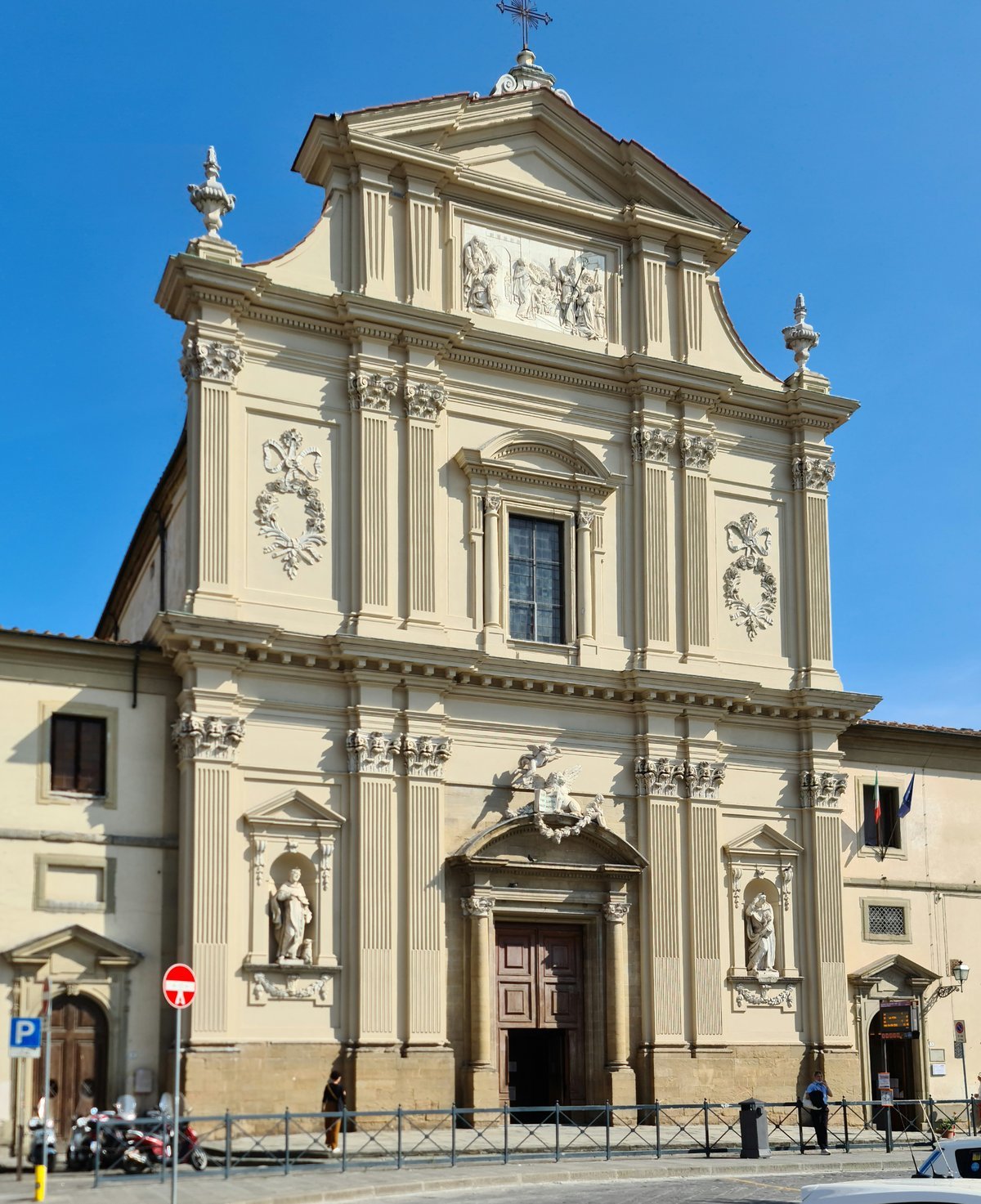
Before the basilica, there was an oratory dedicated to Saint George; later, a Vallombrosian monastery arose on the site, which then passed to the Silvestrines. In 1418, the Silvestrines left the convent, which in 1435 was entrusted to the Observant Dominicans. Two years later, Cosimo the Elder commissioned Michelozzo to renovate the entire complex, while Fra Angelico worked on the decoration. The church was consecrated on the night of Epiphany in 1443. Over time, the bell tower by Baccio d’Agnolo (1512), the chapels by Giambologna (1579), and the neoclassical façade (1777-78) were added. After the confiscation of 1866, part of the convent was turned into a museum in 1869. Here are the main steps:

  • 1418 – departure of the Silvestrines
  • 1435 – arrival of the Observant Dominicans
  • 1437 – Cosimo de’ Medici entrusts the work to Michelozzo
  • 1443 – consecration of the church
  • 1512 – new bell tower by Baccio d’Agnolo
  • 1579 – side chapels by Giambologna
  • 1777-78 – neoclassical façade
  • 1866/69 – confiscation and opening of the museum in the convent

The nave and the treasures of the chapels

Walking along the nave, you get the sense of being inside a jewel-like church. At the second altar on the right is Fra Bartolomeo’s Madonna and Child with Saints, with its serene gentleness; at the third, don’t miss the mosaic of the Virgin: it comes from the ancient basilica of St. Peter’s in the Vatican and arrived in Florence around 1596. The angels around it are painted to imitate gold tesserae, a curious effect. On the left, after Passignano’s altarpiece, you’ll find Cigoli’s large panel with Heraclius carrying the cross. And right there stand the funeral monuments of Pico della Mirandola and Poliziano: these are not like other works; they are pieces of literary history embedded in faith.

Friars, artists, and preachers: the convent that made history

San Marco is also the convent where the Blessed Angelico lived, a friar painter who left so much of himself here. And then there was Girolamo Savonarola, prior of the convent: a statue remembers him in the basilica, and one’s mind immediately goes to his fiery sermons. Beside the church, the Salviati Chapel is dedicated to Saint Antoninus, the bishop who inspired Cosimo the Elder; to see it, you must pass through the Museum of San Marco, but inside it is a small treasure chest with grisaille decorations by Alessandro Allori and sculptures by Giambologna. During your visit, if you are lucky enough to cross paths with the Dominican friars who still animate the parish, ask them for a story: you will feel immersed in a living history, not in front of a sign.

Why visit it

Three concrete reasons to step inside. First: it is still a real church, with its Masses and its rhythms. You won’t find the museum queue, but the scent of wax and the muffled sound of footsteps. Second: there are works that elsewhere would be queued for – the youthful Crucifix by Fra Angelico, the Vatican mosaic, Fra Bartolomeo’s Madonna – and here you have almost all of them to yourself. Third: if you combine the basilica with the nearby convent-museum, you truly understand how the Dominicans of Cosimo the Elder lived, from the cloister to the cells. A stroll through Florence’s most intellectual and spiritual side, without having to choose between art and faith.

When to Go

My advice is to go on a weekday, before the bustle of visits, when in the basilica there are only the faithful and the sacristan preparing the altar. The light enters high and warm, and the silence does justice to the Crucifix by Beato Angelico. If instead you happen to be in Florence on a sunny afternoon, at least look at the facade and the bell tower by Baccio d’Agnolo: the stone lights up with golden tones. There is no need to choose a specific season, because the real atmosphere is that of the church’s daily life. However, if I may, I would avoid the central hours of Saturday, when the square is full and haste is contagious. The basilica deserves a slow stop, with a free mind.

Nearby

As you leave, the most natural step is toward the former convent: the Museo di San Marco is right there, and it contains the cells frescoed by Fra Angelico, with the famous Annunciation at the top of the stairs. Also just a stone’s throw away, the Galleria dell’Accademia houses Michelangelo’s David; if it’s your first time in Florence, take advantage of it since you’re in the right neighborhood. If you want to stretch your walk in a different way, continue to the Basilica of Santissima Annunziata: another beautiful corner, with Brunelleschi’s portico and a square that is almost always less crowded than the others.

Itineraries nearby


💡 Did You Know…?

Among the lesser-known curiosities, the great mosaic of the Virgin on the third altar on the right was not made in Florence: it comes from the ancient St. Peter’s Basilica in the Vatican and arrived here around 1596. Although few notice it today, in the crypt of the Salviati chapel lie the members of the Salviati family, while the adjacent convent preserves the memory of Girolamo Savonarola, prior of San Marco.