Welcome to Collemaggio
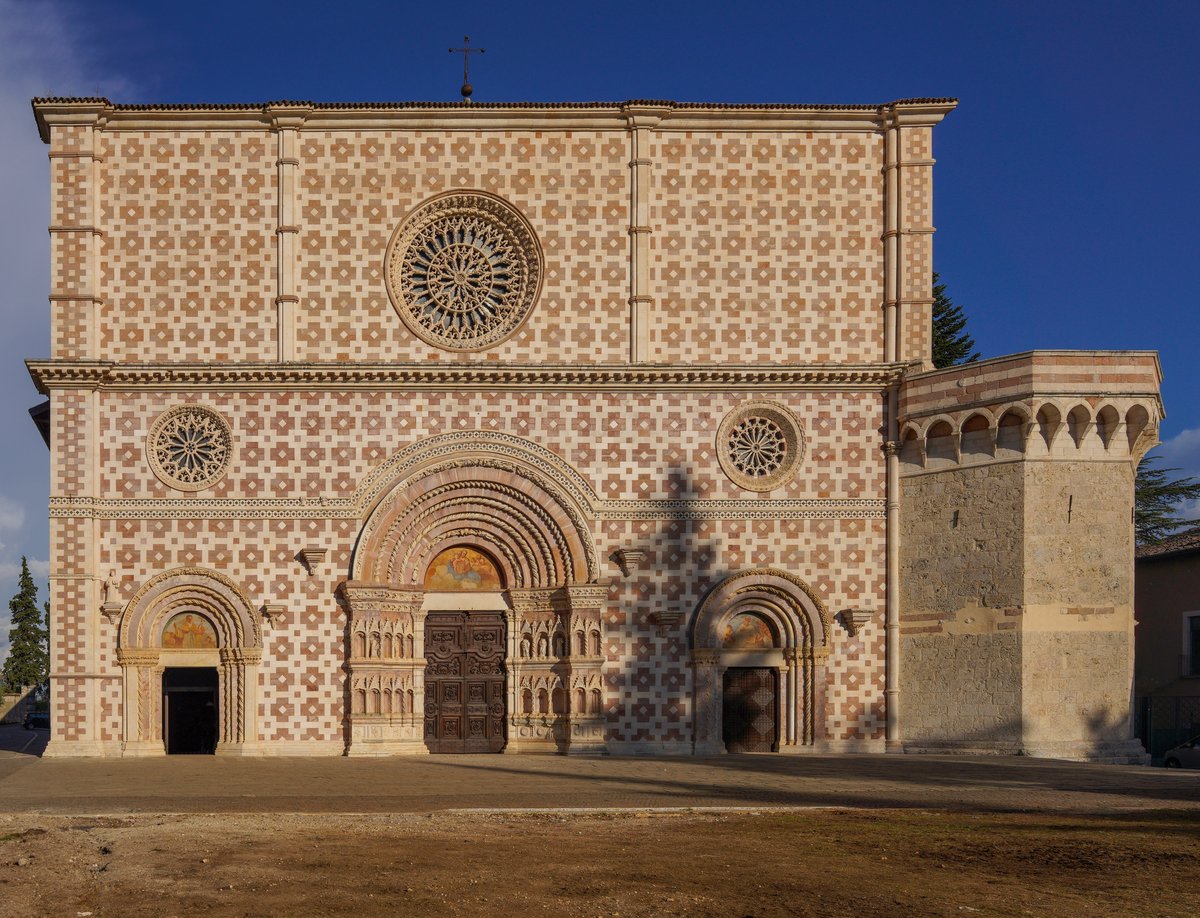
On the hill just outside the walls of L’Aquila, the Basilica of Santa Maria di Collemaggio stands out from the landscape with its white and pink checkerboard facade. It is not just a Romanesque-Gothic masterpiece: here you will find the first Holy Door in history, commissioned by Celestine V in 1294. Even today, every 28–29 August, thousands of pilgrims cross that threshold during the Celestinian Forgiveness, a plenary indulgence that preceded the first Jubilee by six years. The atmosphere is intimate, almost mystical, but the lawn in front – with a view of Gran Sasso – offers a moment of lightness. Entering here is like taking a leap into the Middle Ages, among frescoes, labyrinths, and a Renaissance mausoleum.
Welcome to Collemaggio
On the hill just outside the walls of L’Aquila, the Basilica of Santa Maria di Collemaggio stands out from the landscape with its white and pink checkerboard facade. It is not just a Romanesque-Gothic masterpiece: here you will find the first Holy Door in history, commissioned by Celestine V in 1294. Even today, every 28–29 August, thousands of pilgrims cross that threshold during the Celestinian Forgiveness, a plenary indulgence that preceded the first Jubilee by six years. The atmosphere is intimate, almost mystical, but the lawn in front – with a view of Gran Sasso – offers a moment of lightness. Entering here is like taking a leap into the Middle Ages, among frescoes, labyrinths, and a Renaissance mausoleum.
Historical Background
It all began in 1275, when the hermit Pietro da Morrone – later Pope Celestine V – dreamed of the Virgin asking him to build a church on the hill. The basilica was consecrated in 1288, but the twist came on August 29, 1294: here Pietro was crowned pope, the only papal coronation outside Rome. A few months later he abdicated (Dante’s “great refusal”), but left behind the Bull of Pardon, establishing the Perdonanza. Earthquakes have marked its history: the 2009 earthquake collapsed the dome and transept, but an extraordinary restoration (awarded Europa Nostra 2020) returned it to the city in 2017. The remains of Celestine V were placed in the Renaissance mausoleum of 1517.
Historical Background
It all began in 1275, when the hermit Pietro da Morrone – later Pope Celestine V – dreamed of the Virgin asking him to build a church on the hill. The basilica was consecrated in 1288, but the twist came on August 29, 1294: here Pietro was crowned pope, the only papal coronation outside Rome. A few months later he abdicated (Dante’s “great refusal”), but left behind the Bull of Pardon, establishing the Perdonanza. Earthquakes have marked its history: the 2009 earthquake collapsed the dome and transept, but an extraordinary restoration (awarded Europa Nostra 2020) returned it to the city in 2017. The remains of Celestine V were placed in the Renaissance mausoleum of 1517.
The Checkered Facade and the Secrets of the Rose Windows
The facade is a gem of white and pink stone forming a unique geometric pattern of crosses. Three Gothic portals, three rose windows: the central one is a masterpiece with 36 spokes and 72 rays. Inside, the floor repeats the same motif, with a six-circle labyrinth symbolizing a path of purification. On the left, the Holy Door is crowned by a fresco by Antonio da Atri (late 14th century). Don’t miss the light show on August 15: at sunset, the sun filters through the apse’s mullioned window, projecting an 8-petal flower onto the floor. A detail that shows how skilled the medieval builders were at intertwining art and astronomy.
The Checkered Facade and the Secrets of the Rose Windows
The facade is a gem of white and pink stone forming a unique geometric pattern of crosses. Three Gothic portals, three rose windows: the central one is a masterpiece with 36 spokes and 72 rays. Inside, the floor repeats the same motif, with a six-circle labyrinth symbolizing a path of purification. On the left, the Holy Door is crowned by a fresco by Antonio da Atri (late 14th century). Don’t miss the light show on August 15: at sunset, the sun filters through the apse’s mullioned window, projecting an 8-petal flower onto the floor. A detail that shows how skilled the medieval builders were at intertwining art and astronomy.
The Perdonanza: A Jubilee in 24 Hours
Every year, from August 28 to 29, the Perdonanza Celestiniana transforms the basilica into a beating heart of faith and tradition. The highlight is the opening of the Holy Door: the bishop strikes the door three times with an olive branch. Then, for 24 hours, anyone who enters—confessed and repentant—receives the plenary indulgence. The procession of the Bull starts from the civic tower and crosses the city, while the Cammino del Fuoco del Morrone reenacts the arrival of Celestine V. The event has been a UNESCO Intangible Heritage site since 2019. If you pass by at the end of August, the city is full of stalls, concerts, and an atmosphere that blends the sacred with popular festivities.
The Perdonanza: A Jubilee in 24 Hours
Every year, from August 28 to 29, the Perdonanza Celestiniana transforms the basilica into a beating heart of faith and tradition. The highlight is the opening of the Holy Door: the bishop strikes the door three times with an olive branch. Then, for 24 hours, anyone who enters—confessed and repentant—receives the plenary indulgence. The procession of the Bull starts from the civic tower and crosses the city, while the Cammino del Fuoco del Morrone reenacts the arrival of Celestine V. The event has been a UNESCO Intangible Heritage site since 2019. If you pass by at the end of August, the city is full of stalls, concerts, and an atmosphere that blends the sacred with popular festivities.
Why Visit It
1. First Holy Door in the world: The basilica houses the oldest Holy Door in Christendom, opened as early as 1294, six years before the Vatican Jubilee. 2. A restored masterpiece: The post-2009 earthquake restoration won the 2020 Europa Nostra award for scientific excellence and public-private collaboration. 3. Breathtaking view: From the lawn in front, the basilica overlooks the city and the Gran Sasso; at sunset it’s a sight not to be missed. Additionally, the Perdonanza offers a unique experience of participating in an ancient rite.
Why Visit It
1. First Holy Door in the world: The basilica houses the oldest Holy Door in Christendom, opened as early as 1294, six years before the Vatican Jubilee. 2. A restored masterpiece: The post-2009 earthquake restoration won the 2020 Europa Nostra award for scientific excellence and public-private collaboration. 3. Breathtaking view: From the lawn in front, the basilica overlooks the city and the Gran Sasso; at sunset it’s a sight not to be missed. Additionally, the Perdonanza offers a unique experience of participating in an ancient rite.
When to Go
If you can, choose late August, when the Perdonanza fills the basilica with pilgrims and the city with events. The opening of the Holy Door is a powerful emotion, but the rest of the year the climate is mild. I recommend the late afternoon: the raking light brightens the colors of the façade, and the square is less chaotic. In winter, with snow on Gran Sasso, the scenery is postcard-perfect, but the days are short. Avoid the midday hours in summer, when the sun is beating down – but inside the basilica, among the aisles, it stays cool.
When to Go
If you can, choose late August, when the Perdonanza fills the basilica with pilgrims and the city with events. The opening of the Holy Door is a powerful emotion, but the rest of the year the climate is mild. I recommend the late afternoon: the raking light brightens the colors of the façade, and the square is less chaotic. In winter, with snow on Gran Sasso, the scenery is postcard-perfect, but the days are short. Avoid the midday hours in summer, when the sun is beating down – but inside the basilica, among the aisles, it stays cool.
Nearby
Two unmissable stops: the historic center of L’Aquila, just a few minutes’ walk away, with Piazza del Duomo, the Basilica of San Bernardino, and the civic towers. Then, for a full immersion in nature, the Gran Sasso and Monti della Laga National Park is close by: trails, villages like Castel del Monte, and in winter, skiing. If you have time, stop by the Fountain of the 99 Spouts, another symbol of the city, perfect for a refreshing break.
Nearby
Two unmissable stops: the historic center of L’Aquila, just a few minutes’ walk away, with Piazza del Duomo, the Basilica of San Bernardino, and the civic towers. Then, for a full immersion in nature, the Gran Sasso and Monti della Laga National Park is close by: trails, villages like Castel del Monte, and in winter, skiing. If you have time, stop by the Fountain of the 99 Spouts, another symbol of the city, perfect for a refreshing break.