Cagliari’s Lazzaretto: An 18th-Century Former Quarantine Station Overlooking the Gulf of Angels

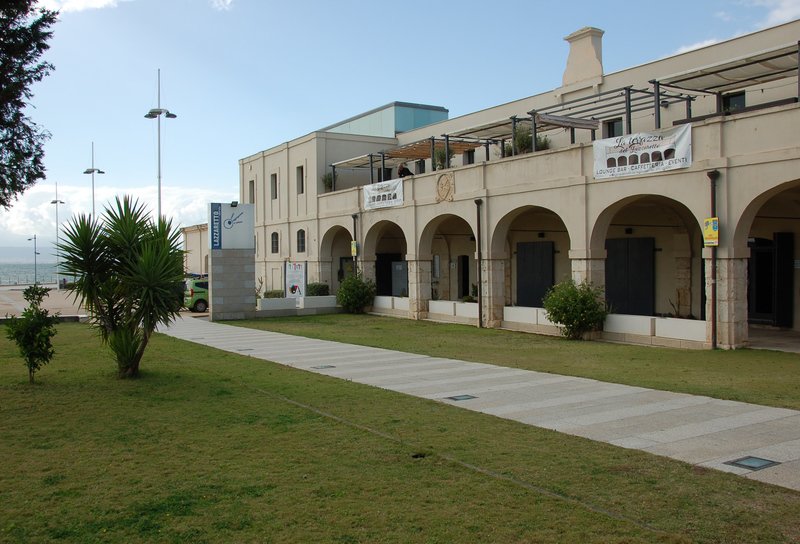
Cagliari’s Lazzaretto is a historic 17th-century building located at the edge of the Sant’Elia district, directly on the sea. It offers a unique perspective on the city and an atmosphere suspended between history and nature, perfect for a rejuvenating break away from the city center. Be sure to check before visiting, as access is not always straightforward and the site is frequently closed to the public.

  • Former 17th-century maritime quarantine station, with a stone structure that appears to float on the water
  • Spectacular views of the Gulf of Angels and the Sant’Elia promontory, with unforgettable sunsets
  • Concrete bridge built during the Fascist era that extends toward the sea, now a photogenic viewpoint
  • Authentic atmosphere of a living ruin with crumbling plaster and windowless frames, not a perfectly restored museum
Copertina itinerario Cagliari's Lazzaretto: An 18th-Century Former Quarantine Station Overlooking the Gulf of Angels
A 17th-century stone structure facing the sea, featuring a concrete bridge suspended over the water and panoramic views of the Sant’Elia promontory. Note: Access can be challenging, and the site is often closed.

Good to know


A Corner of Peace Between History and Sea

The Lazzaretto of Cagliari is not just a historical building; it’s an atmosphere. Arriving from Sant’Elia, that white profile standing out against the blue of the Gulf of Angels strikes you immediately. It almost seems like an island within the city, even though technically it’s a peninsula connected by a thin strip of land. The feeling is that of being in a place suspended in time, far from the chaos of the center yet incredibly close. Waves gently break against the cliffs, the wind carries the salty scent, and that silence broken only by the sea makes you forget you’re just minutes away from traffic. It’s not the typical monument to visit in a hurry – you come here to breathe, to gaze at the horizon, to absorb that strange magic born from the meeting of ancient stones and endless sea.

Historical Overview

Its history is tied to dark yet pivotal moments for the city. Built in the 17th century as an actual lazaretto—a quarantine site for ships and passengers suspected of contagious diseases—it witnessed epidemics, fears, and isolation. Then, over the following centuries, it changed functions multiple times: a warehouse, barracks, and even a shelter for the homeless during World War II. Today, after a long period of abandonment, it has been partially restored and opened to the public, though some buildings still show signs of age. It is not a perfectly restored museum, and perhaps that is its charm: here, history is tangible, in the worn stones, faded inscriptions, and structures that tell centuries of Cagliari’s life.

  • 17th century: construction as a maritime quarantine lazaretto
  • 19th century: transformation into a military depot and warehouse
  • World War II: used as a shelter
  • Late 20th century: abandonment and decay
  • 2000s: initial restoration efforts and public opening

The Charm of Controlled Abandonment

One thing that struck me: the Lazzaretto hasn’t been ‘prettied up’ for tourists. You walk among the buildings and see crumbling plaster, windows without glass, grass growing between the stones. It’s a living ruin, not a sterile reconstruction. This gives the place a rare authenticity—it feels like discovering something secret, not yet fully tamed. Locals come here for early morning jogs or to watch the sunset, treating it as a natural extension of their neighborhood. There’s an area where the remains of old tanks blend with the rock, and when the sea is rough, water crashes into them, creating spectacular sprays. Be careful though: some spots are fenced off for safety, and you need to watch your step. It’s not a playground, but a piece of history that’s still ‘wild’.

That Bridge to Nowhere

Perhaps the most photogenic (and mysterious) element is that concrete bridge that juts out toward the sea, abruptly ending mid-air. It leads nowhere, or rather, it leads only to the spectacle of the gulf. Built during the Fascist era for a never-completed project, today it has become an impromptu viewpoint where everyone stops to take photos. Standing there, on that bridge suspended over the water, with Cagliari visible in the distance and the wind blowing strong, is a strangely poetic experience. In the evening, when the city lights come on, the effect is even more magical. Some say it’s dangerous, others that it’s simply fascinating—I find that it perfectly represents the spirit of this place: unfinished, evocative, and beautiful precisely in its imperfection.

Why Visit It

First: because it offers a different perspective on Cagliari. From the Lazzaretto, you see the city from an unusual angle, with the profile of the Castle emerging in the distance and ships entering and leaving the port. Second: for that sense of discovery. There are no tickets to buy or set paths to follow—you explore freely, find your own corners, get lost in the details. Third, more practical: it’s the perfect spot for a refreshing break. After hours in museums and crowded streets, coming here to take a breath of sea air feels rejuvenating. And there’s something special about seeing how the people of Cagliari themselves use this space—not as tourists, but as part of their daily lives.

When to Go

The best time? Definitely late afternoon, when the sun begins to set behind the Sella del Diavolo and everything is bathed in those warm hues that only the Mediterranean can offer. Summer can be muggy and crowded, while spring and autumn provide wonderful light and milder temperatures. In winter, when the mistral blows strong, the place takes on an almost dramatic character—waves crash powerfully against the rocks, and you feel like you’re on a ship in a storm. Personally, I avoid the midday hours on summer days: there’s no shade, and the sun’s reflection off the white walls of the water can be blinding. Better to visit in two stages: before dinner for the sunset, and perhaps the next morning to see the spot in a different light.

In the Surroundings

If you enjoyed the Lazzaretto, continue exploring the Sant’Elia area. Not far away is Giorgino Beach, a long stretch of golden sand much loved by locals, with its characteristic wooden beach establishments (the ‘lidos’) that seem to come from another era. For a thematically connected experience, visit the Museum of the Treasure of Sant’Eulalia in the historic center, where you’ll discover how Cagliari dealt with epidemics in the Middle Ages through surprising artifacts and documents. Two different worlds – sea and history – that here in Cagliari intertwine naturally.

💡 Did You Know…?

The Lazzaretto was built in the 18th century to isolate plague patients and other epidemics arriving by sea. During World War II, it was used as a military depot and suffered damage. Today, despite restoration projects, it awaits a new life. Legend has it that on full moon nights, you can still hear the moans of the patients isolated there. A little-known detail: the structure is built on an artificial island connected to the mainland by a thin strip of land, an engineering expedient of the time to ensure isolation.