Campanian Amphitheater: Capua’s Colosseum

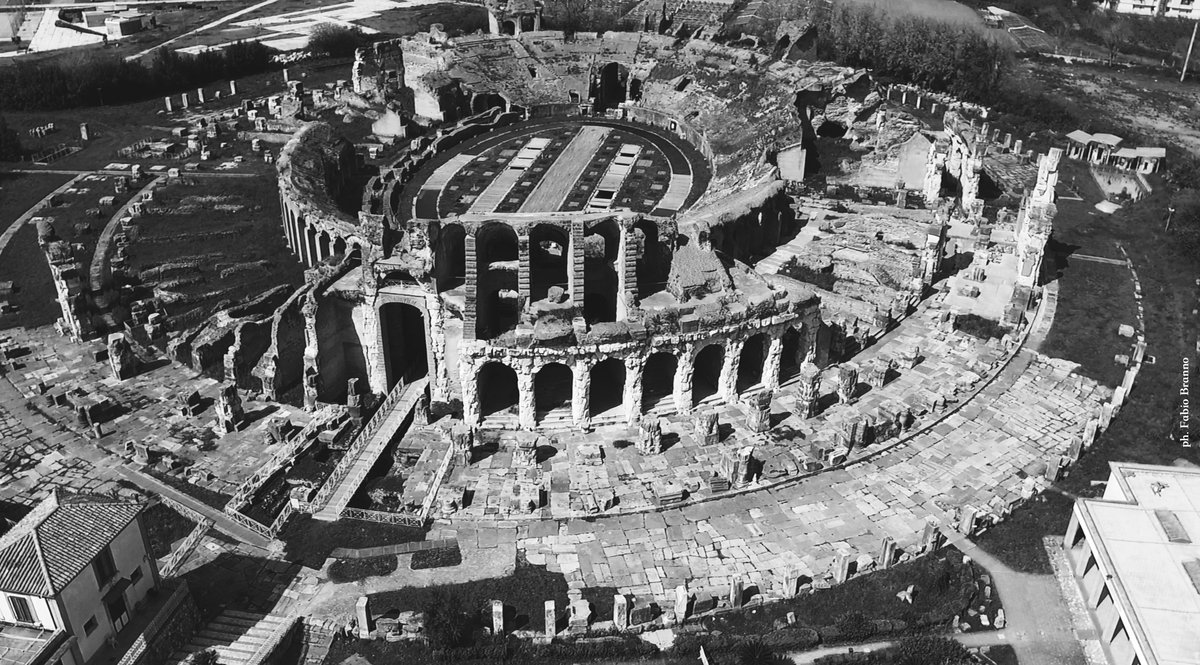
The Campanian Amphitheater is the second-largest Roman amphitheater in Italy, surpassed only by the Colosseum, with a major axis of 170 meters and a capacity of up to 60,000 spectators. It is located in Santa Maria Capua Vetere, along the ancient Appian Way, and is considered the model that inspired the Flavian Amphitheater in Rome. The guided tour lasts about 50 minutes and includes the underground chambers, the Gladiator Museum, and the nearby Mithraeum.
170 meters of major axis and 46 meters of height: a record-breaking mass in the heart of Campania.
– The visitable underground chambers, a labyrinth of corridors, winches, and trapdoors for stage effects.
– The Gladiator Museum with weapons, armor, and a sound diorama that recreates a fight.
– The Mithraeum frescoed with initiation grades and the tauroctony, just steps from the amphitheater.

Copertina itinerario Campanian Amphitheater: Capua's Colosseum
The second-largest Roman amphitheater after the Colosseum, in Santa Maria Capua Vetere. Underground chambers open to visitors, Gladiator Museum and Mithraeum with a single ticket.

Good to know


Campanian Amphitheater: The Colosseum Before the Colosseum

There’s a place, in Santa Maria Capua Vetere, where you feel really small. The Campanian Amphitheater is not just a ruin: it is the second-largest Roman amphitheater after the Colosseum and, according to many scholars, its model. You walk among the surviving pillars and imagine the 80 arches that once ran on three levels, with the busts of Diana and Juno still there watching you. The elliptical plan (almost 170 meters by 139) and the height of 46 meters give you an idea of the scale. But it’s the atmosphere that strikes you: the silence, the light filtering through the arches, the grass growing where the crowd once roared. You don’t need to be an archaeologist to be amazed. Just stop for a moment and listen to the wind.

Historical Notes

The building you see today is not the one from Spartacus’s time, although tradition likes to mix stories. The Campanian Amphitheater arose between the late 1st and early 2nd century AD, in the Flavian age, on an older republican arena (2nd-1st century BC): it was right there, in 73 BC, that the revolt of Spartacus broke out. It was restored by Hadrian (119 AD) and inaugurated by Antoninus Pius (155 AD). It could hold up to 60,000 spectators. With the fall of the Empire, the decline began: Vandals, Saracens, Lombards, and finally the Capuans themselves used it as a stone quarry. Declared a National Monument in 1822, it has been open to visitors since 1913. Essential timeline:

  • 2nd-1st century BC: republican arena, setting of the revolt of Spartacus (73 BC)
  • Late 1st-early 2nd century AD: construction of the Flavian amphitheater
  • 119 AD: restoration by Hadrian
  • 155 AD: inauguration by Antoninus Pius
  • 841 AD: Saracen sack and transformation into a fortress
  • 1822: National Monument
  • 1913: opening to the public

Under the Arena: The Underground

The beauty of the Campanian Amphitheater is that you don’t stop at the surface. Go down into the underground and you’ll find yourself in a labyrinth of corridors, brick pillars, and niches: this is where the machinery hoisted the cages with wild animals and the stage sets appeared out of nowhere. Beneath the arena is also the Catabulum tunnel, used to transfer animals. Light barely enters, the air is damp, and for a moment you think of the gladiators waiting before going up. Recently, comfortable walkways have been added and the area is well-kept, but the charm is untouched. Wear closed-toe shoes: the packed-earth floor is sometimes uneven, and the underground is the real reason this amphitheater outshines many other Roman sites.

Gladiator Museum and Combined Ticket

A few steps from the arena and you’ll find the Gladiator Museum, a small space with two rooms: one reconstructs the seating with marble remains, the other displays weapons, armor, and panels on the life of gladiators. There’s also a sound diorama that evokes a fight: a quick way to understand what happened here. With the same ticket, you also visit the Mithraeum, one of the best-preserved Mithraic sanctuaries in Italy, with frescoes of the god Mithras and the tauroctony. And if you have time, the Archaeological Museum of Ancient Capua completes the picture. All together costs very little: €2.50, reduced €1.25, free under 18. Hard to find a better value for money in Campania.

Why Visit It

Three good reasons not to skip it:

  • It is the model for the Colosseum: seeing the Campanian Amphitheater means seeing the ‘prototype’ of the world’s most famous Roman amphitheater.
  • The underground areas are open to visitors: an experience that, at the Colosseum, for example, is more fragmented, here is told through evocative routes.
  • The combined ticket: for €2.50 you enter the amphitheater, Gladiator Museum, and Mithraeum, and you can add the Archaeological Museum of Ancient Capua.

When to Go

If you can, arrive in the morning when the site opens: the raking light ignites the travertine and the shadows of the pillars stretch obliquely across the pavement. With a bit of luck, you’ll have the underground chambers almost to yourself, and the experience is entirely different. Avoid the central hours of the weekend, when groups crowd in and the silence that makes the place magical disappears. The best season, in my opinion, is shoulder season: mild weather and warm colors, without the sun beating down fully on the arena. But if you happen to be there in summer, that’s fine too: the shade of the arcades helps, and a visit to the underground chambers is always cool.

In the Surroundings

In the surroundings, still in Santa Maria Capua Vetere, there is the Mithraeum, an underground gem from the imperial age: a vaulted hall with red and green stars and frescoes of the god Mithras. A short distance away, the Archaeological Museum of Ancient Capua tells the story of the Roman colony in ten rooms, from the Bronze Age to the Samnites. And if you want the grand finale, the Royal Palace of Caserta is right nearby: another world, but with the same sense of wonder.

Itineraries nearby


💡 Did You Know…?

Fun fact: right in front of the entrance, carved into the paving, is a life-size arch. Archaeologists think a stonecutter used it as a template to replicate the exact dimensions of the amphitheater’s limestone ashlars. And while legend ties the arena to Spartacus’s uprising in 73 BC, the grand amphitheater was actually built afterward: the gladiator fled the Republican amphitheater, whose ruins are still visible alongside. A detail that makes the site all the more authentic.