Evocative Introduction
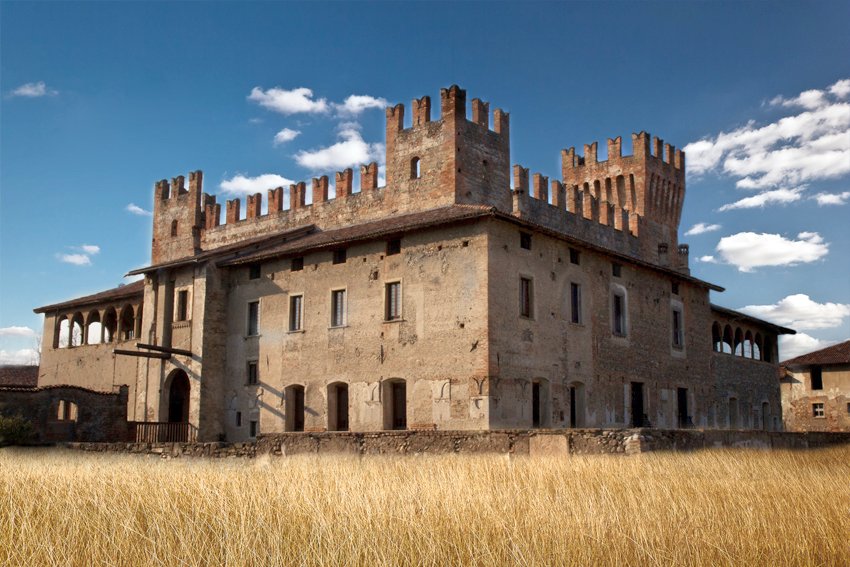
You arrive at Malpaga and the first thing you see is a massive silhouette dominating the plain. Crenellated walls, a moat with water reflecting the sky, a tower pointing straight towards the Prealps. From the outside it looks like a severe, impregnable fortress. Then you cross the gateway and find yourself in a world of colour. The walls are covered in frescoes, the courtyard tells of battles, the banquet hall makes you feel like a guest from the fifteenth century. This is Malpaga Castle, the residence chosen by Bartolomeo Colleoni for his power. It is not one of the usual museum castles: it is a living place, where you can dine like a lord, stroll at night by candlelight, or lose yourself in pictorial details. Get ready to discover a piece of Lombard history you don’t expect, just a stone’s throw from Bergamo.
Historical Background
The origins date back to the 14th century, when a Ghibelline (perhaps the Visconti?) built a fortress. With the advent of gunpowder, the castle fell into decline. In
1456 Bartolomeo Colleoni purchased it for
100 gold ducats and transformed it into an impregnable residence. Here he staged courtly life: in
1474 he received
Christian I of Denmark with banquets and tournaments. After Colleoni’s death (1475), the castle passed to his nephews the Martinengo, then to the Roncalli, the Crespi, and finally to Malpaga Spa. Today it is the focus of a sustainable revival project.
- 14th century: birth of the fortress
- 1456: purchase by Colleoni
- 1458: Colleoni settles in
- 1474: visit of Christian I
- 1475: death of Colleoni
- 1880-1924: changes of ownership
- Today: management by Malpaga Spa
Hidden Masterpieces: The Frescoes
Upon entering, the first impact is the courtyard with the fresco of the Battle of Riccardina, attributed to Romanino. It is damaged by the weather, but the force of the scene is evident. Then you go up to the noble floor: in the Banquet Hall it makes your head spin. The walls tell the visit of King Christian I: processions, knights, laden tables. You look at the faces, the costumes, the colors still vivid after five centuries. There is also an allegory of silence, an old man putting his finger to his lips. And then Colleoni’s bedroom: no fireplace, for safety, and a window with bars. There the condottiero slept, but sitting up, as was customary at the time. Every room has a detail that surprises you: a sacred fresco, a coat of arms, an inscription. It is not a cold museum, it is an illustrated book to be leafed through slowly.
Experience the Castle: Dinners, Nights, and Inn
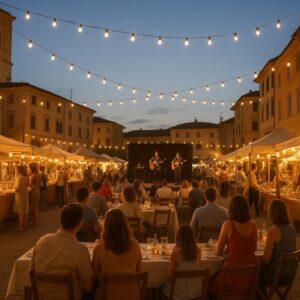
What makes Malpaga special is that you don’t just visit it—you live it. The medieval dinners in the Banquet Hall seat you at the table with 15th-century dishes, while servers in period costumes portray the court. If you prefer something quieter, the Garden of Shields, in the ancient stables, offers a modern twist on Bergamo’s cuisine. And if you want to sleep there, the Inn of Noble Travelers and the Tower Suite welcome you with exposed beams and views of the castle. For children, there are treasure hunts; for adults, candlelit night tours. And in summer, events like ‘Flowers and Tulips’ transform the village into a garden. There isn’t just one reason to come: there are a thousand.
Why visit it
Because it’s not your usual dusty castle. Here you can admire almost intact frescoes by Romanino, narrated by guides who bring the court’s atmosphere back to life. You can dine like a 15th-century noble in a hall that has seen kings and condottieri: an experience few castles offer. And you can explore an authentic landscape, through the fields of the Serio Park, with the chance to visit the nearby Cavernago Castle as well. Moreover, thanks to the Permalpaga project, the village is an example of sustainable rebirth: organic farming, biogas, clean energy. In short, it’s a place where history isn’t locked behind glass, but breathes.
When to go
If you want to see it in its best habitat, choose a sunny autumn afternoon. The raking light caresses the brickwork, the moat reflects the walls, and the surrounding fields turn gold. But if you love thrills, book a candlelit night visit: the shadows on the frescoes create an atmosphere you wouldn’t expect. In spring, on the other hand, the park bursts into color with the tulips of the ‘Flowers and Tulips’ event. Whichever time you choose, avoid peak weekends if you can go midweek. And remember: booking is mandatory, so check the website before you leave.
Nearby
Malpaga is the starting point to discover the Bergamo plain. Just a few steps away is Cavernago Castle, the other fortress of the “Land of Two Castles”. If you have some time, I recommend a walk in Serio Park: flat paths among irrigation canals and farmsteads, perfect for a family outing. And then there’s Bergamo, whose upper town deserves at least half a day. If you want to taste local cuisine, the castle’s own Locanda offers traditional dishes: no need to go far.