Evocative Introduction
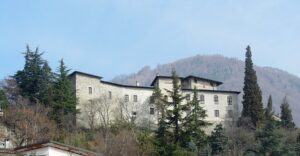
Reaching Cimbergo Castle feels like uncovering a well-kept secret. It’s not an imposing, restored fortress, but an authentic ruin perched high on a rocky spur overlooking Val Camonica. The first glimpse takes your breath away: grey stone walls stand out against the sky, surrounded by woods, with views stretching over the valley’s rock carvings below. You won’t find ticket offices or marked paths, just the silence broken by the wind and the feeling of touching history firsthand. Personally, I was struck by how this place manages to be so powerful in its simplicity—perhaps precisely because it hasn’t been ‘museum-ified,’ it retains a wild soul that makes you feel a bit like an explorer.
Historical Overview
The castle’s history is closely tied to the struggles between Guelphs and Ghibellines that inflamed the Val Camonica during the Middle Ages.
Likely built in the 12th century by the Cemmo family, it later passed to the Federici, who transformed it into a strategic stronghold. It was not a luxurious noble residence but a crucial military outpost for controlling the valley and communication routes toward the Tonale Pass. In the 15th century, it lost military importance and began to decline, first becoming a refuge for bandits and then simply abandoned to the elements. What remains today are mainly the perimeter walls and some traces of the towers, enough to imagine what it was like when soldiers kept watch from above.
- 12th century: probable construction by the Cemmo family
- 13th-14th centuries: dominion of the Federici, peak military splendor
- 15th century: gradual abandonment after loss of strategic importance
- Today: freely visitable ruins, part of Val Camonica’s heritage
The Climb and the View
Reaching the castle requires a short walk along a dirt trail starting from the village of Cimbergo. It’s not particularly challenging, but comfortable shoes are essential as the ground can be slippery after rain. The ascent offers ever-changing perspectives: first you pass through a birch grove, then emerge onto a meadow where cows graze indifferently, and finally the last stretch among emerging rocks. When you finally reach the top, the reward is complete: on one side you see Cimbergo clinging to the mountainside, on the other the Val Camonica valley opens up like a stone book. The area’s rock carvings – those of the Naquane National Rock Carvings Park are visible in the distance – seem almost to converse with the castle stones. It’s one of those places where you feel like sitting down and staying silent, even just for half an hour.
Stones That Tell Stories
Walking through the ruins of Castello di Cimbergo is a tactile as well as visual experience. You can touch the squared stones of the foundations, observe how they were fitted together without mortar, discover traces of openings that are now just holes in the wall. There are no explanatory panels, so you must rely on your imagination: that niche might have been an arrow slit for archers, that space could have been a water cistern. You’ll also notice the marks of time—mosses, lichens, small plants growing in the cracks—that make the place feel alive despite its abandonment. One detail that struck me: in some spots, you can still see the holes where the support beams for the floors were inserted. These are small clues that, when put together, allow you to mentally reconstruct the original structure. It may not be a traditional museum, but it’s an open-air museum where you are the archaeologist.
Why Visit It
Three concrete reasons to include Cimbergo Castle in your itinerary: first, it’s an authentic, non-touristy experience – no queues, no tickets, just you and history. Second, it offers a unique perspective on the Val Camonica rock carvings: seeing from above the territory where those millennia-old works were created gives a fascinating sense of temporal continuity. Third, it’s perfect for those seeking something different from the usual restored castles: here the ruin is part of the charm, and the absence of fences makes you feel free to explore every corner. Plus, if you’re passionate about photography, the sunset light on the gray stones creates spectacular shadow plays.
When to Go
The best time? Undoubtedly late afternoon, especially in spring or early autumn. In summer, days can be muggy in the valley, while at the castle, being at a higher altitude, there’s always a bit of a breeze. But it’s the light that makes the difference: around 5-6 PM, the setting sun illuminates the stones with a golden hue that makes them seem almost alive, and the long shadows accentuate the textures of the walls. In winter, if there’s no icy snow, it can be evocative to see the snow-capped mountains, but be careful as the path might be slippery. Personally, I visited in late September: the air was cool, the woods were beginning to turn yellow, and there was no one else around. Perfect.
In the Surroundings
The castle visit pairs perfectly with two nearby experiences: the Naquane Rock Art National Park in Capo di Ponte, where you can see up close the famous engraved rocks with figures of animals, warriors, and symbols dating back to the Iron Age. It’s the ideal complement because it connects the castle’s medieval history with the valley’s prehistoric past. Or, if you prefer something more ‘living’, the village of Bienno with its ancient, still-functioning forges – here, wrought iron craftsmanship is a tradition that has continued for centuries, and watching the blacksmiths at work is a spectacle. Both places are just a few minutes’ drive away, but completely different worlds that showcase the many souls of Val Camonica.