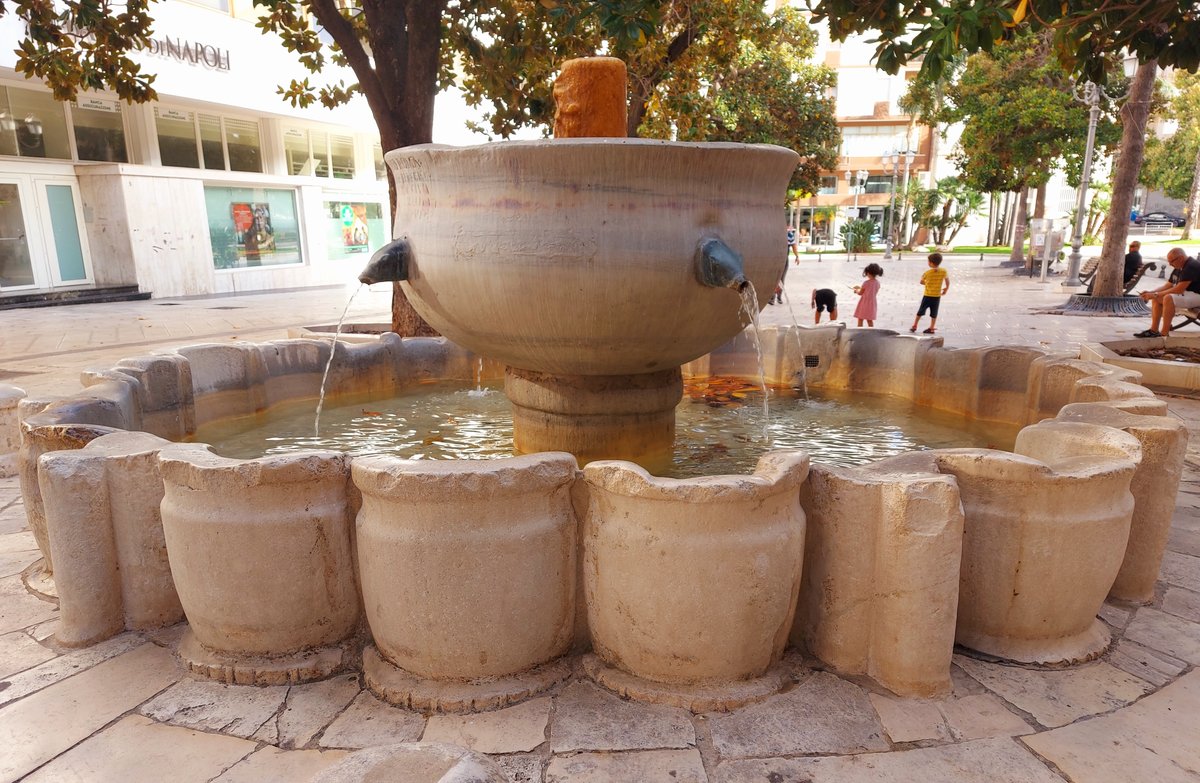
The De Torres Fountain is one of the most characteristic monuments in Brindisi’s historic center, perfect for a stop during a city visit. Built in 1618 at the request of Spanish governor Pedro de Torres, this Renaissance fountain features three stone masks symbolizing the Brindisi, Mesagne, and San Vito rivers. Its location in Piazza Duomo makes it easily accessible during any itinerary in the historic center. The Lecce stone structure still displays well-preserved architectural details despite the centuries. The evening atmosphere with lighting that enhances the masks creates a suggestive scene. The proximity to the Cathedral and the Archaeological Museum makes it a must-see stop for visitors to Brindisi.
Introduction
Have you ever stumbled upon a city corner that makes you stop in your tracks? The Fontana De Torres in Brindisi is one of those places. It’s not just a fountain, but a piece of history that stands unexpectedly in the heart of Piazza Duomo. You see it there, with its three stone masks that seem to watch you, and you immediately understand it’s no ordinary ornament. It’s a Renaissance monument that, despite the centuries, maintains a solemn elegance. Its location, right in front of the Cathedral and just steps from the Provincial Archaeological Museum, makes it an almost obligatory stop. Personally, I was struck by how it manages to be so imposing while being perfectly integrated into the urban fabric. It’s not an isolated relic, but lives together with the city.
Historical Notes
The fountain was commissioned by Spanish governor Pedro de Torres and built in 1618, during the height of the Renaissance period. It was not merely decorative but served a practical purpose: supplying water to the city. The three stone masks are not random decorations; each symbolizes a local river, almost as a reminder of water’s importance for Brindisi, a coastal city. Over time, it has undergone various restorations but has retained its original structure. It’s interesting to think that while Baroque flourished in Naples, here in Puglia, something more sober yet equally majestic was being built. Perhaps it’s not among the most celebrated monuments, but it has a historical dignity that deserves recognition.
- 1618: Construction of the fountain commissioned by Pedro de Torres
- Renaissance era: Integration into the architectural style of the period
- Various restorations: Maintenance interventions over the centuries
- Today: Protected monument and tourist landmark
The Speaking Masks
What fascinated me most were the three stone masks. They are not just simple faces, but representations of local rivers, as if the flowing water had a voice. Observing them up close, you notice the details of their expressions: one appears more severe, another almost smiling. I don’t know if this was intentional or the result of time’s wear, but it adds a touch of mystery. The stone, weathered by the years, has taken on warm hues that change with the daylight. I’ve wondered many times who the sculptor was and what their story might have been, but unfortunately, there isn’t much information. Perhaps it’s better this way—it leaves room for imagination. In any case, these masks are not merely decorative: they tell of an ancient bond between the city and its territory, something we risk forgetting today.
Piazza Duomo: The Perfect Setting
The fountain wouldn’t be the same without its placement in Piazza Duomo. It’s as if it was born to be there, in dialogue with the Cathedral and the other historic buildings. Walking through the square, you see it emerge as a focal point without overwhelming the rest. The feeling is one of balance: it’s not an isolated monument, but part of a larger whole. In the evening, when the lights come on, the atmosphere becomes even more evocative. I’ve noticed many tourists photograph it almost absentmindedly, while perhaps it’s worth pausing a moment longer. It’s a place where you can sit on a bench and watch life go by, with the fountain as a silent backdrop. It’s not just a checklist stop, but a corner where you can breathe in the history of Brindisi.
Why Visit It
Why is it worth stopping here? First, it’s a rare example of Renaissance architecture in Puglia, a region more often associated with Baroque. Then, its location is strategic: in two minutes you can go from the fountain to the Cathedral or the Provincial Archaeological Museum, making the visit efficient. Finally, the mascheroni (grotesque masks) are a unique detail: you won’t find them like this in many other Italian fountains. It’s a place that doesn’t require hours, but gives you a vivid image of historic Brindisi. Perfect if you’re passing through and want to capture the essence of the city without getting lost in complex itineraries. I appreciated it precisely for this immediacy: no frills, just history and beauty.
When to Go
The best time? At sunset, without a doubt. The warm sunlight falling on the stone of the mascheroni creates shadow plays that make everything more magical. In summer, it can be crowded, but towards evening the atmosphere becomes more intimate. In spring or autumn, on the other hand, you can enjoy softer light and fewer crowds. I would avoid the midday hours, when the sun is too strong and the details get lost. Personally, I visited on a September evening and found it perfect: it was still warm, but not muggy, and the square was lively without being chaotic. It’s one of those places that changes with the seasons but always retains its charm.
In the Surroundings
From the fountain, you can explore other gems of Brindisi. Just a few steps away is the Brindisi Cathedral, with its Romanesque facade and historically rich interiors. It’s worth a visit even just for the peaceful atmosphere. A little further on, the Provincial Archaeological Museum offers artifacts that tell the city’s long history, from the Messapians to the Romans. If you enjoy walking, head to the waterfront for a view of the port. These are all experiences that complete the picture, showing how Brindisi is not just a transit city, but a place with interesting cultural layers. I did it this way: fountain, cathedral, museum, and I felt like I understood something more.