
🧭 What to Expect
- Ideal for: curious travelers and history lovers
- Highlights: Monument to the Sailor, Cathedral, Swabian Castle, Archaeological Museum
- Must-see: Crypt of San Biagio and Alfonsino Castle
- Tip: visit the seafront at sunset
- Best time: spring and autumn
Events nearby

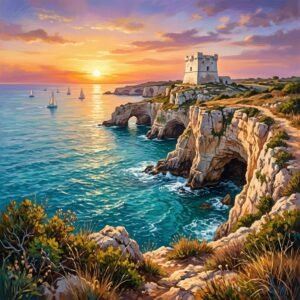
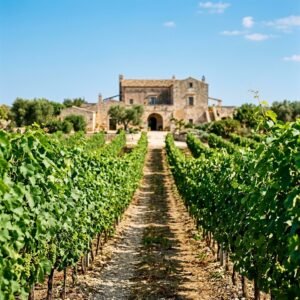
Brindisi is a city that knows how to surprise. Gateway to the East for centuries, today it offers a blend of history and seaside life. Strolling along the seafront, you'll come across the Monument to the Italian Sailor, a symbol of the city. Nearby, the Swabian Castle overlooking the harbor tells tales of past dominations. The heart is the Cathedral, while the F. Ribezzo Archaeological Museum houses artifacts from the Messapians to the Romans. Don't miss the Crypt of San Biagio with its frescoes. For a break, the De Torres Fountain or Palazzo Granafei-Nervegna. And if you have time, the Alfonsino Castle on the island of Sant'Andrea. With this guide, you won't miss the unmissable places of Brindisi.
Overview
- Monument to the Italian Sailor: The Symbol of Brindisi
- Brindisi Cathedral: A Dive into Norman History
- Swabian Castle of Brindisi: A Dive into the Middle Ages Between Sea and Prison Stories
- The Ribezzo Museum: From Prehistory to the Bronzes of the Sea
- Castello Alfonsino, the fortress that floats on the sea
- New Teatro Verdi: a gem suspended between archaeology and spectacle
- Fontana De Torres: the Baroque heart of Brindisi
- Palazzo Granafei-Nervegna: History and Archaeology in Brindisi
- St. Biagio Crypt: A Hidden Byzantine Gem Between Brindisi and San Vito
- Porta Mesagne: History, Architecture, and Resistance
- Punta Penne Tower: History, Sea, and Nature
- Vasche Limarie in Brindisi
- Small Temple of Saint Miserino: an Early Christian Jewel in the Brindisi Countryside
- Monument to Virgil: A Modern Tribute to the Latin Poet
- San Pietro degli Schiavoni: A Dive into Roman Brindisi
Itineraries nearby


Monument to the Italian Sailor: The Symbol of Brindisi
- Go to the page: Monument to the Italian Sailor: Rudder and Crypt in Brindisi
- Piazzale Eroi di Tutte le Guerre, Brindisi (BR)
- Open in Google Maps
- View on Google Images
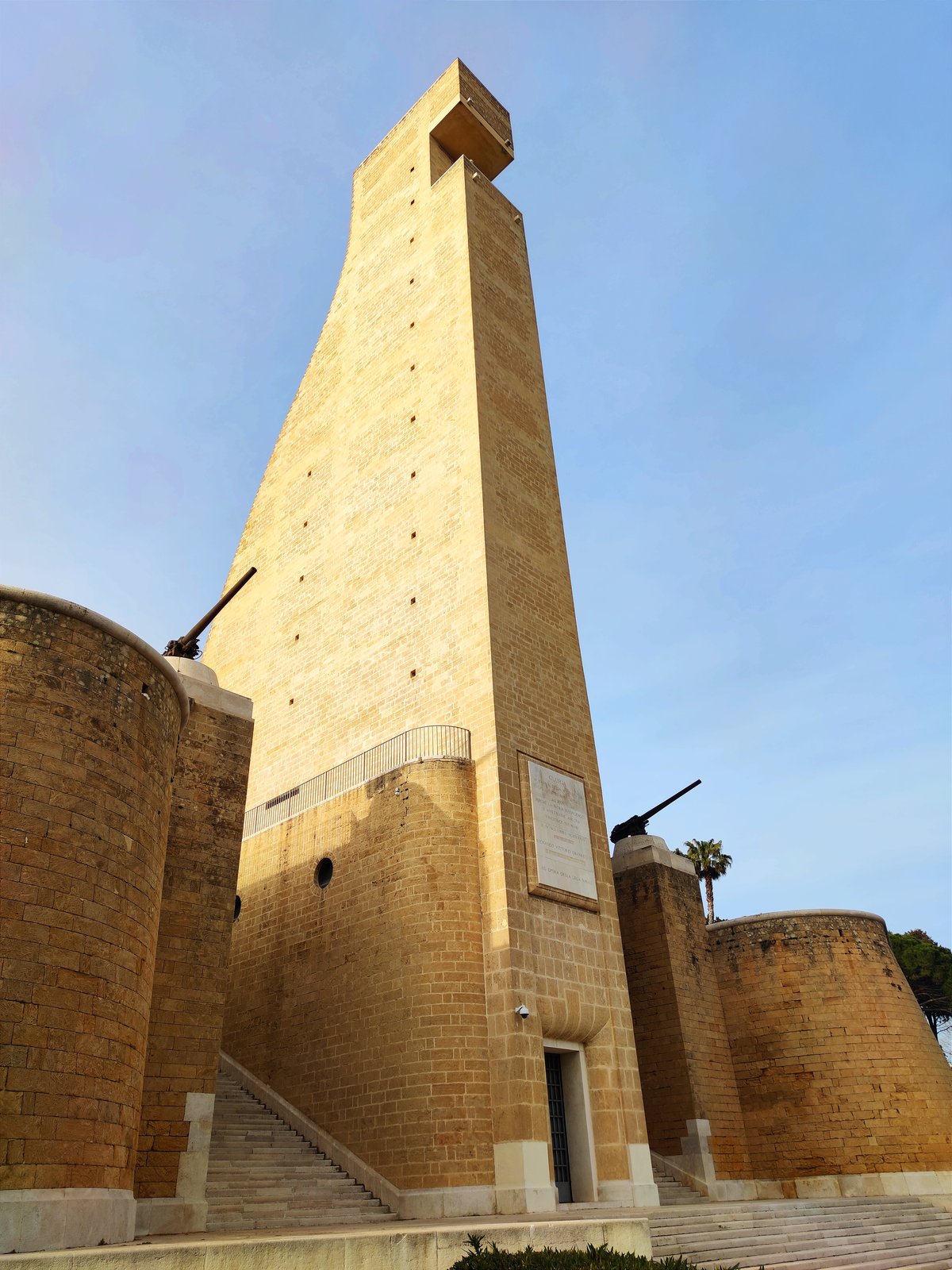 Perched on the port of Brindisi, the Monument to the Italian Sailor is one of those places that gets under your skin. Not only for the history it carries, but for what it represents: the sacrifice of thousands of sailors. Inaugurated on November 4, 1933 in the presence of King Victor Emmanuel III, it is a giant ship's rudder 54 meters high (68 from the waterfront), entirely clad in carparo, an ochre-colored stone that ignites with golden reflections at sunset. Locals affectionately call it "la jatta 'ssittata" (the sitting cat), because of its shape that resembles a crouching feline.
Climbing to the terrace – yes, now you can, after the restoration works that reopened the monument in 2026 – your gaze sweeps over the port, the Adriatic Sea, and the city. Inside, a spiral staircase or an elevator takes you to the top. But the heart of the monument is the crypt-shrine, 27 meters deep and shaped like an overturned hull. Here, on black marble slabs, are engraved the names of about 6,000 fallen sailors from World War I onward. On the altar, the bronze statue of the Madonna Stella Maris keeps silent vigil, while the bell from the battleship Benedetto Brin, sunk in the port in 1915, rests in a corner.
In the upper square, two anchors and two Austro-Hungarian cannons recall the naval victories of 1918. The visit is simple: you enter from Via Ammiraglio Millo, entrance is free for residents, while for adults it costs 3 euros. Open every day except Wednesday, from 10 am to 4:40 pm. A tip? Don't limit yourself to the crypt: climb all the way to the top, the view is worth every step.
Brindisi Cathedral: A Dive into Norman History
- Go to the page: Brindisi Cathedral: Mosaics, Wooden Choir, and Relics
- Via Colonne, Brindisi (BR)
- https://www.cattedralebrindisi.it/
- Open in Google Maps
- View on Google Images
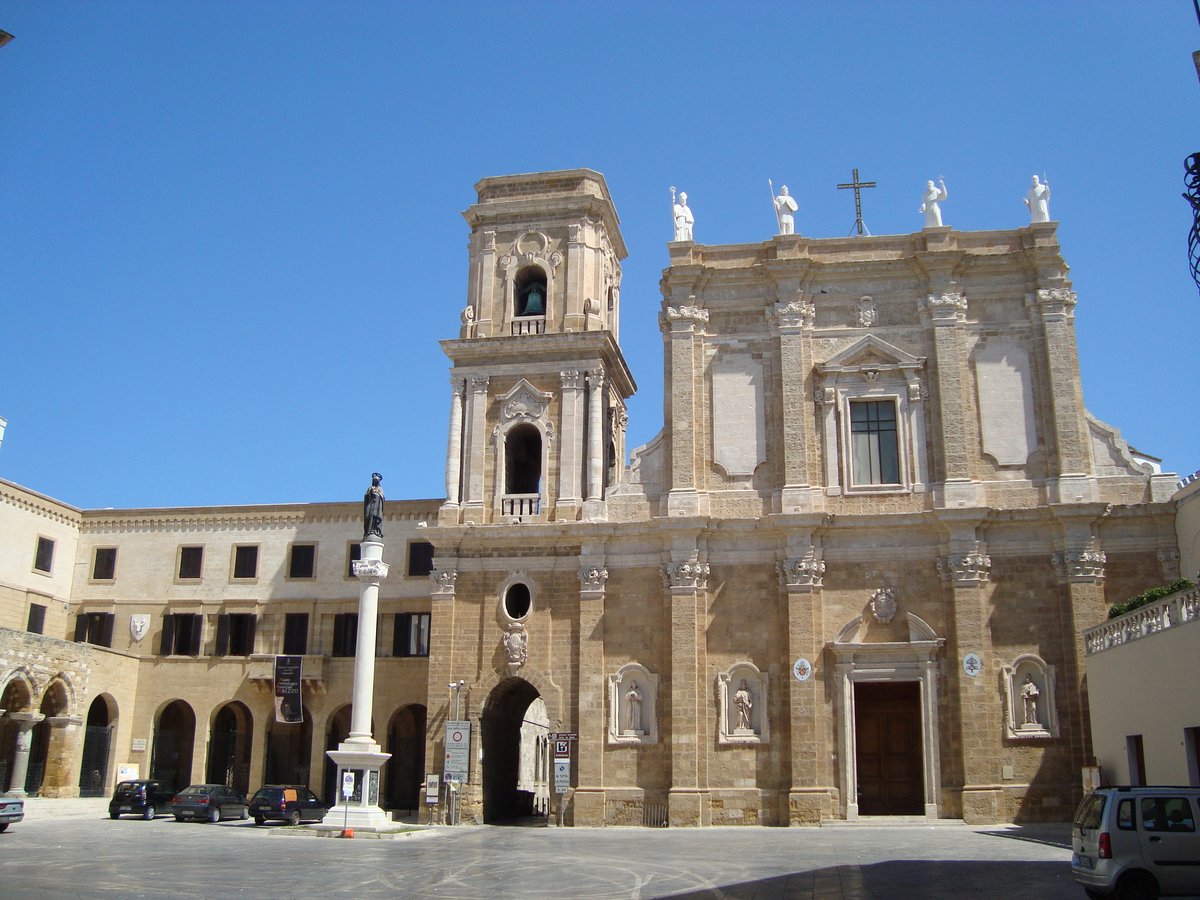 Brindisi Cathedral, dedicated to the Visitation and St. John the Baptist, is far more than a church: it is the beating heart of the city's history. Consecrated by Pope Urban II in 1089 and completed in 1143, it stands in the historic center, on Piazza Duomo. Its Romanesque layout of three naves, similar to that of the Basilica of St. Nicholas in Bari, tells of a time when Brindisi was a strategic port for pilgrims bound for Jerusalem. Inside, time seems to have stood still: admire the fragments of the mosaic floor from 1178, with zoomorphic figures reminiscent of the Otranto mosaic, and the wooden choir from 1594, carved by skilled local hands. A hidden gem? The Chapel of St. Theodore of Amasea, the city's patron saint along with St. Lawrence, which has been an ecumenical space for Catholics and Orthodox since 2010. Here rest the martyr's remains, along with other precious relics such as the arm of St. George and the hydria from the Wedding at Cana. Don't miss the 18th-century canvases by Oronzo Tiso and Diego O. Bianco adorning the side aisles. Outside, the 18th-century bell tower and the facade with statues of Saints Leucio, Theodore, Lawrence of Brindisi, and Justin de Jacobis welcome you like stone sentinels. A breathtaking place, perfect to start your journey through history and spirituality.
Swabian Castle of Brindisi: A Dive into the Middle Ages Between Sea and Prison Stories
- Go to the page: Swabian Castle of Brindisi: History and Free Tours
- Via dei Mille, Brindisi (BR)
- Open in Google Maps
- View on Google Images
 If you're passing through Brindisi, don't miss the Swabian Castle, a gem that holds eight centuries of history. I assure you it's worth it. Built by Frederick II of Swabia between 1227 and 1233, this fortress is also known as the Castle of the Land. Its trapezoidal layout, with seven towers and an inner courtyard, is the result of successive expansions: first the Angevins, then the Aragonese added an outwork with circular bastions to withstand firearms. Under Spanish rule in the 16th century, the Levant Battery and the Campanella Bastion were built to defend the port. For centuries the castle also served as a prison: in 1813 Joachim Murat turned it into a penal colony, housing up to 800 convicts. Even today, in the turret of the ferrata, you can see carvings and chains left by prisoners. Since 1909 it has been owned by the Italian Navy, which used it as a naval base. During World War II, from September 1943 to February 1944, it hosted Victor Emmanuel III when Brindisi was the capital of Italy. Today the castle is open free of charge one weekend per month, with mandatory booking on the website www.pastpuglia.it. Inside you can admire the Angevin chain that closed the port, the Imperial Hall, and a sea view. Bring an ID for entry. It's a place that speaks of power, defense, and suffering, and it leaves a mark.
The Ribezzo Museum: From Prehistory to the Bronzes of the Sea
- Go to the page: F. Ribezzo Archaeological Museum: Bronzes and History in Brindisi
- Piazza Duomo 7, Brindisi (BR)
- http://cartapulia.it/dettaglio?id=129434
- Open in Google Maps
- View on Google Images
- museoribezzo.brindisi@regione.puglia.it
- +39 0831 544257
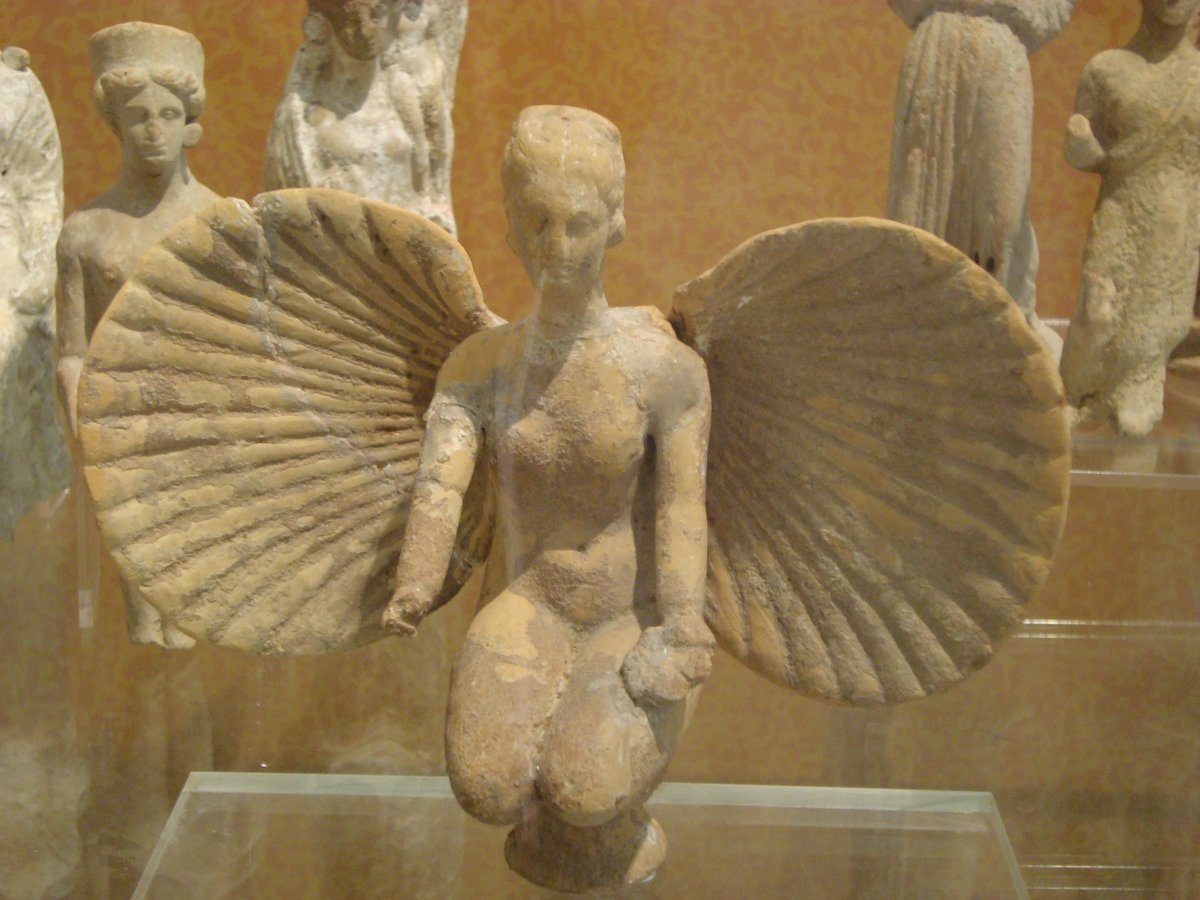 To truly understand Brindisi, you must visit the Provincial Archaeological Museum F. Ribezzo. It's not one of those dusty museums: it's alive, full of artifacts that take you on a journey through time. Start in the Portico of the Knights Templar, where bronze anchor stocks and ancient sarcophagi greet you. Then go down into the rooms, and you'll find yourself face to face with incredible things: the Messapian trozzella vases, with their geometric decorations that seem modern, and the Attic red-figure vases that somehow ended up here. And then there are the Bronzes of Punta del Serrone, recovered from the sea in 1992: a statue of consul Lucius Aemilius Paullus, heads of philosophers, a wing of Victory. The kind of stuff that gives you goosebumps. On the underground floor, the headless statue of Clodia Anthianilla, a Brindisi scholar from the 2nd century, and a Roman mosaic depicting the battle between Theseus and the Minotaur. The museum is in Piazza Duomo, open Tuesday to Sunday 9:00 AM–7:15 PM, closed on Mondays. And the best part? Admission is free. Perfect for a cultural break between one beach and another.
Castello Alfonsino, the fortress that floats on the sea
- Go to the page: Alfonsino Castle: The Red Fortress on Brindisi's Port
- Via Luigi Rizzo, Brindisi (BR)
- Open in Google Maps
- View on Google Images
- +39 379 2653244
 On the island of Sant'Andrea, at the entrance to the port of Brindisi, stands Castello Alfonsino, also known as the Red Castle for the warm color of the carparo stone at sunset. Its history begins in 1481, when Alfonso of Aragon built a first defensive tower to protect the city after the reconquest of Otranto. Then, between 1558 and 1604, Philip II of Habsburg added the Forte a Mare, an imposing system of walls and bastions designed to resist attacks from the sea. The result is a complex that almost seems to float on the water, with a small internal port accessible through an archway and a dock that once housed ships. Inside, the reception hall preserves a stone sink from 1527 with viceregal coats of arms, while the patrol walks offer spectacular views. After years of abandonment and a €5 million restoration, the castle reopened to the public in December 2024. Today it is only visited with a guide (mandatory booking, €8 full price, reduced for residents). It is an experience that combines military history, Renaissance architecture, and an almost magical atmosphere, especially at sunset, when the walls turn red and the sea reflects the colors. Perfect for those who want to discover an unknown side of Brindisi.
New Teatro Verdi: a gem suspended between archaeology and spectacle
- Go to the page: New Verdi Theatre Brindisi: Modern Architecture and Theatre Season
- Via Santi 1, Brindisi (BR)
- https://www.nuovoteatroverdi.com/
- Open in Google Maps
- View on Google Images
- 0831 562554
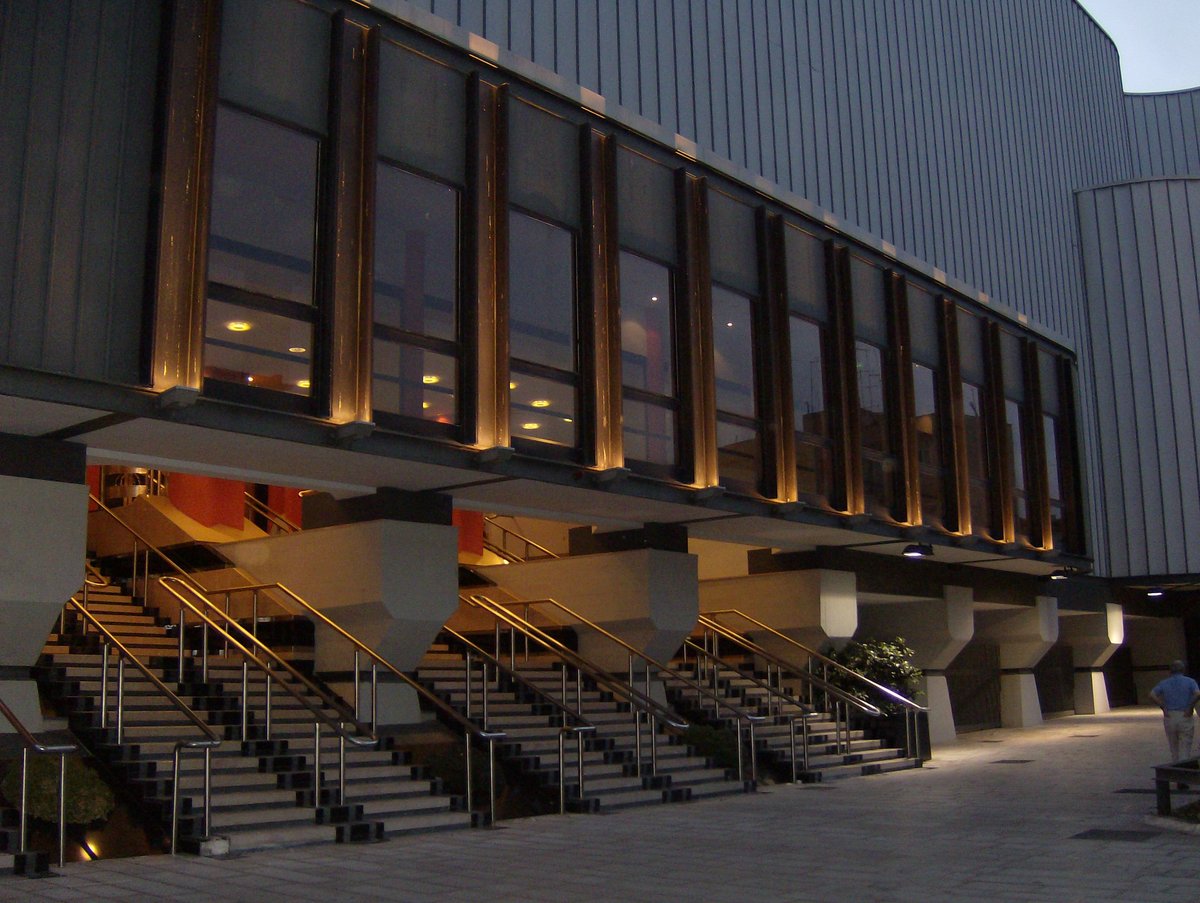 If you think a theater is just velvet seats and a curtain, the New Teatro Verdi in Brindisi will make you think again. Inaugurated on December 20, 2006 with a concert conducted by Riccardo Muti, this theater is literally suspended over the past. Designed by architect Enrico Nespega, it stands on pillars overlooking an entire Roman district, San Pietro degli Schiavoni, which emerged during excavations for the foundations. And the most fascinating thing? The foyer has a glass floor that reveals streets, mosaics, and ancient Roman buildings. One of the largest stages in Italy: 25.5 meters wide, 18 meters deep, with a capacity of 995 seats between stalls and gallery. The structure, with its 4,500 m² and 40,000 m³ volume, is a successful mix of modernity and history. Today, the theater is a vibrant cultural hub: the 2025-2026 season ranges from comedies like "Benvenuti in casa Esposito" by Alessandro Siani to classics like "Iliad" with Alessio Boni, ending with the "Verdi Green" section dedicated to young people. Tickets cost from 18 to 30 euros (with discounts for under 25 and over 65), and the box office is open Monday to Friday from 11 am to 1 pm and from 5:30 pm to 7:30 pm. If you're passing through Brindisi, don't miss a visit: you go in to see a show and find yourself walking on history.
Fontana De Torres: the Baroque heart of Brindisi
- Go to the page: De Torres Fountain in Brindisi: The 16th Century Monumental Fountain
- Piazza della Vittoria, Brindisi (BR)
- Open in Google Maps
- View on Google Images
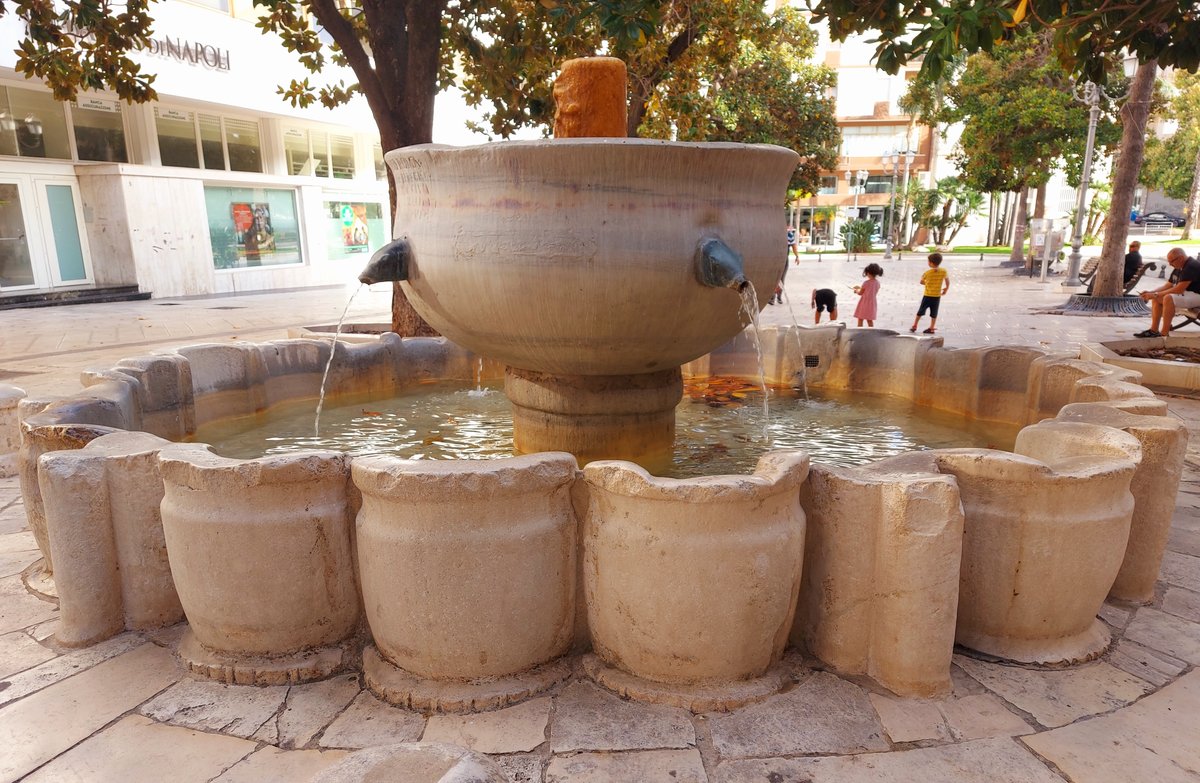 In the heart of Piazza Vittoria, in Brindisi, stands a monument that tells centuries of history: the Fontana De Torres. Commissioned in 1618 by the Spanish governor Pedro Aloysio de Torres, it was built to solve the city's chronic water shortage following epidemics that had decimated soldiers and civilians. De Torres taxed the wealthy and restored the ancient Roman aqueducts, bringing water to three fountains; of these, only the De Torres has survived. At first glance, the fountain looks like a collection of disparate elements: a lower basin surrounded by half-jars and pieces of small columns, and above it a smaller basin that – according to scholars – is none other than a 12th-century baptismal font, possibly from the Church of San Giovanni al Sepolcro. Four bronze horse heads pour water into the large basin, while a central stem supports the coat of arms of Philip III of Spain. Looking closely, you can see Latin inscriptions commemorating De Torres, the king, and the viceroy Duke of Osuna. What struck me is the story of its survival: in 1922, the municipality wanted to demolish it to make room for a war memorial, but a canon, Don Pasquale Camassa, opposed it and saved it. Today the fountain is purely ornamental, but it remains a corner of history to admire. As you stroll through the square, stop to observe the details: the bronze protomes, the reused basins, the traces of time. It's a perfect example of how Brindisi mixes eras and styles.
Palazzo Granafei-Nervegna: History and Archaeology in Brindisi
- Go to the page: Palazzo Granafei-Nervegna: History, Art, and Roman Mosaics in Brindisi
- Brindisi (BR)
- Open in Google Maps
- View on Google Images
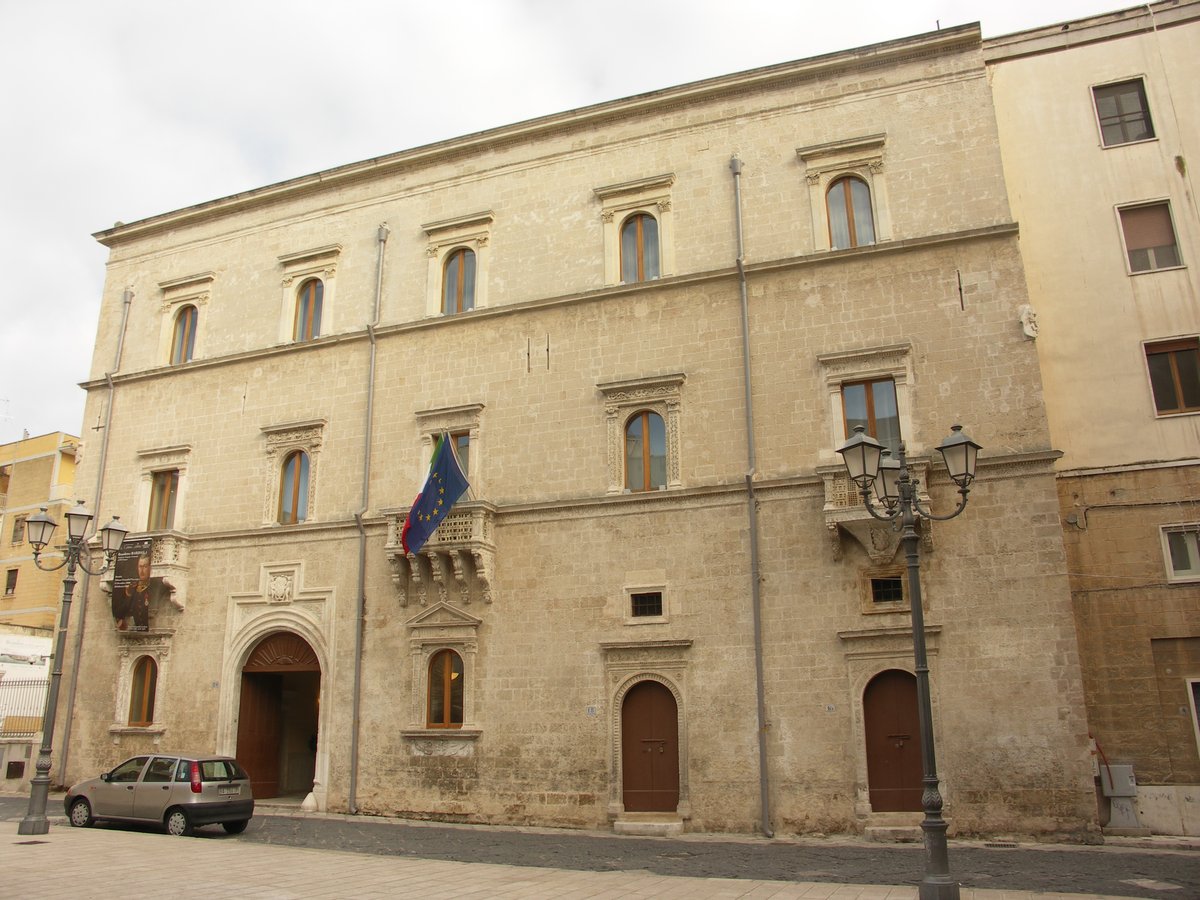 In the heart of the historic center, on Via Duomo, stands a palace that seems to speak for itself: Palazzo Granafei-Nervegna. Its original core dates back to 1565, when Nicolò Granafei – a family originally from Constantinople – decided to build it. Since then, it has seen merchants, politicians, and even judges pass through: for nearly fifty years, from 1930 to 1976, it housed the Brindisi courthouse. Then came abandonment, and finally the restoration that in 2008 returned it to the city as a cultural center.
The facade is a Renaissance jewel with Baroque touches. Look up: four Latin aphorisms are engraved on the cornice, including “The wise woman builds her house.” And above the portal, the Granafei coat of arms: a rampant lion holding a sheaf of wheat stalks, a clear reference to their trade (hence the surname, “grana fert”). The windows are all different, with intertwining decorations that invite you to observe every detail.
Upon entering, the surprise is on the ground floor: during the restorations, the floors of a 2nd-century AD Roman domus were uncovered, with polychrome star and octagon mosaics. A piece of ancient history under your feet. And in the Sala della Colonna – the former courtroom – the capital, pulvin, and last drum of the Roman column of Brindisi, a symbol of the city, are preserved. Today the palace hosts temporary exhibitions, the children's library Testefiorite, and municipal offices. Admission is free, open daily from 8 am to 8 pm. An unexpected place where the past intertwines with everyday life.
St. Biagio Crypt: A Hidden Byzantine Gem Between Brindisi and San Vito
- Go to the page: Crypt of San Biagio Brindisi: Byzantine Frescoes in the Heart of the City
- SP38, Brindisi (BR)
- Open in Google Maps
- View on Google Images
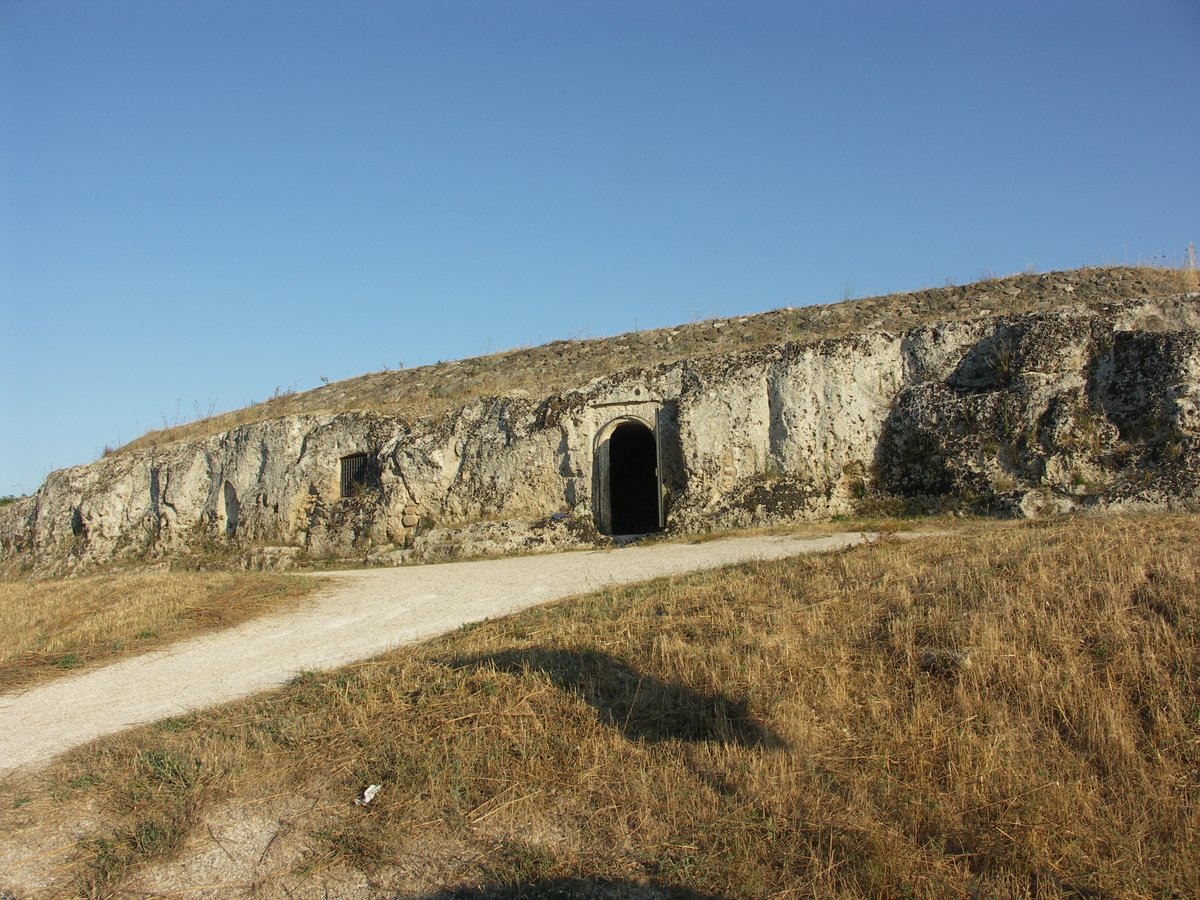 Just a few kilometers from Brindisi, nestled in the Apulian countryside, the St. Biagio Crypt is one of those unexpected places. It is a 12th-century rock settlement carved into the cliff along the Canale Reale, about 11 km from the center. A community of Italo-Byzantine monks once lived here, and the crypt was their religious heart. The dimensions are almost intimate: 12.50 m long, 4.50 m wide, 2.70 m high. Originally, it had two entrances: one for priests, one for the faithful. Today, you enter from one side and are left speechless. The pictorial cycle dates to October 8, 1196, the work of the painter Daniele, and it is one of the best-preserved in all of Apulia. Scenes unfold on the vault: Christ Pantocrator in a starry circle, the Annunciation, the Flight into Egypt (Mary on a white horse, Joseph carrying Jesus on his shoulders), the Presentation in the Temple, the Entry into Jerusalem. St. Biagio is depicted with healed animals, St. Nicholas has an inscription in both Greek and Latin. And then there are St. George, St. Demetrius, the Nativity with midwives Salome and Zalomi. Light filters in from the entrance, and the colors are still vivid. To visit, you must book: call or email sanvitoprenotazioni@gmail.com. Tickets are €3 (€2 reduced), and group sizes are limited. Just ahead is the Masseria Jannuzzo farm, and in winter they also have a Living Nativity. If you feel like taking a step back in time, this is the place.
Porta Mesagne: History, Architecture, and Resistance
- Go to the page: Porta Mesagne: The Ancient Gate of Brindisi Saved from Demolition
- Via Appia, Brindisi (BR)
- Open in Google Maps
- View on Google Images
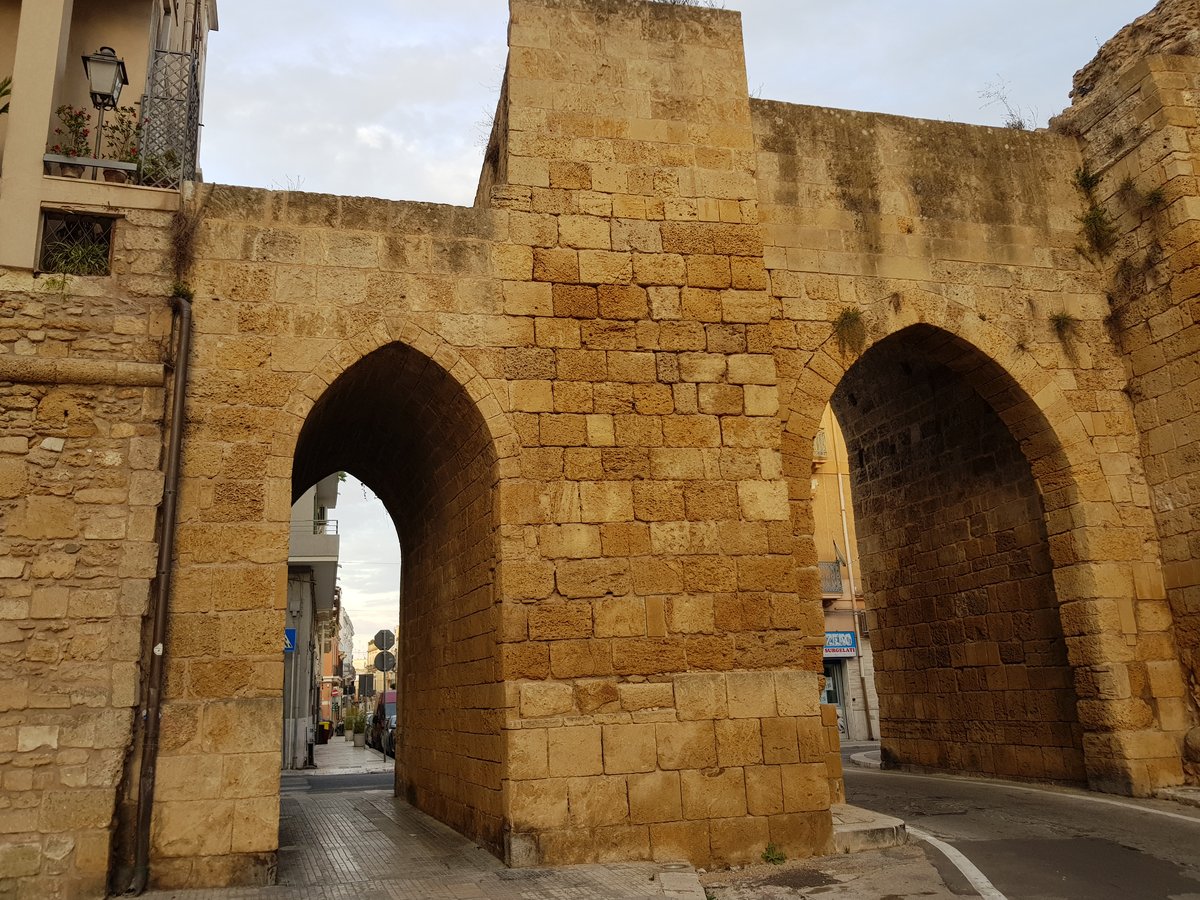 Porta Mesagne (or Porta Napoli) is the oldest gate of Brindisi, with origins dating back to Roman times, although its current appearance is medieval. It was commissioned by Frederick II of Swabia in 1236 (or 1243, depending on sources) as a monumental entrance to the city, with a Gothic pointed arch. The dimensions are imposing: the passage is 5.80 meters long, 4.60 wide, with varying heights (internal 9.50 m, external 7 m). Even today, you can see the holes for the beams of the door and remnants of medieval frescoes.
Next to it stands the Aragonese pentagonal bastion, remodeled during the Spanish period in 1551 by Giovan Battista Loffredo, with three gunports and coats of arms of Charles V. A complex that tells centuries of history.
But the most fascinating story is that of 1925: the gate, damaged by a storm, had been condemned to demolition by the mayor. Canon Pasquale Camassa, known as "Papa Pascalinu", physically opposed it, lying down under the arch to stop the work. Telegrams to Rome and days of waiting: in the end the gate was saved and restored, with the opening of a lateral pedestrian passage.
Today, unfortunately, the gate is still crossed by traffic, and plastic telephone cabinets mar the view. Associations like WWF and Italia Nostra are demanding pedestrianization and the removal of these modern horrors. Despite everything, Porta Mesagne remains a symbol of resilience, a monument to visit calmly, perhaps after admiring the nearby Roman lime basins and the sixteenth-century walls.
Punta Penne Tower: History, Sea, and Nature
- Go to the page: Punta Penne Tower: History and Nature Along the Brindisi Coastline
- Via di Punta Penne, Brindisi (BR)
- Open in Google Maps
- View on Google Images
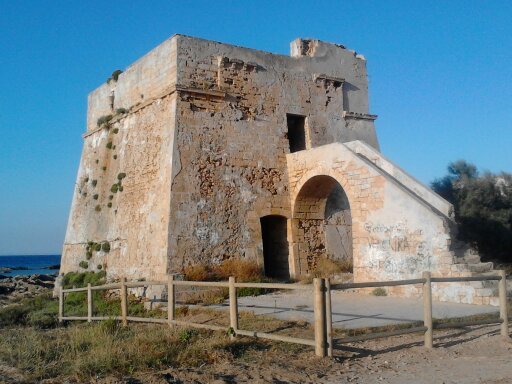 If you're looking for a place that combines history, sea, and nature, Punta Penne Tower is just what you need. Located just a stone's throw from Brindisi Airport, this coastal tower lies within the Punta Penne – Punta del Serrone Municipal Nature Park, a 23-hectare area inaugurated in 2014 after careful reclamation.
The tower has ancient origins: it existed before 1563, the year its reconstruction was ordered. It was then rebuilt in 1568 by master mason Giovanni Parise. Despite its defensive purpose, it did not prevent Turkish pirate landings: in 1676, two Turkish galleys plundered nearby farms and kidnapped 12 people. During World War II, the Guardia di Finanza modified and lowered it. Today, two floors remain, each with two rooms, and an external staircase has replaced the original movable one.
The structure is in a state of abandonment, but an information panel by the Brindisi Archaeological Group tells its story. Nearby, you can also see the remains of the Batteria Menga and some World War I casemates. The park offers trails on suspended boardwalks through Mediterranean scrub and rocky cliffs, with rare habitats like salicornia. From the tower, you can enjoy a panoramic view of Brindisi's northern coastline, a peaceful corner waiting to be discovered.
Vasche Limarie in Brindisi
- Via Cristoforo Colombo, Brindisi (BR)
- Open in Google Maps
- View on Google Images
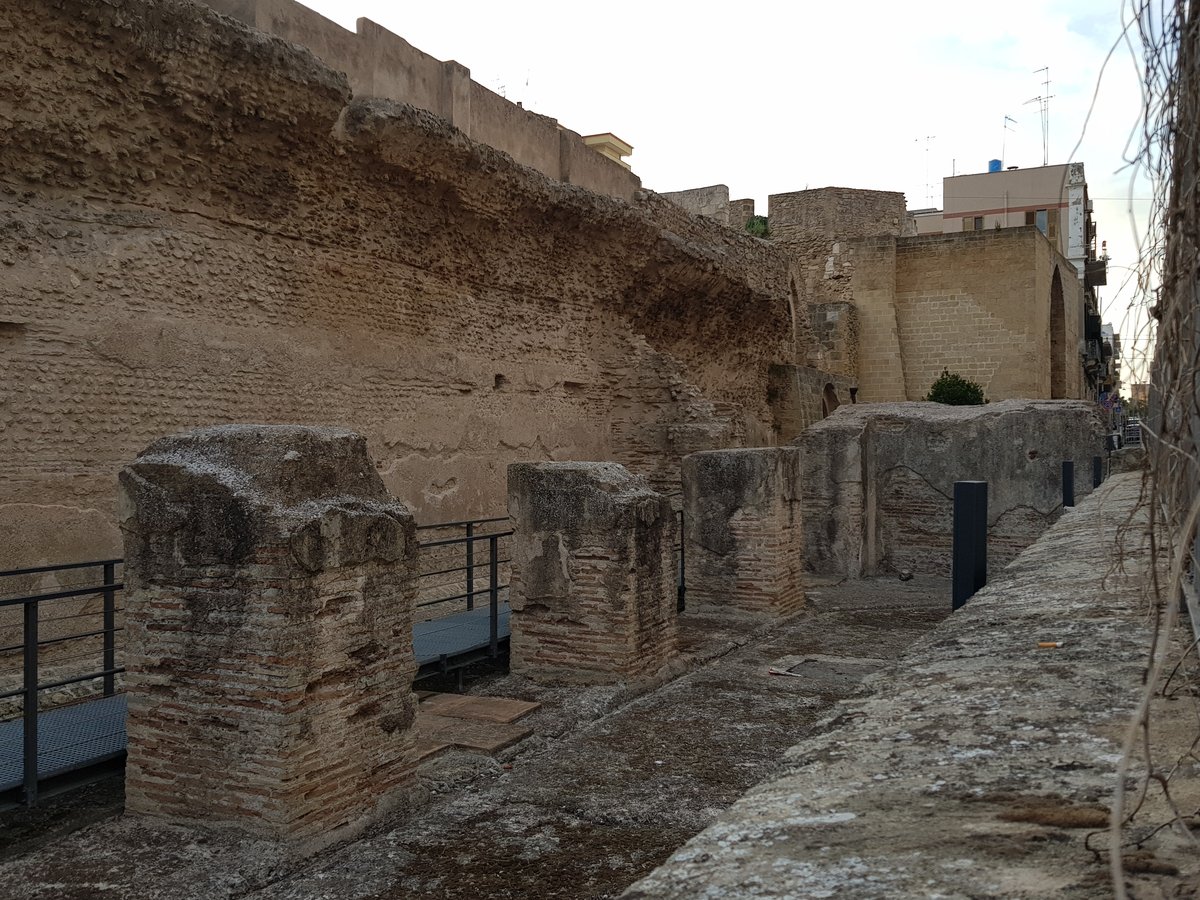 Just a stone's throw from Porta Mesagne, the Vasche Limarie are one of Brindisi's most astonishing archaeological treasures. These are ancient Roman sedimentation basins, part of a 12 km aqueduct that brought water from Pozzo di Vito into the city. Here, the water was left to settle so that silt could deposit before being distributed to the fountains. The original complex consisted of at least three interconnected tanks, with a total length of 51 meters and a width of 11.20 meters. The largest tank, to the south, measures 29.28 meters long and 8.10 meters wide, and was divided into two aisles by six pillars that supported a double barrel vault (now lost). The walls are made of opus caementicium and latericium, with a floor of terracotta slabs – and here's a detail: a U-shaped channel on the floor was used to drain water and mud during cleaning. Built in the late Republican period (2nd-1st century BC), the tanks are the only example of a castellum aquae in the entire Salento region. In the 16th century, their vault was demolished because it exceeded the height of the new walls ordered by Charles V. After centuries of neglect and improper use as a pub (in the 1970s and 1980s it housed the "La Tortuga" bar), they were restored in the 1990s and returned to the city. Today they can be visited for free: just enter through the gate on via Cristoforo Colombo. It's thrilling to think that water flowed here two thousand years ago, sustaining life in Brundisium. A tip? Bring your camera, because the play of light on the carparo stone walls is spectacular.
Small Temple of Saint Miserino: an Early Christian Jewel in the Brindisi Countryside
- Strada Provinciale Oria - Cellino San Marco, Brindisi (BR)
- Open in Google Maps
- View on Google Images
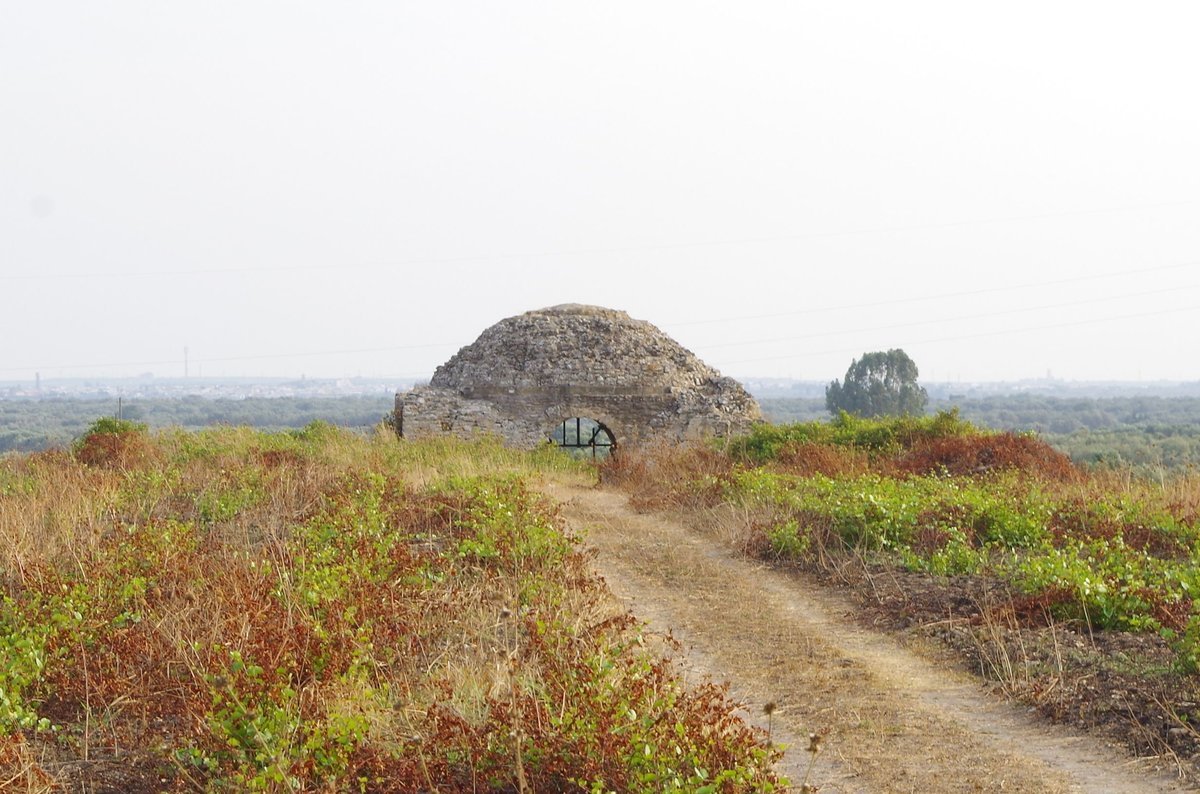 If you are in Brindisi and want to discover a hidden corner of history, you absolutely must visit the Small Temple of Saint Miserino. Located in the countryside of San Donaci, this building is considered the oldest Christian place of worship in Salento. Its history is fascinating: originally a Roman nymphaeum from the 2nd century, it was later transformed into a church in the 6th century. You will notice the octagonal plan and the lowered dome, typical of Roman architecture. Inside, fragments of bichrome mosaic and traces of frescoes tell centuries of history. Unfortunately, the small temple is in a state of neglect, but recent archaeological excavations (starting July 2025) are bringing to light the Roman villa of which it was part. A tip: arrive early in the morning, when the light illuminates the apses and you can enjoy the silence of the countryside. And yes, the name 'San Miserino' is a popular invention: there is no such saint, but the ironic nickname has made this place even more special. Park nearby and follow the paths; the signage guides you. It is an authentic experience, away from the crowds.
Monument to Virgil: A Modern Tribute to the Latin Poet
- Piazza Vittorio Emanuele II, Brindisi (BR)
- Open in Google Maps
- View on Google Images
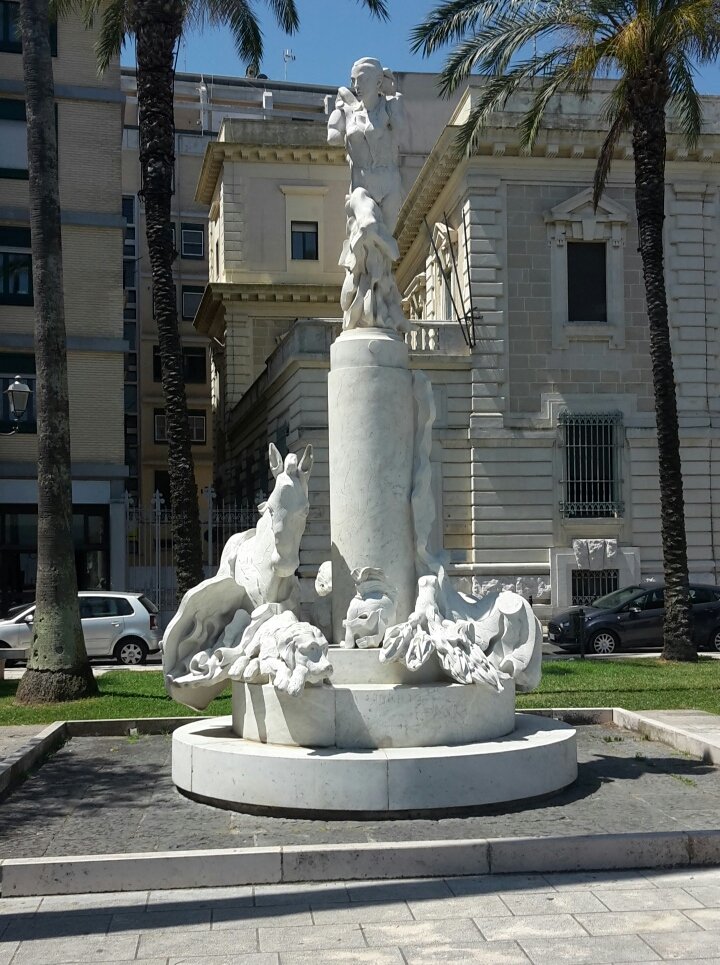 Strolling through Brindisi, in the gardens of Piazza Vittorio Emanuele II, you come across a monument that blends contemporary art with ancient memory: the Monument to Virgil. Created in 1985 by sculptor Floriano Bodini, it is a work in white Carrara marble celebrating the bimillennium of the poet's death, which occurred in Brindisi in 19 BC. Inaugurated on March 27, 1986, and moved to its current location two years later, the monument is far more than a simple bust: it is a complex allegory. At its center, a winged Victory without arms rises atop a column wrapped in a shroud—a powerful symbol that victory brings with it pain and mourning. At the base, you can make out a helmet, a horse, sheep, and an olive branch, evoking themes from Virgil's works: war and peace, active and contemplative life. The sculpture faces the eastern sea, from where, according to myth, Aeneas set sail. This is no coincidence: Virgil, who owned a house on the waterfront near the Roman columns, described that very port in the Aeneid. Unfortunately, the monument shows signs of wear from smog and weather, and in 2018 it was cleaned of lichens. Yet it remains a landmark for anyone wanting to understand the deep bond between Brindisi and its most illustrious poet. If you find yourself in the city, stop for a moment: let these symbols tell you the story of a man whose verses shaped Western culture.
San Pietro degli Schiavoni: A Dive into Roman Brindisi
- Largo Gianni D'Errico, Brindisi (BR)
- http://musei.beniculturali.it/musei?mid=878&nome=878
- Open in Google Maps
- View on Google Images
- +39 099 4532112
 If you think Brindisi is just a ferry port, get ready to change your mind. In the heart of the historic center, right beneath the Nuovo Teatro Verdi, lies one of the city's most fascinating archaeological sites: the San Pietro degli Schiavoni area. Discovered by chance in the 1960s during work on the courthouse, this area of about 4,800 sq m preserves an authentic piece of the Latin colony of Brundisium. The name, with its exotic ring, comes from the Greek-Albanian community (the "Schiavoni") that lived here from the 1400s and from the now-vanished church of San Pietro. At the center runs a basalt-paved road 60 meters long, an ancient cardo with cart ruts still clearly visible. On either side are the remains of patrician domus with mosaic floors and a late Roman bath complex: the frigidarium with its semicircular pool and the caldarium heated by pillars (suspensurae). The highlight? Part of the theater is suspended over the excavations, and the foyer has a transparent floor from which to view the remains from above. Too bad the area is currently closed for renovations, but it's worth keeping an eye on: as soon as it reopens, it's a must for history lovers.