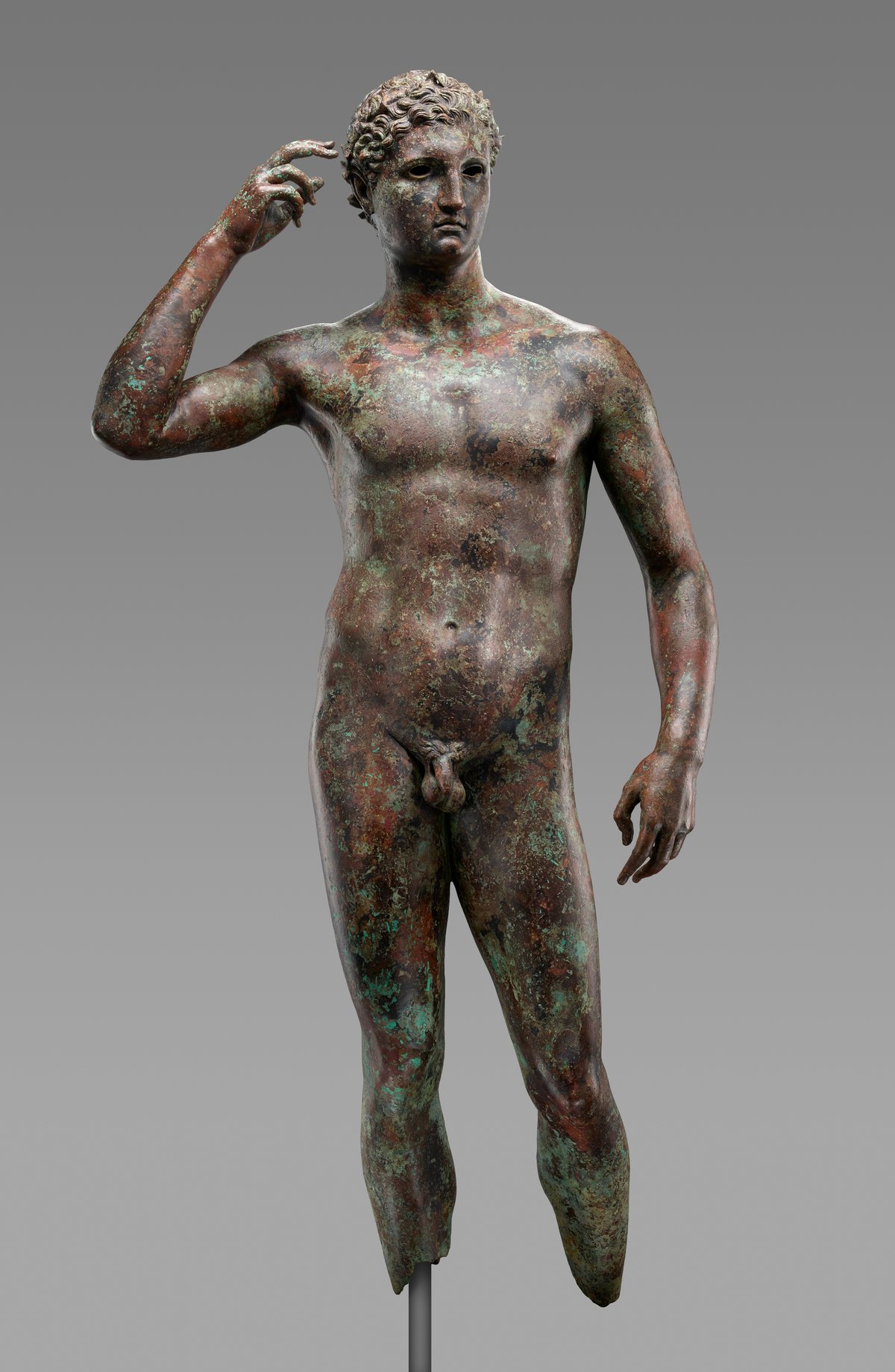
The Fano Athlete, also known as the Victorious Youth, is a rare Greek bronze statue that emerged from the Adriatic Sea in 1964. After a troubled history of illegal exports, it is now displayed at the Getty Museum in Malibu, but Italy has never stopped reclaiming it. Fano, the city of discovery, celebrates this connection with a seaside walk dedicated to Lysippos.
Recovered on August 14, 1964 off the coast of Fano by a fishing boat
Attributed to Lysippos or his school, dated between the 4th and 2nd centuries BC
Symbol of contention between Italy and the United States: two rulings in Italy’s favor, but the work remains at the Getty
In Fano, the ‘Lysippos walk’ along the seafront commemorates the event and awaits the statue’s return
Introduction
The Atleta di Fano is a Greek bronze masterpiece, but you won’t find it in Fano. Recovered in 1964 by a fishing boat just off these coasts, the statue ended up at the Getty Museum in Malibu, and has since been at the center of a legal dispute between Italy and the United States. In Fano, however, its story is alive: along the seafront there is the Passeggiata del Lisippo, with a reproduction, and the pride of a city that has never stopped asking for its symbol back.
Introduction
The Atleta di Fano is a Greek bronze masterpiece, but you won’t find it in Fano. Recovered in 1964 by a fishing boat just off these coasts, the statue ended up at the Getty Museum in Malibu, and has since been at the center of a legal dispute between Italy and the United States. In Fano, however, its story is alive: along the seafront there is the Passeggiata del Lisippo, with a reproduction, and the pride of a city that has never stopped asking for its symbol back.
Historical Background
On August 14, 1964, the fishing trawler Ferruccio Ferri recovered the statue from the Adriatic waters. After being hidden for a year in a cabbage field, it was sold to an antiquarian in Monaco and then to the Getty for about $4 million in 1977. Italy claims ownership: in 2018, the Italian Supreme Court confirmed the confiscation, and in 2024, the European Court of Human Rights ruled in Italy’s favor. But the statue remains in Malibu. Meanwhile, Fano celebrates August 14 as ‘Lysippus Day’.
Historical Background
On August 14, 1964, the fishing trawler Ferruccio Ferri recovered the statue from the Adriatic waters. After being hidden for a year in a cabbage field, it was sold to an antiquarian in Monaco and then to the Getty for about $4 million in 1977. Italy claims ownership: in 2018, the Italian Supreme Court confirmed the confiscation, and in 2024, the European Court of Human Rights ruled in Italy’s favor. But the statue remains in Malibu. Meanwhile, Fano celebrates August 14 as ‘Lysippus Day’.
Discovery and Clandestine Journey
It all begins at sea: fishermen, hauling in their nets, find a bronze boy in their hands. Instead of reporting it, they bury it in a cabbage field in Fano. Then it passes from hand to hand – from Gubbio to Monaco – until it ends up in an American magnate’s collection. An odyssey steeped in smuggling, complete with secret restorations and forged documents. Today, as lawyers argue, the bronze remains on display at the Getty Villa.
Discovery and Clandestine Journey
It all begins at sea: fishermen, hauling in their nets, find a bronze boy in their hands. Instead of reporting it, they bury it in a cabbage field in Fano. Then it passes from hand to hand – from Gubbio to Monaco – until it ends up in an American magnate’s collection. An odyssey steeped in smuggling, complete with secret restorations and forged documents. Today, as lawyers argue, the bronze remains on display at the Getty Villa.
A Bronze Masterpiece
The Athlete is nude, in a plastic pose: the right arm rises to place a crown (perhaps of wild olive) on the head, the eyes were in glass paste, the nipples in copper. The dark green patina and the slender proportions place it between the 4th and 2nd centuries BC, with strong references to the school of Lysippos. But more recent criticism says: it is not by Lysippos, but by one of his pupils. It remains one of the few intact Greek bronze statues, although lacking feet.
A Bronze Masterpiece
The Athlete is nude, in a plastic pose: the right arm rises to place a crown (perhaps of wild olive) on the head, the eyes were in glass paste, the nipples in copper. The dark green patina and the slender proportions place it between the 4th and 2nd centuries BC, with strong references to the school of Lysippos. But more recent criticism says: it is not by Lysippos, but by one of his pupils. It remains one of the few intact Greek bronze statues, although lacking feet.
Why You Should Visit
There’s no original in Fano, but two good reasons to go: the Lisippo walk along the seafront, where a copy of the statue gazes at the sea from which it emerged; and the Museum of the Sea, which tells the story of fishing and the discovery. Plus, every year on August 14th, the ‘Lisippo Day’ is celebrated with events to keep the demand for restitution alive. It’s a way to experience firsthand a story that blends art, law, and local identity.
Why You Should Visit
There’s no original in Fano, but two good reasons to go: the Lisippo walk along the seafront, where a copy of the statue gazes at the sea from which it emerged; and the Museum of the Sea, which tells the story of fishing and the discovery. Plus, every year on August 14th, the ‘Lisippo Day’ is celebrated with events to keep the demand for restitution alive. It’s a way to experience firsthand a story that blends art, law, and local identity.
When to Go
The best time? Summer, especially around August 14th, when the city comes alive with celebrations for the anniversary of the discovery. But if you prefer tranquility, choose spring or autumn: the seafront is less crowded and the light on the sea makes the walk dedicated to the athlete enchanting. In any case, the story of the Athlete is felt all year round in the museums and in the tales of the people of Fano.
When to Go
The best time? Summer, especially around August 14th, when the city comes alive with celebrations for the anniversary of the discovery. But if you prefer tranquility, choose spring or autumn: the seafront is less crowded and the light on the sea makes the walk dedicated to the athlete enchanting. In any case, the story of the Athlete is felt all year round in the museums and in the tales of the people of Fano.
Nearby
Two must-see stops in Fano: the Arch of Augustus, the Roman gateway to the city, and the Rocca Malatestiana, a Renaissance fortress that now hosts exhibitions. If you have time, the Archaeological Museum of Fano preserves Roman artifacts and tells the story of the area. A few kilometers away, Pesaro offers Rossini’s birthplace and beautiful beaches. All places that enrich the visit with art and culture.
Nearby
Two must-see stops in Fano: the Arch of Augustus, the Roman gateway to the city, and the Rocca Malatestiana, a Renaissance fortress that now hosts exhibitions. If you have time, the Archaeological Museum of Fano preserves Roman artifacts and tells the story of the area. A few kilometers away, Pesaro offers Rossini’s birthplace and beautiful beaches. All places that enrich the visit with art and culture.