Introduction
Nestled in a forest of ancient holm oaks, the Sanctuary of Fontecolombo is one of the most intense stops on the Cammino di Francesco in the Valle Santa. Here, on a hill at 549 meters, you can breathe an atmosphere out of time. The name itself, “Fontecolombo,” has a poetic origin: Francis saw a spring where white doves drank and called it “Fons colombarum.” The sanctuary is nicknamed the Franciscan Sinai: in this cave, the saint wrote the definitive Rule of the Order. Entering the Sacro Speco, the silence is almost sacred. It’s a place that speaks for itself, among rock, wood, and faith. You don’t need to be a believer to be struck by the power of the place.
Introduction
Nestled in a forest of ancient holm oaks, the Sanctuary of Fontecolombo is one of the most intense stops on the Cammino di Francesco in the Valle Santa. Here, on a hill at 549 meters, you can breathe an atmosphere out of time. The name itself, “Fontecolombo,” has a poetic origin: Francis saw a spring where white doves drank and called it “Fons colombarum.” The sanctuary is nicknamed the Franciscan Sinai: in this cave, the saint wrote the definitive Rule of the Order. Entering the Sacro Speco, the silence is almost sacred. It’s a place that speaks for itself, among rock, wood, and faith. You don’t need to be a believer to be struck by the power of the place.
Historical Notes
The history of Fontecolombo is tied to two key events in the life of Francis. Between 1222 and 1223, the saint retreated here for 40 days of fasting and prayer, writing in the cave of Sacro Speco the approved Rule, which was endorsed by Pope Honorius III on November 29, 1223. At the end of 1225, Francis returned to undergo cauterization of the optic nerve: a red-hot iron applied to the eye which, according to tradition, he endured without pain by invoking “brother fire”. The complex was entrusted to the Reformed Friars Minor in 1519. The current church was consecrated on July 19, 1450 by Cardinal Nicholas of Cusa.
Historical Notes
The history of Fontecolombo is tied to two key events in the life of Francis. Between 1222 and 1223, the saint retreated here for 40 days of fasting and prayer, writing in the cave of Sacro Speco the approved Rule, which was endorsed by Pope Honorius III on November 29, 1223. At the end of 1225, Francis returned to undergo cauterization of the optic nerve: a red-hot iron applied to the eye which, according to tradition, he endured without pain by invoking “brother fire”. The complex was entrusted to the Reformed Friars Minor in 1519. The current church was consecrated on July 19, 1450 by Cardinal Nicholas of Cusa.
The Sacred Cave and the Grotto of the Rule
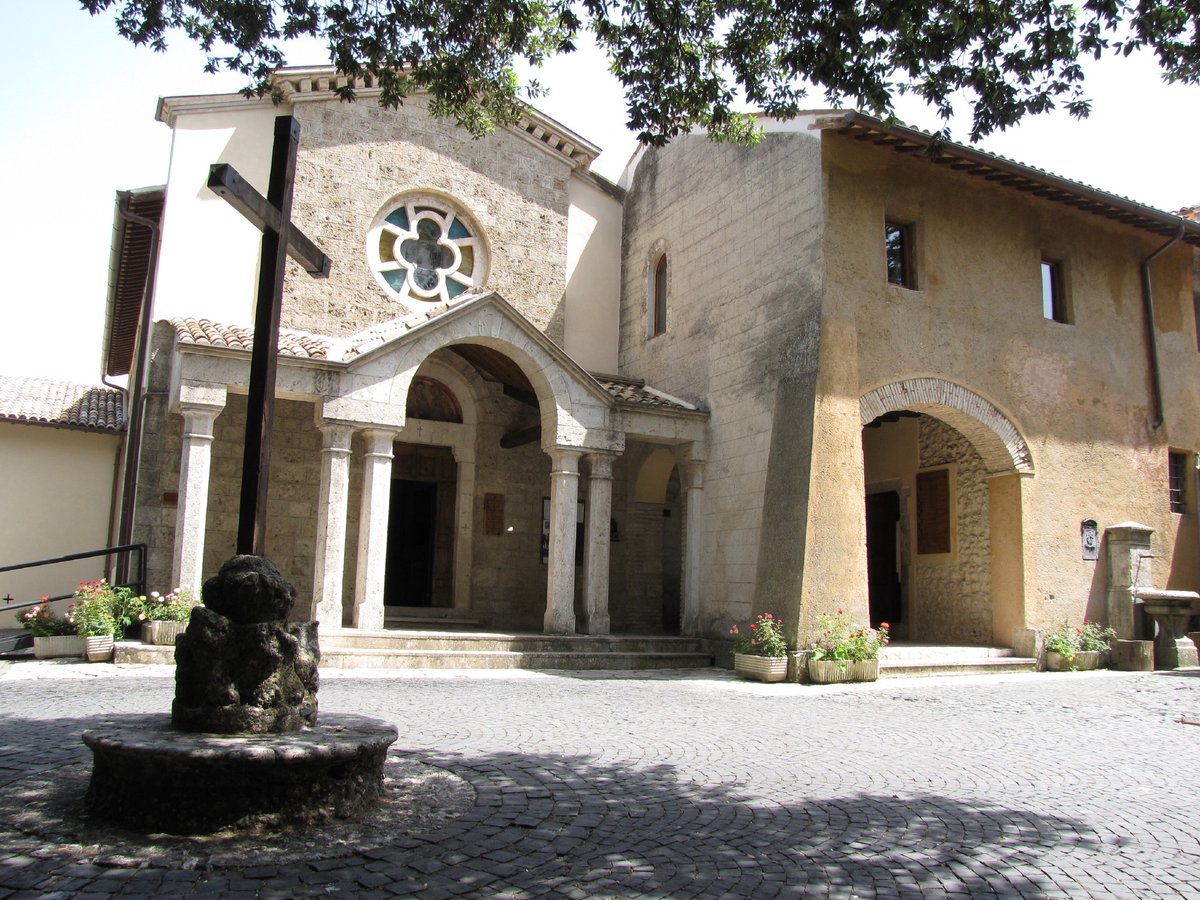
The heart of the sanctuary is the Sacro Speco, a crevice in the rock where Francis retreated. Here, according to tradition, the saint dictated the Rule to Brother Leo, while a divine light confirmed the words. Today, the entrance is protected by the Oratory of St. Michael, with a simple wooden cross marking the place. The fissure in the rock is evocative: it is said to have opened at the moment of Christ’s death. Climbing up, you encounter the chapel of the Blessed Virgin (or of the Magdalene) with 13th-14th century frescoes and an enigmatic Tau design in red, perhaps drawn by Francis himself. An intimate corner where history and spirituality merge.
The Sacred Cave and the Grotto of the Rule
The heart of the sanctuary is the Sacro Speco, a crevice in the rock where Francis retreated. Here, according to tradition, the saint dictated the Rule to Brother Leo, while a divine light confirmed the words. Today, the entrance is protected by the Oratory of St. Michael, with a simple wooden cross marking the place. The fissure in the rock is evocative: it is said to have opened at the moment of Christ’s death. Climbing up, you encounter the chapel of the Blessed Virgin (or of the Magdalene) with 13th-14th century frescoes and an enigmatic Tau design in red, perhaps drawn by Francis himself. An intimate corner where history and spirituality merge.
The Hermitage and the Cauterization
Continuing along the devotional path, you reach the Hermitage of Saint Francis, the cell where the saint underwent eye surgery. A stark episode: the doctor heated an iron and applied it from eyebrow to eyelid. Francis, invoking “brother fire,” felt no pain. Today the space is bare, but a stained-glass window in the church recalls the scene. Just beyond, a staircase leads to the Fountain of the Doves, the spring that gave the place its name. Along the path, fourteen maiolica Stations of the Cross from 1745 accompany the pilgrim. The forest itself is sacred, and a gate at the entrance reads: “Remove your sandals, for the ground is holy.”
The Hermitage and the Cauterization
Continuing along the devotional path, you reach the Hermitage of Saint Francis, the cell where the saint underwent eye surgery. A stark episode: the doctor heated an iron and applied it from eyebrow to eyelid. Francis, invoking “brother fire,” felt no pain. Today the space is bare, but a stained-glass window in the church recalls the scene. Just beyond, a staircase leads to the Fountain of the Doves, the spring that gave the place its name. Along the path, fourteen maiolica Stations of the Cross from 1745 accompany the pilgrim. The forest itself is sacred, and a gate at the entrance reads: “Remove your sandals, for the ground is holy.”
Why Visit It
Fontecolombo is not just any sanctuary. Here are three reasons not to miss it:
1. A unique place in Franciscan history: here was born the Rule that thousands of friars still follow today. It is Francis’s ‘Sinai’, a place that changed the course of the Church.
2. The centuries-old holm oak forest: walking among these ancient trees is an almost mystical experience. Silence broken only by wind and birds. Ideal for escaping the chaos.
3. Part of the St. Francis Trail: included in the Valle Santa route, together with Greccio, Foresta, and Poggio Bustone. An itinerary that combines nature, art, and spirituality.
Why Visit It
Fontecolombo is not just any sanctuary. Here are three reasons not to miss it:
1. A unique place in Franciscan history: here was born the Rule that thousands of friars still follow today. It is Francis’s ‘Sinai’, a place that changed the course of the Church.
2. The centuries-old holm oak forest: walking among these ancient trees is an almost mystical experience. Silence broken only by wind and birds. Ideal for escaping the chaos.
3. Part of the St. Francis Trail: included in the Valle Santa route, together with Greccio, Foresta, and Poggio Bustone. An itinerary that combines nature, art, and spirituality.
When to Go
The best time? At dawn or dusk, when the woods turn to gold and shadows lengthen. The low light illuminates the rock of the Sacro Speco and makes everything more intimate. In autumn, the foliage takes on warm hues and the air is crisp. But also in spring, when wildflowers dot the undergrowth, it’s a spectacle. Avoid the dead of winter if you’re not a fan of the cold, but snow makes it even more evocative. In any case, the sanctuary is open year-round: tranquility is almost always guaranteed, except for some pilgrimages.
When to Go
The best time? At dawn or dusk, when the woods turn to gold and shadows lengthen. The low light illuminates the rock of the Sacro Speco and makes everything more intimate. In autumn, the foliage takes on warm hues and the air is crisp. But also in spring, when wildflowers dot the undergrowth, it’s a spectacle. Avoid the dead of winter if you’re not a fan of the cold, but snow makes it even more evocative. In any case, the sanctuary is open year-round: tranquility is almost always guaranteed, except for some pilgrimages.
In the Vicinity
Fontecolombo is just one of the four Franciscan sanctuaries in the Santa Valley. A few kilometers away, don’t miss Greccio, where Francis created the first live nativity scene. The sanctuary is perched on a cliff and offers breathtaking views. Nearby, Santa Maria della Foresta is set in an oak forest, while Poggio Bustone recalls Francis’s forgiveness. If you have time, also visit the center of Rieti, with its medieval old town and the Cathedral of Santa Maria. An excellent base for exploring the entire Santa Valley.
In the Vicinity
Fontecolombo is just one of the four Franciscan sanctuaries in the Santa Valley. A few kilometers away, don’t miss Greccio, where Francis created the first live nativity scene. The sanctuary is perched on a cliff and offers breathtaking views. Nearby, Santa Maria della Foresta is set in an oak forest, while Poggio Bustone recalls Francis’s forgiveness. If you have time, also visit the center of Rieti, with its medieval old town and the Cathedral of Santa Maria. An excellent base for exploring the entire Santa Valley.