The Sanctuary of the Annunciation in Trapani is the spiritual and artistic heart of the city, famous for the statue of Our Lady of Trapani, a Gothic masterpiece from the 14th century attributed to Nino Pisano. Free admission allows you to admire the Baroque interior, the light filtering through the stained-glass windows, and the atmosphere of contemplation, just steps away from the lively Corso Vittorio Emanuele.
- Statue of Our Lady of Trapani: A Gothic masterpiece in Carrara marble from the 14th century, protector of the city and sailors.
- Baroque interior: Stuccoes, side altars, and polychrome marbles illuminated by the light from the stained-glass windows.
- Museum and cloister: Votive offerings, sacred objects, and a secret corner of peace with stone arches.
- Central location: In the heart of Trapani, near the Pepoli Regional Museum and the Church of Purgatory.
Introduction
As soon as you cross the threshold of the Sanctuary of the Annunciation in Trapani, you breathe in an atmosphere that envelops you. It’s not just a place of worship; it’s a concentration of history and art that strikes you right in the heart. The sober facade, made of local stone, doesn’t prepare you for the spectacle inside. The light filtering through the stained-glass windows illuminates the interior almost magically, creating plays of shadows on the polychrome marbles. And there, on the main altar, is her: the Madonna of Trapani. A statue that seems alive, with that sweet and penetrating gaze. She looks at you and asks for silence, respect. You don’t need to be a believer to feel the weight of centuries of devotion that linger in this church. It’s a place that makes you slow down, that invites you to stop and observe the details. The first time, I was enchanted by the peace you can feel despite the central location, just steps away from the chaos of the historic center. A true hidden gem, but not too hidden.
Historical Background
The history of the Sanctuary is deeply intertwined with that of the city and its most precious statue. It originated in the 14th century, but the building we see today is the result of centuries of transformations. The
Madonna of Trapani, attributed to Nino Pisano or his workshop, arrived here in the 14th century, possibly brought by sailors or fleeing nobles. It immediately became the heart of Trapani’s devotion. In the 16th and 17th centuries, the church was expanded and embellished, taking on Baroque forms that harmoniously blend with the original Gothic structures. Consider that during the plague of 1624, the people of Trapani invoked the Madonna, and according to tradition, the epidemic subsided. Since then, the feast on August 16th has been a grand event. The statue has traveled little, but each outing is an occasion.
It was recently restored, revealing the original colors of the marble, and today it shines more than ever. A timeline to set the facts:
- 14th century: Construction of the original church and arrival of the Madonna statue.
- 16th-17th centuries: Expansions and embellishments in Baroque style.
- 1624: The Madonna is invoked during the plague, becoming the city’s patron.
- 21st century (2000s): Conservation restoration of the statue.
The Madonna of Trapani: A Masterpiece Up Close
Approach the main altar and prepare to be amazed. The Madonna of Trapani is not just a statue; it’s a work that speaks. Carved from Carrara marble, it has a delicacy in its features that seems impossible for stone. The child she holds in her arms is not a doll; it has a lively, almost mischievous expression. The folds of her robe fall with a naturalness that makes you forget the material. Look closely at the hands: they are fine, elegant, with slender fingers. And the Madonna’s face? It has a gaze that follows you, sweet yet intense. Its position is central, beneath a majestic frescoed dome, and the light that illuminates it seems designed to highlight every curve. Around it, the Baroque altar serves as a lavish frame but doesn’t steal the scene. There’s always someone praying before her, and even if you don’t pray, you’ll find yourself falling silent. One detail that struck me? The silver and precious stone crown sometimes placed on her head during festivities. Without it, she’s even more beautiful, more human.
The Hidden Treasures of the Complex
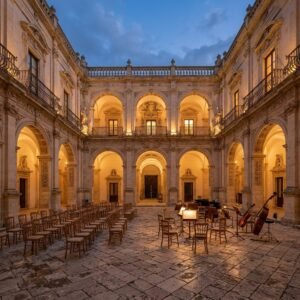
The Sanctuary is not just the main church. Behind the altar, there’s a small museum housing ex-votos and sacred objects of priceless value. It’s not huge, but every piece has a story. You’ll see painted tablets depicting miracle scenes, jewelry offered by the faithful over centuries, and finely embroidered liturgical vestments. Then, if you’re lucky and ask politely, you might gain access to the inner cloister, an almost secret corner of peace. Here, away from the noise, there are stone arches and a central well. It’s the ideal spot for a moment of reflection. There are often temporary exhibitions delving into aspects of local history or sacred art. I found a collection of ancient processional candles fascinating. Don’t overlook the sacristy either, where inlaid marbles tell of the craftsmanship of Trapani’s artisans. In short, take your time to explore every corner. There’s always something more to discover beyond the obvious.
Why Visit It
Three concrete reasons not to skip the Sanctuary of the Annunciation. First: it’s the spiritual and artistic heart of Trapani. Without seeing the Madonna of Trapani, you haven’t truly known the city. Second: admission is free, and on a trip where every euro counts, this is a pleasant exception. Third: it’s an oasis of tranquility just steps away from the lively Corso Vittorio Emanuele. After a morning of shopping or exploring the historic center, stepping inside here is like taking a deep breath. Plus, if you’re an art enthusiast, the statue is a rare example of well-preserved Italian Gothic art. And even if you’re not an expert, its beauty is immediate and needs no explanation. Finally, it gives you an authentic sense of Sicilian popular devotion, which blends faith with art and community.
When to go
The best time? Late morning, when sunlight streams through the stained glass windows and illuminates the nave. The colors from the windows project onto the marble, creating an almost theatrical effect. Avoid lunchtime, when it might be closed for a break. As for the time of year, I prefer spring or autumn. In summer, Trapani is extremely crowded, and the Sanctuary might also be overrun with tourist groups. In winter, on the other hand, there’s a more intimate atmosphere, but check the opening hours as they might be reduced. If you can, try to coincide with one of the minor celebrations, not necessarily the big August festival. You’ll see locals in prayer and better understand the connection between the city and this place. A Sunday morning, perhaps after the 11 a.m. mass, is perfect: there’s still some activity, but not the crowds.
In the Surroundings
After leaving the Sanctuary, don’t rush off. Just a two-minute walk away is the Pepoli Regional Museum, housed in a former convent. Here you’ll find a diverse collection ranging from archaeology to decorative arts, with particular attention to the history of Trapani. The crafted corals are unmissable, showcasing a local artisan tradition. Then, if you wish to continue with the religious-artistic theme, take a quick trip to the Church of Purgatory, where the Misteri di Trapani are kept, the majestic statues carried in procession during Holy Week. It’s another piece to understand the deep popular religiosity of this area. Both places are reachable on foot, without hurry, by walking through the historic center’s alleys.