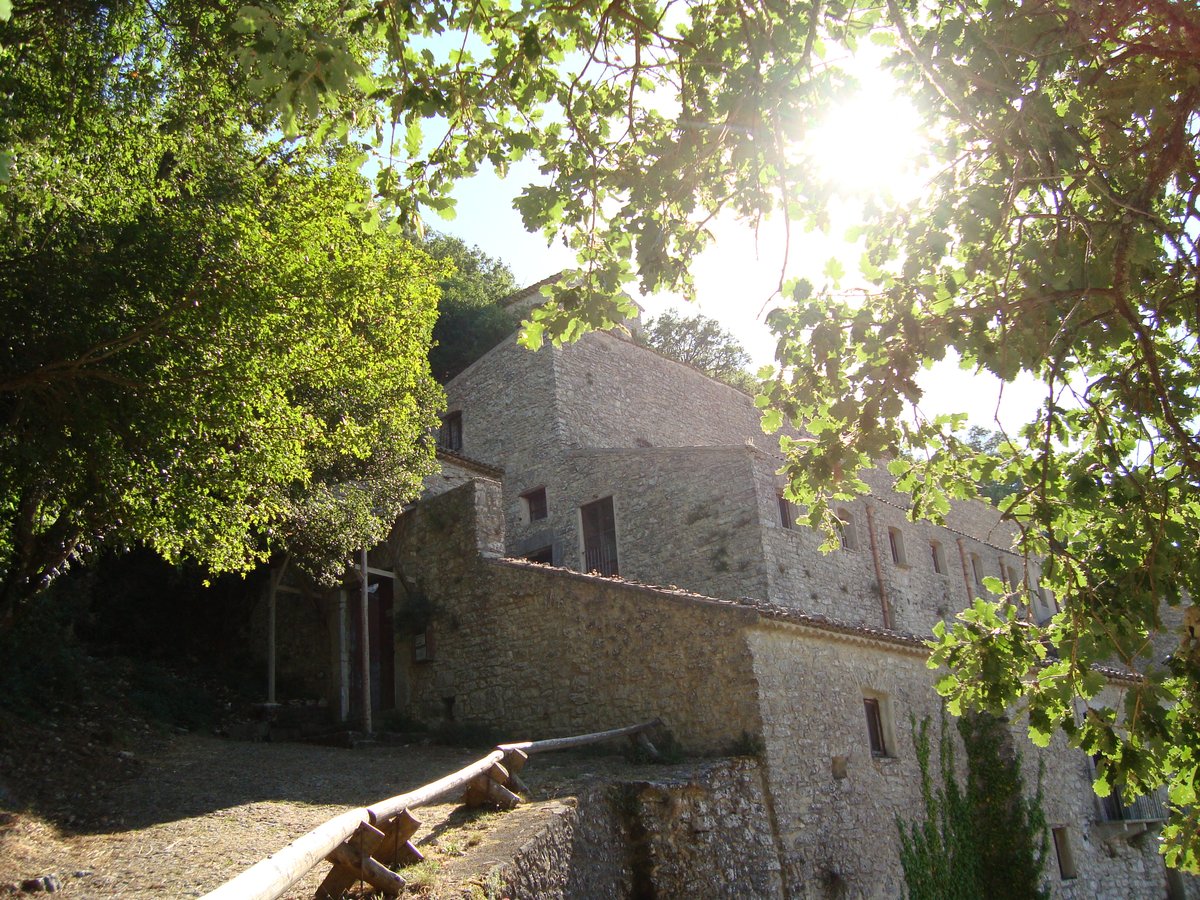
The Santa Rosalia Hermitage at Quisquina is a rock-hewn sanctuary carved into the Sicani Mountains at 800 meters above sea level. The visit includes a short walk through the woods leading to the natural cave with 17th-century frescoes and a simple altar, followed by a panoramic trail overlooking the surrounding valleys. The atmosphere is one of absolute peace, far from mass tourism, ideal for moments of contemplation in nature.
- Natural cave with 17th-century frescoes and altar where Saint Rosalia lived
- Panoramic trail with views over the valleys of the Sicani Mountains
- Atmosphere of silence and spirituality away from mass tourism
- Rock-hewn complex carved into the mountainside at 800 meters elevation
Introduction
The Hermitage of Santa Rosalia alla Quisquina is not just a place of worship; it’s an experience that catches you off guard. Perched at 800 meters above sea level on the Sicani Mountains, it appears almost like a mirage among limestone rocks and Mediterranean scrub. Getting there is already part of the adventure: a scenic road winding through curves and sudden glimpses, with Santo Stefano Quisquina appearing and disappearing in the distance. When you finally see it, you understand why Santa Rosalia chose this very spot to retreat: the silence is almost tangible, broken only by the wind through the holm oaks and, if you’re lucky, by the flight of a bird of prey. It’s not as majestic as the Baroque churches of Palermo, but it has an intimate atmosphere that makes you feel out of time. Personally, I was struck by how the contrast between the simplicity of the hermitage and the grandeur of the panorama creates a perfect balance. It’s not a place for those seeking luxury, but for those who want to breathe authenticity.
Historical Background
The history here is deeply intertwined with Saint Rosalia, the patron saint of Palermo. According to tradition, in the 12th century, the young noblewoman retreated to this rugged location to live in penance, finding refuge in a natural cave. The hermitage itself began to take shape after her death, when it became a pilgrimage destination. In the 17th century, during the plague in Palermo, her relics were carried in procession and the city was freed from the disease, solidifying the cult. Locals will tell you that for centuries, shepherds in the area have safeguarded and kept this place alive, adding small chapels and cells. What you see today is the result of centuries of popular devotion, with interventions ranging from the Middle Ages to the 19th century. This is not a story of kings and popes, but of ordinary people who kept a flame burning in the mountains.
- 12th century: Saint Rosalia retreats to the cave.
- 1624: The saint’s relics save Palermo from the plague, increasing pilgrimages.
- 17th-19th centuries: Construction and expansion of the hermitage structures.
- Today: A destination for pilgrims and tourists seeking spirituality and nature.
The Cave Sanctuary and Its Rocky Charm
The heart of the hermitage is the natural cave where Saint Rosalia lived. Entering it is a somewhat mystical experience: the space is small, damp, lit only by the faint light filtering through the entrance and a few candles. On the rock wall, you see ancient carvings, crosses, and ex-votos left by pilgrims over the centuries. There is a simple altar and a statue of the saint. What strikes you is not opulence, but the immediate sense of contemplation. Outside the cave, the complex unfolds with a seventeenth-century chapel, monks’ cells, and a courtyard with a well. Everything is built by utilizing the existing rock, almost camouflaged. Walking through these spaces, you notice the details: the stone floors worn by time, the wrought-iron grilles, the small windows framing pieces of sky. It seemed to me as if faith here had adapted to the mountain without overwhelming it. A tip: take a few minutes to sit in the courtyard and listen. The sound of water dripping from the rock is hypnotic.
The Panorama Trail
If the hermitage captivates you with its spirituality, the surroundings will enchant you with the view. Just behind the building, a well-marked dirt trail begins, climbing briefly up the mountainside. It’s not challenging, but comfortable shoes are recommended. In just a few minutes, you’ll reach a viewpoint that, honestly, is worth the trip alone. From there, your gaze sweeps over a green valley dotted with oak and olive groves, with the gentle profiles of the Sicani Mountains in the distance. On the clearest days, they say you can see all the way to the sea near Agrigento, but I wasn’t that fortunate. What I did see, however, was already spectacular: the silence broken only by the rustle of leaves and the clean air scented with aromatic herbs. It’s the perfect spot for a contemplative pause or to take photos that capture the essence of this inland Sicily, far from the crowds. Personally, I stayed longer than planned, almost losing track of time.
Why Visit
First, to experience an authentic journey off the beaten tourist track. Here you won’t find souvenir shops or queues, but the chance to connect with a genuine, rural Sicily. Second, for the unique contrast between spirituality and wild nature: within an hour, you can move from the subdued dimness of the cave to the dazzling light of mountain vistas, feeling both pilgrim and explorer. Third, for the tangible history you breathe in every stone: it’s not a museum, but a living place where popular devotion blends with legends, and where you can touch centuries of tradition. It’s a place that stays with you, more through sensations than facts.
When to go
The best time? Early afternoon in spring or early autumn. During these seasons, the light is golden and warm, perfect for illuminating the stone facade of the hermitage and enjoying the views without the summer heat. In summer, it can get very hot during the day, while in winter, although evocative with the mists enveloping the mountains, the damp cold of the cave might not be for everyone. I visited in late September and the atmosphere was magical: the fresh air, the colors of the vegetation beginning to change, and very few people. Another idea? Try to coincide with one of the local religious festivals, such as that of Santa Rosalia in September, to see the hermitage animated by the community, but check in advance as there might be more visitors.
In the Surroundings
To complete the experience, I recommend two nearby stops that connect with the history and flavors of this area. The first is Santo Stefano Quisquina, the village at the foot of the mountain. It’s worth a stroll through the historic center, with its cobblestone alleys and the Mother Church. Here you can taste local cheeses, especially the pecorino from the Monti Sicani, in one of the small dairies in the village. The second is the Monte Cammarata Oriented Nature Reserve, the highest protected area in the province. It’s not far and offers easy hiking trails through a forest of beech and maple trees, with the chance to spot wildlife like the peregrine falcon. It’s another way to immerse yourself in the rugged, beautiful nature of these mountains, perhaps after the spiritual visit to the hermitage.