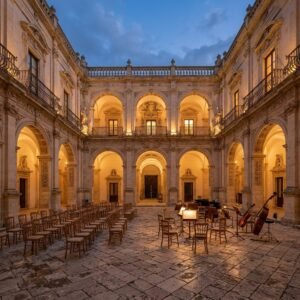
The Iblean Archaeological Museum in Ragusa, located in the heart of Ragusa Ibla within an 18th-century palace, offers a journey through the millennial history of the Iblean area with artifacts from local excavations and an accessible display for all visitors.
- Collection spanning from prehistoric to late Roman times with artifacts from Kamarina, Scornavacche, and Ragusa Ibla
- Section dedicated to Kamarina with red-figure and black-figure ceramics, funerary items, and underwater artifacts
- Modern display with clear labels and an intimate environment, suitable for families and non-experts
- Artifacts including votive statuettes, everyday tools, and evidence of exchanges with Greeks, Phoenicians, and Romans
Introduction
Entering the Iblean Archaeological Museum of Ragusa is like taking a leap back in time, but without the dust of history books. It welcomes you in an eighteenth-century palace, already a piece of art in itself, and you immediately understand that this isn’t just about display cases full of pottery shards. The setup is modern and engaging, with lights that seem to caress the artifacts, especially those from the excavations of Kamarina and other key sites in southeastern Sicily. There’s a quiet, almost intimate atmosphere that invites you to linger. It’s not one of those huge, sprawling museums that make you feel obliged to see everything in a hurry. Here, each room tells a precise story of the Iblean territory, and the feeling is that of discovering pieces of a puzzle that explain why this area of Sicily has such a layered charm. Personally, I was struck by how they manage to make antiquity dialogue with the elegance of the venue, creating an experience that stimulates the curiosity even of those who aren’t experts.
Historical Overview
The history of this museum is deeply intertwined with the desire to tell the profound roots of the Ragusa region. It did not come about by chance, but from a specific need to provide a home for the many artifacts that came to light during excavations in the province, especially from the post-World War II period onward. The collection formed gradually, welcoming the fruits of research campaigns at key sites such as ancient Kamarina, the Piano della Città necropolis in Ragusa Ibla, and the areas of Scornavacche and Monte Casasia. These findings tell a story spanning from prehistory to the late ancient era, passing through Greek, Roman, and Byzantine influences. It is fascinating to think that many of these objects were recovered right here, almost beneath our feet. The timeline below gives you an idea of the key moments that shaped the collection you see today.
The Treasures of Kamarina
One of the most captivating sections is undoubtedly the one dedicated to Kamarina, the ancient Greek colony on the coast. It’s not just about vases and amphorae; here, you can breathe in the life of a city that was an important crossroads. The red and black figure ceramics stand out, with a craftsmanship that makes you understand the artistic level achieved. But what truly impressed me are the funerary items from the necropolises: everyday objects that accompanied the deceased, such as bronze mirrors, unguent jars, and jewelry. They make you reflect on the beliefs and rituals of that time. There is also a selection of underwater artifacts, recovered from the sea in front of the colony, which add a touch of adventure to the visit. It’s as if the museum has captured not only the objects but also a piece of that people’s identity. A room not to be missed, even just to admire the delicacy of some decorations.
A Museum for Everyone
What I appreciate about this place is its accessibility. It’s not a sacred temple reserved for scholars. The labels are clear and not overly technical, and there are often visual aids that help contextualize the artifacts. I found it particularly suitable for families as well: there are no enormous halls to traverse, and the variety of objects (from prehistoric pottery shards to Roman oil lamps) can capture even the youngest visitors’ attention. The environment is calm, well-lit, and invites you to take your time. I noticed many visitors stopping to chat in front of the display cases, exchanging impressions—a sign that the museum successfully stimulates conversation. It may not have the monumentality of other major Sicilian archaeological museums, but precisely for this reason, it offers a more intimate and direct experience, where you can focus on the substance without distractions.
Why Visit It
For at least three concrete reasons. First, because it provides an essential key to understanding the Iblean territory: you see where the history of these places comes from, before the Baroque architecture and the countryside. Second, because the collection of artifacts from Kamarina is truly significant and well-presented, allowing you to approach one of the most important Greek colonies in southeastern Sicily without necessarily having to reach the archaeological site (which is still worth visiting). Third, for its practicality: it’s located in the center of Ragusa, easily combined with a visit to Ibla or a coffee break in the city. It’s a time investment that pays off in understanding the context. And, between us, after seeing many dusty museums, finding one so carefully curated in its display is a pleasant surprise.
When to go
The museum is open year-round, but in my opinion, it holds a special charm in the afternoon hours, especially on weekdays. The natural light filtering through the windows of the 18th-century building creates enchanting plays of light on the display cases, and there are fewer visitors, allowing you to enjoy it at a leisurely pace. I would avoid the midday hours during the hottest summer days, not because of the museum itself (which is air-conditioned), but because the walk to get there might be less pleasant. In autumn or spring, with beautiful, mild light, the experience is perfect: you step out of the museum and find yourself immersed in the atmosphere of Ragusa, ready to be explored. It’s one of those places that lends itself to a quiet, unhurried visit, perhaps as part of a day dedicated to culture.
In the Surroundings
After leaving the museum, I recommend getting lost in the streets of Ragusa Ibla, the UNESCO World Heritage Baroque quarter just a few minutes’ walk away (downhill, fortunately). It’s ideal for continuing your journey through time, moving from archaeology to eighteenth-century splendour. Alternatively, if you want to stay on the theme of antiquity, you could consider a trip to the Cava d’Ispica Nature Reserve, a canyon that houses prehistoric necropolises, catacombs, and cave settlements. It’s a place with strong landscape and historical appeal, completing the picture of human presence in this part of Sicily. Both options give you a different but complementary taste of the richness of the territory.