
The Monument to the Italian Sailor in Brindisi is an imposing 54-meter rudder-shaped structure, a symbol of the city. Inaugurated in 1933, it commemorates sailors who fell in war. Inside, the crypt-shrine holds the names of thousands of fallen soldiers. From the panoramic terrace, you can enjoy a spectacular view of the harbor and the Adriatic Sea.
- Height 54 m, rudder shape made of carparo stone and Trani stone
- Crypt with names of the fallen and bronze Stella Maris statue
- Open every day except Wednesday (monument) and also Thursday for the crypt
- Tickets: €3 adults, free for residents and under 10, reduced for groups
Events nearby


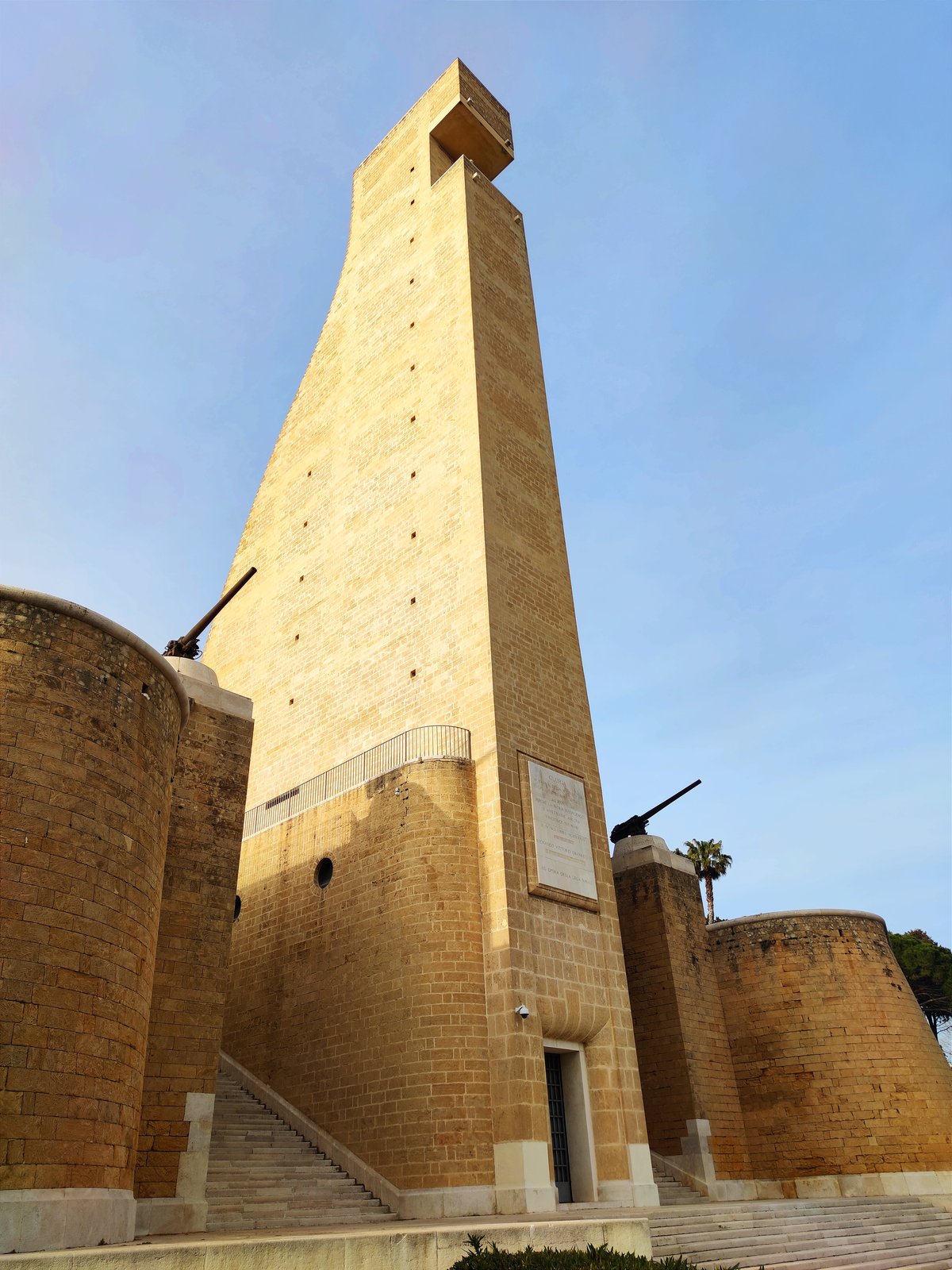
The Monument to the Italian Sailor in Brindisi is a 54-meter rudder overlooking the harbor. Inside the crypt, the names of 6,850 fallen soldiers. Panoramic view from the top. Ticket €3, free for residents and under 10.
- Piazzale Eroi di Tutte le Guerre, Brindisi (BR)
- Open in Google Maps
- View on Google Images Monumento al Marinaio d’Italia a Brindisi
Good to know
Evocative Introduction
If you arrive in Brindisi, you can’t miss it: the Monument to the Italian Sailor towers over the port like a giant 54-meter rudder. It’s impossible to remain indifferent before this mass of golden stone that seems to want to guide the city towards the sea. Climbing to the top, the view spans the port, the promenade, and all the way to the Adriatic. A breathtaking sight, especially at sunset when the warm light caresses the carparo stone. Inside and out, every detail speaks of the sea and memory.
Historical Notes
Inaugurated on November 4, 1933 in the presence of King Victor Emmanuel III, the monument was built to commemorate the 6,850 sailors who fell at sea since the unification of Italy. The design, winner of a national competition, is by Luigi Brunati and Amerigo Bartoli. Work lasted one year, at a cost of 2,300,000 lire. Beneath the base lies a crypt-shrine with the names of the fallen. Here are the key moments:
- October 28, 1932: start of work
- November 4, 1933: inauguration
- 1955: placement of the statue of the Madonna at the top
- 1965: votive altar for the fallen of World War II
- 2014: transfer to the Municipality of Brindisi
The Crypt-Sanctuary
Descending beneath the monument, you find yourself in a striking space: the crypt is 27 meters deep, shaped like an inverted hull, with pointed arches and black marble walls. Engraved there are the names of 6,850 fallen sailors since 1860. On the altar stands the bronze statue of the Madonna Stella Maris, a work by Bartoli. The crypt also houses the stern bell of the battleship Benedetto Brin, sunk in 1915 in the port of Brindisi and recovered in 1968. A place of contemplation that moves you with its sacred and maritime atmosphere.
The climb to the top
Climb to the top – via spiral staircase or elevator – and the view rewards every effort. From the terrace over 50 meters high, you can take in the port of Brindisi, the seafront, the Adriatic Sea and, on clear days, even the airport. The structure is entirely clad in carparo, a golden stone that lights up with warm reflections at sunset. It’s the perfect spot for a souvenir photo or simply to enjoy the salty breeze.
Why Visit It
Two solid reasons: first, it’s a unique monument – a 54-meter rudder you can explore inside and out, with amazing views. Second, it’s cheap: €3 for adults, free for under 10s and residents. If you’re passing through, it’s worth every cent. Plus, with the €5 combo ticket you can also visit the Tempietto di San Giovanni al Sepolcro, another hidden gem in Brindisi. A must for history lovers and fans of unusual architecture.
When to Go
The best time? Late afternoon, around sunset. The low light gives the carparo stone amber hues, and the view of the harbor becomes spectacular. Keep an eye on the hours: the monument is open from 10:00 AM to 4:40 PM (closed on Wednesdays), the crypt from 8:00 AM to 4:00 PM (closed Wednesday and Thursday). It’s best to arrive about an hour before closing to enjoy the climb without rushing. If you come in summer, the warm sun makes the experience even more pleasant.
Nearby
After your visit, I recommend two nearby stops. Just a few steps away, the Tempietto di San Giovanni al Sepolcro, a circular Norman-era church worth a detour (combo ticket!). For a relaxing walk, the Brindisi Waterfront with its bars and restaurants: perfect for an aperitivo with a view of the harbor. If you have time, the historic center with the Swabian Castle and the cathedral are a short walk away.
Itineraries nearby


💡 Did You Know…?
The people of Brindisi affectionately call the monument ‘la jatta ‘ssittata’ (the sitting cat) due to its shape. In 1968, during harbor dredging, the bell of the battleship Benedetto Brin, sunk in 1915, was recovered and is now kept in the crypt. A piece of history that moves every visitor.