Alfonsino Castle of Brindisi: The Aragonese Fortress Dominating the Port

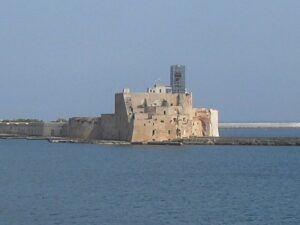
Alfonsino Castle, or the Sea Castle, is a 15th-century Aragonese fortress built on an artificial island at the entrance to Brindisi’s port. Constructed at the behest of Ferdinand I of Aragon, it was part of a defensive system with the nearby Land Castle. Today, it is a symbol of the city, accessible through guided tours that depart from the waterfront.

• 15th-century Aragonese fortress on an artificial island
• Part of the defensive system with the Land Castle
• Panoramic views of the port and Brindisi’s waterfront
• Guided tours departing from the city center


Events nearby


Copertina itinerario Alfonsino Castle of Brindisi: The Aragonese Fortress Dominating the Port
The 15th-century Aragonese fortress, also known as the Sea Castle, protected the port of Brindisi. It can be visited along with the Land Castle, offering panoramic views of the waterfront and the city’s military history.

Good to know


Introduction

The Alfonsino Castle of Brindisi is not just a fortress: it is a silent guardian of the harbor that for centuries has watched the comings and goings of ships and people. Approaching from the seafront promenade, its imposing structure of light-colored stone immediately strikes you, seeming almost to emerge from the waters. It is also called the Sea Castle, and you understand why: it was built on an artificial islet, connected to the mainland by a bridge. The view from its patrol walkway is pure magic: on one side, the historic harbor bustling with life; on the other, the open sea stretching to the horizon. Personally, I have always been fascinated by it as a boundary place, between land and water, between past and present. It is not the typical fairy-tale castle, but has a rugged, military character that tells of a strategic and combative Brindisi.

Historical Background

The history of Alfonsino Castle is closely tied to the Aragonese domination of Southern Italy. It was commissioned by Ferdinand I of Aragon in 1481 specifically to strengthen the defenses of the port of Brindisi, which was then vital for trade with the East. It was not an isolated structure: it formed a defensive system with the Castle of Terra on the coast, creating a pincer-like defense. Over the centuries, it has witnessed armies passing through, withstood sieges (such as that by the Venetians in 1528), and was adapted to new military technologies with the addition of bastions and gun emplacements. During World War II, it was used as a military post. Today, after careful restoration, it is finally open to visitors and tells the story of these historical layers.

  • 1481: Construction begins at the behest of Ferdinand I of Aragon.
  • 1528: Withstands the assault by the fleet of the Republic of Venice.
  • 16th-17th centuries: Expansions and adaptations to new artillery.
  • World War II: Used as a defensive position.
  • Recent restorations: Reopened to the public and enhanced for visitors.

The Fortress on the Sea

Visiting Castello Alfonsino means walking through a fortress designed for the sea. There are no lavish halls, but functional and powerful spaces. You are immediately struck by the cannon emplacements facing the harbor, still clearly visible: from there, every vessel entering or leaving was monitored. Climbing onto the bastions, the wind brushes your face and the view stretches 360 degrees. To the north, you see the skyline of Brindisi’s historic center with the Roman Column; to the south, the channel entrance to the port and, on clear days, the Salento coast is glimpsed. Inside, the rooms are sober, sometimes a bit bare, but it is precisely this essentiality that makes you understand its military nature. I like to imagine the sentries on guard centuries ago, with their eyes fixed on the horizon, awaiting friendly or enemy sails.

A Perfect Pair: Alfonsino and Svevo

One of the smartest things you can do in Brindisi is visit both castles together. With the same ticket, you move from the sea fortress to the land fortress, the Svevo Castle (or Castle of Terra). It’s a fascinating contrast. The Alfonsino is completely oriented toward the water, while the Svevo, older and more massive, is rooted in the city. The visit allows you to understand how the city’s integrated defensive system worked. From the Svevo, by the way, you set off to reach the Alfonsino with a short walk along the dock, a stretch that already immerses you in the port atmosphere. I recommend dedicating time to both: if the Alfonsino offers you views, the Svevo tells you about Frederick II and medieval Brindisi. Together, they compose a complete story.

Why Visit It

For at least three concrete reasons. First: to experience a unique viewpoint on Brindisi. From Alfonsino Castle, you see the city as ship captains once did, from the water. Second: to witness firsthand 15th-century military engineering. The quadrangular layout with angular bastions is a clear example of how a strategic port was defended. Third: to understand Brindisi’s identity as a port city. Its history is made of arrivals and departures, exchanges and defenses, and this castle is its most tangible symbol. It’s not just an old stone structure; it’s the key to understanding the city’s relationship with its sea.

When to Go

The best time? Late afternoon, especially in spring or early autumn. The light turns golden, the sun sets toward the sea, and the reflections on the water make everything more evocative. In summer, the midday hours can be very hot and crowded. In winter, on the other hand, clear-sky days offer a melancholic and authentic atmosphere, with few visitors. A personal preference of mine: go just before sunset. Seeing the harbor lights turn on as the sky turns orange is a spectacle that alone makes the trip worthwhile.

In the Surroundings

A visit to the Alfonsino Castle pairs perfectly with another Brindisi experience: a stroll through the historic center to Virgil’s Staircase and the Roman Column, the city’s symbol. It’s a pleasant walking route that takes you from the Middle Ages to ancient Rome. Alternatively, if you want to stay on the “water” theme, you can take a boat tour of the inner and outer harbor on one of the small boats departing from nearby docks. This offers a different perspective, from below, on the fortress’s grandeur. Two complementary ways to discover Brindisi.

Itineraries nearby


💡 Did You Know…?

The castle was built between 1481 and 1492 based on a design by military architect Francesco di Giorgio Martini. During World War II, it was used as an Italian naval base and suffered damage from bombings. Today, restoration work has uncovered the original cannons facing the sea, testifying to its strategic function.