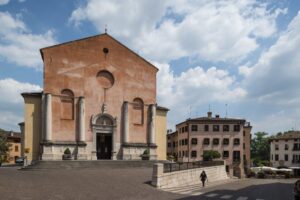
Patriarchal Palace of Udine: Giovanni da Udine’s Golden Staircase and Renaissance Frescoes

The Patriarchal Palace of Udine, built from 1517, is a Renaissance jewel housing artistic masterpieces and the Diocesan Museum. Located steps from Piazza Libertà and the Castle, it offers a tranquil atmosphere away from tourist crowds.

  • Golden Staircase with stuccoes and frescoes by Giovanni da Udine, a pupil of Raphael
  • Frescoed halls on the noble floor with works by Pomponio Amalteo and other Friulian masters
  • Diocesan Museum and Tiepolo Galleries with frescoes by Giambattista Tiepolo
  • Gallery of Ancestors with portraits of patriarchs and Red Hall for audiences

Copertina itinerario Patriarchal Palace of Udine: Giovanni da Udine's Golden Staircase and Renaissance Frescoes
Renaissance residence of the Patriarchs of Aquileia featuring Giovanni da Udine’s Golden Staircase, frescoes by Pomponio Amalteo, and the Diocesan Museum with works by Tiepolo. Episcopal seat in the heart of Udine.

Good to know


Introduction

The Patriarchal Palace of Udine is not just a historic building, but the beating heart of this Friulian city. As soon as you step into its courtyard, you’re enveloped in an atmosphere of quiet majesty, far removed from the bustle of the central streets. Its Renaissance architecture, with its portico and loggia, immediately transports you to another era. It’s not a cold, distant museum, but a living place that tells centuries of history through its walls and frescoes. If you love art and history, you’ll find plenty to feast on here, but also simply a peaceful corner where you can breathe in the essence of Udine. It’s the ideal starting point for understanding the city, as this is where the Patriarchs of Aquileia passed through, leaving an indelible mark. Prepare to be awestruck by the masterpieces of Giovanni da Udine and Pomponio Amalteo that adorn the interior halls.

Historical Overview

The history of the palace begins in 1517, when the Patriarch of Aquileia, Daniele Delfino, decided to build a residence worthy of his role in Udine. Construction continued under various patriarchs, but it was especially under Giovanni Grimani in the second half of the 16th century that the palace took on the majestic appearance we see today. Grimani, a great patron of the arts, called upon leading artists to decorate the halls, transforming it into a Renaissance jewel. After the suppression of the Patriarchate of Aquileia in 1751, the palace passed to the Archdiocese of Udine, becoming the archiepiscopal seat. Today it houses the Diocesan Museum and Tiepolo Galleries, which safeguard sacred artworks and the celebrated frescoes by Giambattista Tiepolo. It is not just a monument, but a silent witness to the power and culture that have shaped Friuli.

  • 1517: Construction begins at the behest of Patriarch Daniele Delfino.
  • Mid-16th century: Expansion and decoration under Patriarch Giovanni Grimani.
  • 1751: Suppression of the Patriarchate; the palace becomes the archiepiscopal seat.
  • Today: Home to the Diocesan Museum and Tiepolo Galleries.

The Ancestors’ Gallery and the Frescoes

One of the most emblematic rooms is the Ancestors’ Gallery, located on the first floor. Here, a series of portraits of patriarchs guides you on a journey through time, from the most ancient figures to the more recent ones. But the true visual impact comes with the frescoes. In the Red Hall, dedicated to audiences, you can admire the works of Giovanni da Udine, a pupil of Raphael, who brought the Roman Renaissance style to Udine. His putti, festoons, and grotesque decorations display extraordinary lightness and elegance. Then there are the rooms frescoed by Pomponio Amalteo, with biblical and allegorical scenes that narrate stories of faith and power. Every detail, from the ceilings to the fireplaces, is meticulously crafted. These are not merely decorations but a true iconographic program intended by the patriarchs to celebrate their authority. Walking through these halls is like reading an open book on art history.

The Diocesan Museum and its Hidden Treasures

Housed within the palace is the Diocesan Museum and Tiepolo Galleries, a true concentration of Friulian sacred art. The collection spans from the Middle Ages to the 18th century, featuring works by local and other artists. Here you can see altarpieces, wooden sculptures, sacred vestments, and liturgical objects that tell the story of the region’s devotion and craftsmanship. But the highlight is undoubtedly the frescoes by Giambattista Tiepolo, which decorate the staircase and some rooms. His pictorial cycles, with scenes from the Old Testament and allegories, are sublime examples of Venetian Rococo. The light, colors, and mastery in rendering the figures leave you breathless. The museum isn’t huge, but it’s incredibly rich: each object has a story, often linked to local churches and convents. It’s a dive into the spirituality and art of Friuli, perfect for those who want to go beyond the surface.

Why Visit It

Visiting the Patriarchal Palace is worthwhile for at least three concrete reasons. First, the Renaissance and 18th-century frescoes are of absolute quality: seeing the works of Giovanni da Udine, Pomponio Amalteo, and Tiepolo in person is an experience that books cannot provide. Second, the palace offers a comprehensive historical journey: from its construction as the seat of patriarchal power to its transformation into a museum, you can understand the evolution of Udine and Friuli. Third, it is a tranquil and intimate place, ideal for a visit without crowds, where you can linger over the details. Additionally, the admission ticket includes access to the Diocesan Museum, giving you double the value. Perfect for art enthusiasts, but also for those seeking an immersion in local history without too many frills.

When to Go

The best time to visit the palace is in the morning, shortly after opening, when natural light streams through the windows and illuminates the frescoes, offering more vivid colors and a captivating atmosphere. Additionally, you’ll avoid the larger groups that typically arrive midday. As for the time of year, spring and autumn are ideal: the mild climate allows you to also enjoy the inner courtyard and surrounding area without summer heat or winter chill. On weekdays, the visit is even more tranquil and personal. Avoid Mondays, when the museum is closed, and always check the official website for any schedule changes.

In the Surroundings

After visiting the Patriarchal Palace, you can explore other gems of Udine just a short walk away. A must-see is the Udine Castle, which overlooks the city from the hill: here you’ll find civic museums, a breathtaking panoramic view, and other frescoed halls. For a thematic experience related to art, head to the Church of Santa Maria di Castello, also in the city center, which houses works by Friulian artists and offers an intimate atmosphere. If instead you want a taste of local life, make a stop at the Matteotti Square Market, where you can find typical products and breathe in the daily air of the city. All these places are reachable on foot in a few minutes, enriching your day in Udine without the need for long journeys.

Itineraries nearby


💡 Did You Know…?

Not everyone knows that the palace houses the Throne Room, where the patriarchs received delegations. The frescoes of the Golden Staircase, created by Giovanni da Udine, show grotesques and vegetal motifs inspired by Raphael’s Loggias in the Vatican, a direct link to Rome. In a side room, a fresco depicts a Marcian lion, symbol of the Serenissima, a witness to Venetian rule over the city. The visit offers unique glimpses of the inner courtyard, with its central well and the quiet atmosphere that contrasts with the liveliness of the surrounding streets.