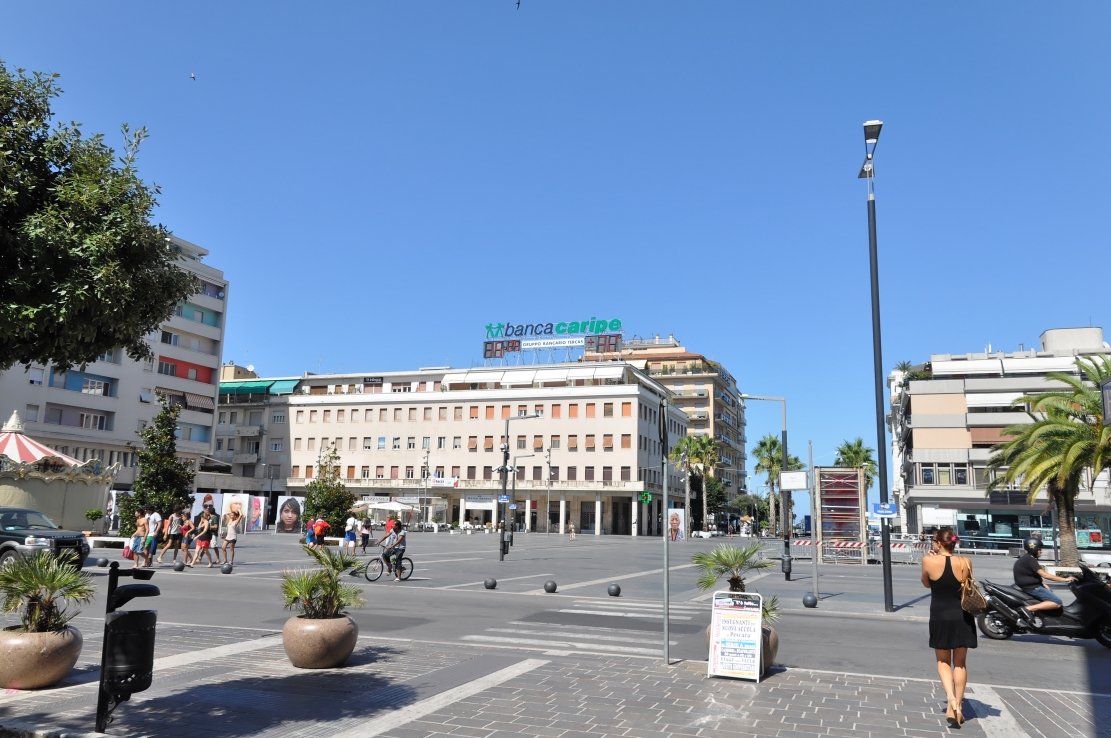
Piazza della Rinascita, affectionately called Piazza Salotto by the people of Pescara, is the true nerve center of the city. Here you can breathe the lively atmosphere of Pescara, between rationalist architecture and proximity to the Adriatic Sea.
• Monumental fountain: The symbol of the square, with water features that create a suggestive atmosphere, especially in the evening.
• Characteristic arcades: Perfect for a shaded stroll, they host historic cafés and shops.
• Strategic location: Just steps from the seafront and the main street, it allows you to reach the main attractions on foot.
• City life: The ideal place to observe the daily life of Pescara’s residents and savor the local atmosphere.
Introduction
As soon as you arrive in Pescara, Piazza della Rinascita welcomes you with an energy you feel immediately. It’s not just a square, it’s truly the city’s living room, the point where everything seems to converge. The first thing that strikes you is its oval shape, wide and airy, with the arcades framing it like an embrace. And then there it is, the monumental fountain at the center, with its water features that, when you see them, make you understand you’re at the heart of things. From here, in a moment, you’re in the historic center or you find yourself on the seafront promenade, with that scent of salt air already calling you. It’s a place that doesn’t just get crossed: it invites you to stop, to look around, to feel part of the city.
Historical Notes
The history of this square is closely tied to Pescara’s rebirth after the war. Previously, there was a maze of narrow alleys, but after World War II, it was decided to create a modern space, symbolizing a city looking to the future. The project, initiated in the 1930s and completed after the conflict, aimed to give a new face to the city center. The fountain, with its sculptures representing local rivers, was added later, quickly becoming the focal point. It’s not an ancient square, but it perfectly tells
the spirit of reconstruction and vitality that characterized Pescara in the 20th century.
- Before the 20th century: area occupied by a network of narrow streets in the historic center.
- 1930s: start of planning for a modern square as part of urban reorganization.
- Post-World War II: completion of the square as a symbol of the city’s rebirth, from which it takes its name.
- Subsequent decades: the square becomes the main meeting place and venue for community events.
Life Under the Porticoes
The porticoes of Piazza della Rinascita are not just shelter from the sun or rain. They are a microcosm of city life. Under those arches, you can find everything: historic cafés where people stop for an espresso watching the comings and goings, small shops selling local products, and often temporary stalls with handicrafts. I love sitting in one of those bars, perhaps at the ‘Gran Caffè’, and observing. In the morning, it’s a bustle of fishermen returning and people heading to work; in the afternoon, it fills with families and tourists; in the evening, especially in summer, it becomes an informal meeting point. It’s there that you understand the rhythm of the city, that mix of daily routine and tourist welcome that blends effortlessly. The porticoes truly give the feeling of a protected place where you can linger without hurry.
The Fountain and Its Meaning
The fountain is not just a decorative element. It is a sculpture that speaks of the territory. The figures represent the Aterno and Pescara rivers, which meet here before flowing into the Adriatic Sea. Looking at it up close, you notice the details of the shapes, that flow of water that seems to tell the geographical story of the area. During the day, with the sun reflecting on the splashes, it is bright and lively; in the evening, when it is illuminated, it takes on an almost theatrical atmosphere. For me, it is the perfect symbol of Pescara: a city where water – that of the rivers and that of the sea – is a foundational element. Sometimes I wonder if those who pass by in a hurry ever stop to notice these details. It’s worth doing, because it adds an extra layer of meaning to the place.
Why Visit It
Visiting Piazza della Rinascita is practically a must for three concrete reasons. First, it’s the best orientation point in the city: from here, the main streets to the historic center (like Corso Manthonè) start, and in just a few steps you’re on the seafront, so you can easily plan your day. Second, it’s an authentic place to see the life of Pescara’s residents, not a sterile postcard: people meet, chat, and live here. Third, it often hosts small spontaneous events or markets, especially on weekends, so you might stumble upon something unexpected and pleasant. In short, it’s not a checklist stop, but an experience that makes you feel immediately part of the city.
When to Go
The best time? Definitely late afternoon, around aperitivo hour. The sun begins to set, the light turns golden, and a warm, relaxed atmosphere emerges. The venues under the porticos come alive, the fountain is lit up, and you can hear a cheerful buzz of voices. In summer, with long evenings, it’s magical: the sea breeze reaches the square, and the air becomes cool. In winter, on clear sunny days, the porticos shelter from the wind, and the square remains lively. I’d perhaps avoid the midday hours on a sweltering August day when the heat can be intense—but even then, everything transforms in the evening.
In the Surroundings
From Piazza della Rinascita, two nearby experiences enrich the visit. One is getting lost in the network of Corso Manthonè, the street that starts from the square and delves into the historic center: it’s full of artisan shops, wine bars, and ancient buildings, a perfect contrast to the modernity of the square. The other is reaching the Ponte del Mare, the pedestrian and cycling bridge over the Pescara River: from the square, you can get there with a short walk along the corso, and from there, you have an incredible panoramic view of the river mouth and the sea. They are two sides of the same coin: history told by the stones and openness towards the coastal landscape.