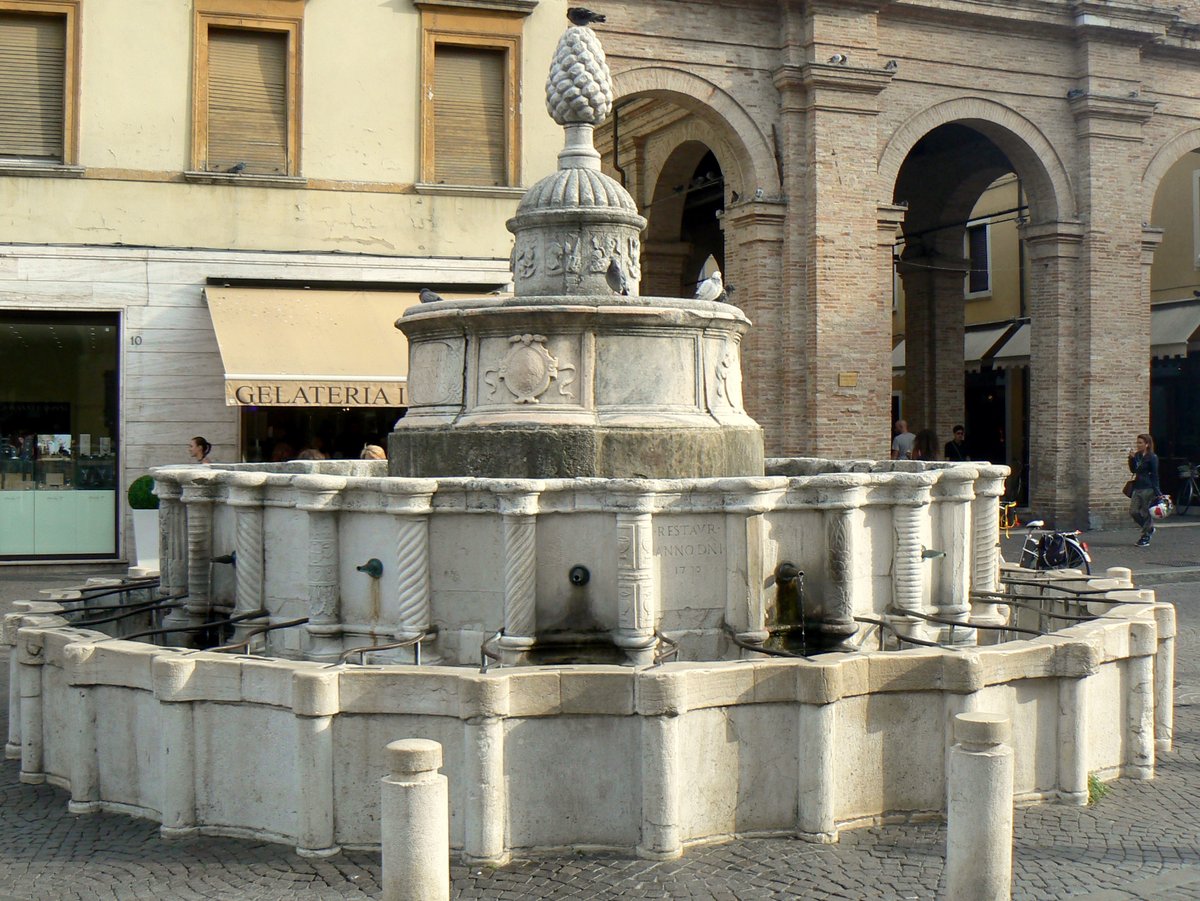
The Pigna Fountain is a Renaissance jewel from 1543 in the heart of Rimini, created by Giovanni da Carrara. With its basin in white Verona marble and the statue of Saint Paul added in 1616, it represents an authentic piece of the city’s history. Located in Piazza Cavour, it offers a peaceful corner ideal for a break during your visit to the historic center, just steps away from other attractions like the Malatesta Temple and Galli Theatre.
Introduction
Do you ever find yourself walking through Rimini’s historic center and feeling the need for a break? Well, the Fontana della Pigna is the perfect spot. It’s not just a fountain; it’s a small Renaissance gem that transports you back in time, right in the heart of the city. You’ll see it there, in Piazza Cavour, with its elegant white marble basin and the statue of Saint Paul that seems to watch over the square. I like to think of it as an oasis of peace, a corner where you can pause for a moment, perhaps after exploring the nearby Tempio Malatestiano. The flowing water has a soothing sound, almost inviting you to sit on a bench and observe life passing by. It’s not as monumental as other Italian fountains, but it has a discreet, somewhat hidden charm that makes it special. If you’re in Rimini, don’t just glance at it in passing: take five minutes to appreciate the details, like the acanthus leaf decorations or the octagonal base. It’s one of those places that, if you pay attention, leaves a lasting impression.
Historical Background
The history of this fountain is closely intertwined with that of Rimini. It was built in 1543 based on a design by Giovanni da Carrara, a local architect, to celebrate the completion of the city’s aqueduct. Before that, water supply was irregular, and this fountain represented a significant advancement for the city. The statue of Saint Paul that crowns it is not the original: it was added in 1616, replacing a previous pinecone (from which the fountain gets its name) that had become damaged. Interestingly, for centuries it was one of the main water supply points for the people of Rimini. I like to imagine the women who came here to fetch water, chatting among themselves. Today, after a restoration in the 1990s, it stands in all its splendor, a silent witness to centuries of history.
- 1543: Construction of the fountain based on Giovanni da Carrara’s design.
- 1616: Addition of the statue of Saint Paul, replacing the original pinecone.
- 1990s: Major restoration that reinforced its structure.
The Water That Unites
What perhaps not everyone knows is that the Fontana della Pigna was never just an ornament. For centuries, it was the most important public water source in Rimini. Before the arrival of modern aqueducts, people came here to fill buckets and jugs. This gives it incredible social value: it was the place where the community gathered, exchanged a few words, and perhaps caught up on the latest news. Even today, if you pay attention, the surrounding square is a meeting point. The fountain, with its constant flow, seems to keep this tradition of gathering alive. I like to see it this way: not as a static monument, but as a living element that continues to unite people, even if today it does so differently, perhaps by attracting curious tourists or locals stopping for a break.
A detail not to be missed
When you observe it up close, try looking at the base of the basin. You’ll notice acanthus leaf decorations carved into the marble. They are a classic Renaissance motif, but here they have something special: they almost seem to move with the water. The artisans of the time did exquisite work, bringing the stone to life. It’s a detail you can only appreciate by truly being close to it, not in a hurry. Every time, I wonder how long it took them to create these, and with what tools. Then, raise your gaze towards the statue of Saint Paul: he holds a sword and a book, symbols of his martyrdom and preaching. It’s an imposing figure that has dominated the square for over four centuries. These small details make the visit much more interesting than a simple glance.
Why Visit It
First, because it’s an authentic piece of Renaissance history from Rimini, not a reconstruction. You can breathe the air of the 1500s, and it’s free. Second, for its strategic location: it’s in the heart of the historic center, just steps away from other attractions like the Malatesta Temple or the Galli Theater. This makes it a perfect, almost mandatory stop on any walking itinerary in Rimini. Third, for the atmosphere: the square is often lively, with occasional markets or simply people strolling. The fountain becomes the focal point of this hustle and bustle, a fixed point amidst the movement. Visiting it gives you an authentic snapshot of city life, as well as a pleasant moment of pause.
When to Go
My advice? Visit in the early morning or late afternoon. The light is softer, and the sun’s rays gently caress the white marble of the fountain, creating beautiful plays of shadow. During these hours, the square is also less crowded, allowing you to enjoy it more peacefully. If possible, avoid the lunchtime rush during peak season. In winter, with a bit of luck, you might find it wrapped in a more intimate atmosphere, perhaps with some Christmas decorations nearby. In any case, it’s visitable year-round, but the best time for a photo or simply to be there in tranquility is when the crowds thin out.
In the Surroundings
Once you’ve taken a look at the fountain, take a few steps and reach the Malatesta Temple. It’s just a minute’s walk away, and the contrast is striking: from the Renaissance simplicity of the fountain to the grandeur of this Renaissance jewel, designed by Leon Battista Alberti. The interior is a spectacle. Then, if you’re in the mood for a livelier experience, head to the nearby Covered Market (in Piazza Cavour or the adjacent streets, depending on the day). Here you can sample some local specialties, like piadina, or simply immerse yourself in the colors and scents of Emilia-Romagna. These are two experiences that perfectly complement your visit to the fountain: art, history, and flavor, all within walking distance.