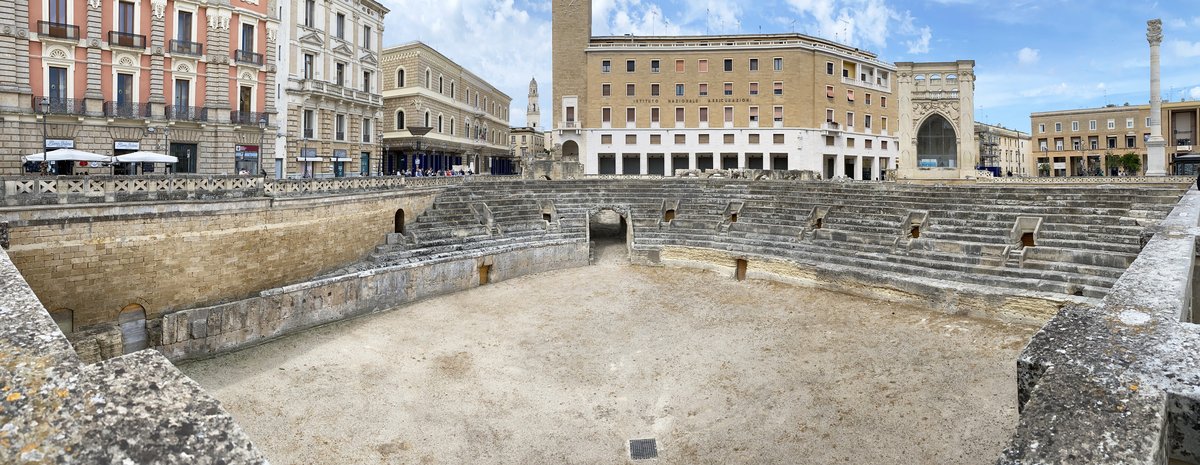
The Roman Amphitheatre of Lecce is a national monument in the heart of the city, in Piazza Sant’Oronzo. Dating back to the Augustan age, it could hold up to 25,000 spectators and was used for gladiator fights and animal hunts. After a restoration in 2023, it is once again open to visitors, offering a unique experience in the historic center.
Central location: in Piazza Sant’Oronzo, steps away from Lecce’s Baroque architecture.
Historic capacity: up to 25,000 spectators, among the largest in Italy.
Recent restoration: reopened in 2023 with new accessible pathways.
Summer events: concerts and shows in the ancient arena.
Introduction
Walking through Piazza Sant’Oronzo, you suddenly find yourself in front of a stone giant emerging from the ground. The Roman Amphitheater of Lecce is like that: it appears suddenly, set between baroque palaces and churches, reminding you that under the modern city lies an ancient Lupiae. Only one third of the original structure remains, but it’s enough to leave you breathless. The steps, the tuff pillars, the elliptical arena: everything speaks of a glorious past. And the best part is that it’s not a dusty museum: here history is still alive, blended with the daily life of the square.
Introduction
Walking through Piazza Sant’Oronzo, you suddenly find yourself in front of a stone giant emerging from the ground. The Roman Amphitheater of Lecce is like that: it appears suddenly, set between baroque palaces and churches, reminding you that under the modern city lies an ancient Lupiae. Only one third of the original structure remains, but it’s enough to leave you breathless. The steps, the tuff pillars, the elliptical arena: everything speaks of a glorious past. And the best part is that it’s not a dusty museum: here history is still alive, blended with the daily life of the square.
Historical Background
Built between the 1st and 2nd centuries AD, the amphitheater was commissioned by
Augustus himself to thank Lupiae for the hospitality he received after Caesar’s assassination. It could hold up to
25,000 spectators (some sources say 20,000) and was the center of Roman social life: gladiatorial fights, animal hunts (venationes), public executions. After the fall of the Empire, it fell into ruin and was stripped of its materials. Only in 1901, during work for the Bank of Italy,
Cosimo De Giorgi brought it back to light. Since 2014 it has been managed by the Ministry of Culture.
- 1st century BC–2nd century AD: construction under Augustus and Hadrianic restorations
- Middle Ages: stripping and abandonment, materials reused in the crypt of Otranto
- 1901–1940: excavations by Cosimo De Giorgi
- 2023: reopening after restoration
Historical Background
Built between the 1st and 2nd centuries AD, the amphitheater was commissioned by
Augustus himself to thank Lupiae for the hospitality he received after Caesar’s assassination. It could hold up to
25,000 spectators (some sources say 20,000) and was the center of Roman social life: gladiatorial fights, animal hunts (venationes), public executions. After the fall of the Empire, it fell into ruin and was stripped of its materials. Only in 1901, during work for the Bank of Italy,
Cosimo De Giorgi brought it back to light. Since 2014 it has been managed by the Ministry of Culture.
- 1st century BC–2nd century AD: construction under Augustus and Hadrianic restorations
- Middle Ages: stripping and abandonment, materials reused in the crypt of Otranto
- 1901–1940: excavations by Cosimo De Giorgi
- 2023: reopening after restoration
Architecture and Curiosities
The amphitheater is a blend of engineering and art: dimensions of 102 x 83 meters, arena of 53 x 34. The Leccese stone pillars supported 68 arches, of which only 24 remain today. The parapet (podium) separating the arena from the cavea was covered in marble with reliefs of hunting scenes: bears, lions, bulls, elephants. Some of these reliefs are now at the Castromediano Museum. A curiosity: after its discovery, the amphitheater was considered an obstacle to the city’s decorum, and its cleaning was entrusted to a florist, who in exchange could sell plants on the stands. During the 2023 restoration, the median ambulatory was made accessible for the first time.
Architecture and Curiosities
The amphitheater is a blend of engineering and art: dimensions of 102 x 83 meters, arena of 53 x 34. The Leccese stone pillars supported 68 arches, of which only 24 remain today. The parapet (podium) separating the arena from the cavea was covered in marble with reliefs of hunting scenes: bears, lions, bulls, elephants. Some of these reliefs are now at the Castromediano Museum. A curiosity: after its discovery, the amphitheater was considered an obstacle to the city’s decorum, and its cleaning was entrusted to a florist, who in exchange could sell plants on the stands. During the 2023 restoration, the median ambulatory was made accessible for the first time.
Life and Spectacles
What happened here two thousand years ago? In the morning, venationes took place: exotic animals imported from the port of San Cataldo (built by Hadrian for this purpose) were made to fight each other or against hunters. In the afternoon, it was time for the munera gladiatoria, the gladiatorial combats. The acoustics must have been incredible, and the crowd rowdy. Today the amphitheatre comes alive in summer with concerts and theatrical performances: deep down, its soul hasn’t changed. One detail: beneath the arena there was a hypogeum for machinery and gladiators, which is no longer visible but remains part of its history.
Life and Spectacles
What happened here two thousand years ago? In the morning, venationes took place: exotic animals imported from the port of San Cataldo (built by Hadrian for this purpose) were made to fight each other or against hunters. In the afternoon, it was time for the munera gladiatoria, the gladiatorial combats. The acoustics must have been incredible, and the crowd rowdy. Today the amphitheatre comes alive in summer with concerts and theatrical performances: deep down, its soul hasn’t changed. One detail: beneath the arena there was a hypogeum for machinery and gladiators, which is no longer visible but remains part of its history.
Why Visit
Three good reasons not to miss it. 1. Unique of its kind: an amphitheatre emerging in the middle of a busy square, a contrast that strikes you. 2. Honest price: costs only €5, and the view from the square is free. 3. Two in one: 300 meters away is the Roman Theatre, another hidden gem. Plus, at MUST you can see a model of ancient Lupiae. And if you have time, at the Castromediano Museum you’ll find the head of Augustus and the original reliefs from the amphitheatre. A real dive into history.
Why Visit
Three good reasons not to miss it. 1. Unique of its kind: an amphitheatre emerging in the middle of a busy square, a contrast that strikes you. 2. Honest price: costs only €5, and the view from the square is free. 3. Two in one: 300 meters away is the Roman Theatre, another hidden gem. Plus, at MUST you can see a model of ancient Lupiae. And if you have time, at the Castromediano Museum you’ll find the head of Augustus and the original reliefs from the amphitheatre. A real dive into history.
When to Go
The best time? Late afternoon, when the sunlight bathes the Lecce stone in warm hues and shadows stretch among the arches. In winter it’s more intimate, with fewer tourists; in summer, the amphitheater comes alive with events: concerts and performances that let you relive the ancient atmosphere. If possible, choose a weekday, so the square is quieter. Avoid the midday hours in summer: the sun beats down hard on the arena.
When to Go
The best time? Late afternoon, when the sunlight bathes the Lecce stone in warm hues and shadows stretch among the arches. In winter it’s more intimate, with fewer tourists; in summer, the amphitheater comes alive with events: concerts and performances that let you relive the ancient atmosphere. If possible, choose a weekday, so the square is quieter. Avoid the midday hours in summer: the sun beats down hard on the arena.
Nearby
Just a stone’s throw away is the Roman Theatre on Via degli Ammirati: another Roman site, smaller but fascinating. To complete the immersion, visit the Castromediano Museum (about a 15-minute walk): here you’ll find artifacts from the amphitheater, including the head of Augustus and the podium reliefs. Or stop by MUST (the City’s Historical Museum) on Via degli Ammirati: there’s a scale model reconstructing the amphitheater of Lupiae and Rudiae. Everything within walking distance.
Nearby
Just a stone’s throw away is the Roman Theatre on Via degli Ammirati: another Roman site, smaller but fascinating. To complete the immersion, visit the Castromediano Museum (about a 15-minute walk): here you’ll find artifacts from the amphitheater, including the head of Augustus and the podium reliefs. Or stop by MUST (the City’s Historical Museum) on Via degli Ammirati: there’s a scale model reconstructing the amphitheater of Lupiae and Rudiae. Everything within walking distance.