Introduction
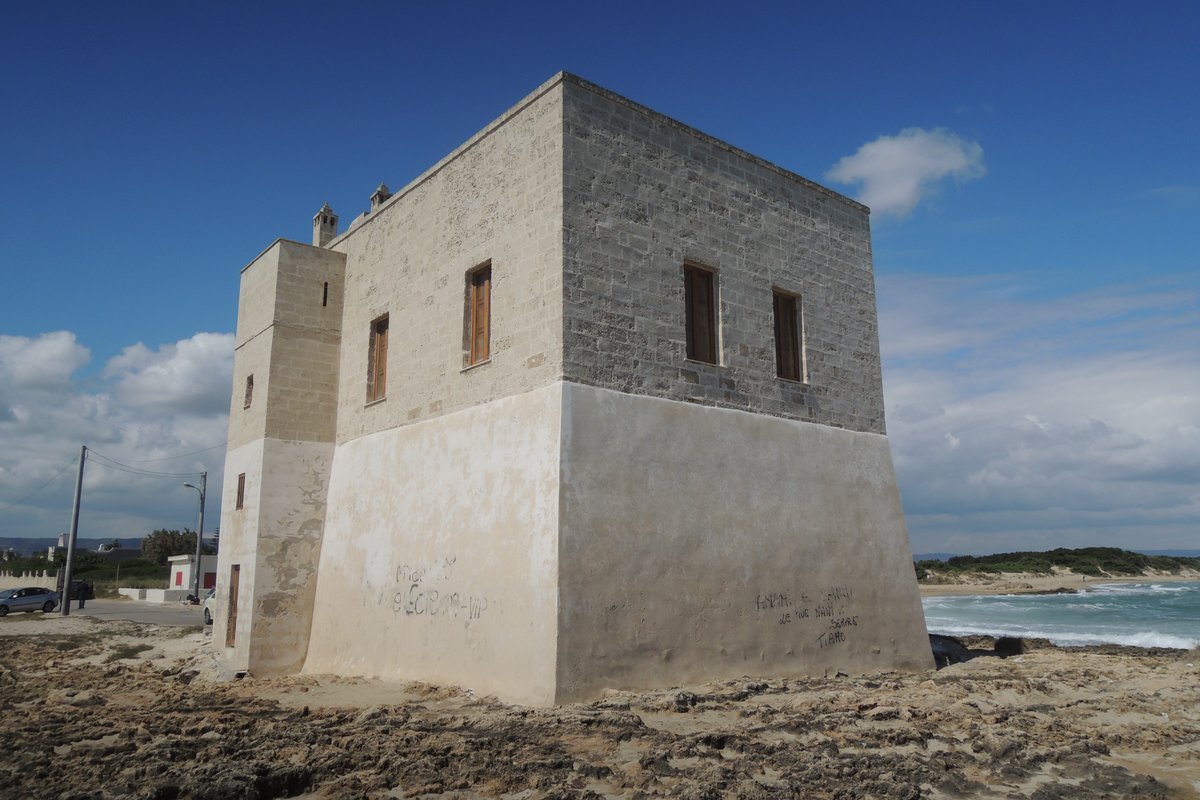
Torre San Leonardo is not just a watchtower: it’s a balcony suspended between the blue of the Adriatic and the green of the Itria Valley. The first time I saw it, I was struck by how it seems to guard two worlds – the sea on one side, the countryside dotted with trulli on the other. The walk to reach it is already part of the experience: a dirt path winding through ancient olive trees and Mediterranean scrub, with the scent of thyme and rosemary accompanying you. When you finally arrive at the base of the tower, you understand why it’s worth it: the view is truly breathtaking, one of those that makes you forget the time. It’s not as tall as other coastal towers, but its strategic position makes it special – it almost seems to be teasing you, showing you the best of maritime and rural Puglia simultaneously.
Historical Background
Built in 1568 at the behest of Spanish viceroy Pedro Afán de Ribera, Torre San Leonardo was part of the defensive system against Saracen pirate raids that plagued the Apulian coasts. It was not an isolated tower: it communicated visually with Torre Pozzelle to the north and Torre Santa Sabina to the south, forming a surveillance chain that protected the hinterland. Interestingly, despite its military functions, the tower features rather refined architectural elements for its time, such as the internal spiral staircase made of local stone. In the 18th century, it gradually lost strategic importance, first becoming a customs post and then a simple reference point for fishermen. Today, after a conservation restoration, it is open to visitors and offers an authentic glimpse into the coastal history of Brindisi.
- 1568: Construction commissioned by the Spanish viceroy
- 16th-17th centuries: Surveillance system against pirates
- 18th century: Transformation into a customs post
- 20th century: Abandonment and decay
- 2008-2010: Conservation restoration
- Today: Visitable site and panoramic viewpoint
The Climb to the Terrace
The internal stone staircase is narrow and steep—I’ll tell you right away, it’s not for those who suffer from vertigo or claustrophobia. But if you push past that moment of hesitation (it took me a second to decide), the reward is incredible. The upper terrace offers a 360-degree panorama that you’ll hardly forget. To the east, the Adriatic Sea stretches endlessly, with its shades ranging from turquoise to cobalt. To the west, the Itria Valley opens up with its patchwork of fields, dry-stone walls, and those characteristic trulli that look like stone mushrooms sprouting from the earth. On particularly clear days, you can even make out the silhouette of Ostuni in the distance, the ‘white city’ shining in the sun. Personally, I lingered to observe the details: the stones worn by the salty wind, the lichens coloring the masonry yellow and orange, the arrow slits from which soldiers once scanned the horizon.
The Path of Scents
What many overlook is that the true magic of Torre San Leonardo begins long before reaching the tower itself. The access trail, about 800 meters long, is a sensory immersion into the most authentic Mediterranean scrubland. Each season has its dominant scent: in spring, it’s the explosion of yellow broom; in summer, the warm aroma of myrtle and mastic; in autumn, the earthy notes of wild mushrooms sprouting after rain. I noticed the ground is dotted with fossil shells—evidence that here, millennia ago, there was the sea. Along the path, keep an eye out for traces of local wildlife: I’ve seen fox tracks, hedgehog droppings, and once even spotted a kestrel gliding above the tower. It’s not uncommon to encounter shepherds with their flocks, especially during the cooler hours of the day—an image that seems straight out of an ancient painting.
Why Visit
Three concrete reasons why Torre San Leonardo deserves a visit? First: it offers a unique perspective on the Apulian landscape, allowing you to take in both sea and countryside with a single glance in a way you’ll rarely find elsewhere. Second: it’s an experience accessible to everyone—the walk is short and not demanding, suitable even for families with children who can walk independently (though not with strollers). Third: it’s free. There are no tickets to buy, no restrictive opening hours (though it’s obviously closed at night), making it perfect for a last-minute excursion when the weather is nice. Unlike other more famous coastal towers, you won’t find crowds of tourists here—I’ve often been there almost alone, and this feeling of intimacy with the place is precious. And let’s be honest: how often do you get the chance to climb a well-preserved structure from the 1500s?
When to go
The best time? Sunset, without a doubt. Not only because the warm light of the setting sun on the sea creates spectacular color displays, but also because the air becomes cooler and the scents of the Mediterranean scrub intensify. In summer, avoid the middle of the day—there are no trees providing shade along the path, and the Apulian sun is unforgiving. In spring and autumn, however, you can go practically anytime: temperatures are mild and the light is perfect for photographs. Personally, I have a preference for days with the Maestrale wind, when it clears the atmosphere and visibility is at its peak—you can see so far that it almost feels like you could touch the Albanian coast. A frank piece of advice: check the wind forecast before you go, because when it’s blowing strongly, access to the terrace might not be advisable.
In the Surroundings
After visiting the tower, it’s worth taking a short drive to Masseria Ferri, a family-run farm just minutes away. This isn’t your typical tourist farm: here they produce organic extra virgin olive oil and offer genuine tastings without any frills. If you’d rather continue with the historical theme, head to Torre Guaceto – not the tower itself (which is similar to San Leonardo), but the surrounding nature reserve. It’s a protected area with nature trails, sandy dunes, and a natural pool where you can swim in crystal-clear waters. Both places maintain that authenticity sometimes lost in more touristy spots, perfectly completing the experience that began with Torre San Leonardo.