
If you have only one day to visit Verona, don’t worry: this walking itinerary will take you to discover the best of the city in just a few hours, from iconic monuments to lesser-known corners. Starting from the Arena, a symbol of Roman heritage, you’ll cross lively squares like Piazza Bra and Piazza delle Erbe, full of history and cafés. You’ll then head to Castelvecchio, an imposing Scaliger castle that now houses an important art museum. The route winds entirely through the historic center, allowing you to admire hidden churches and quiet gardens. Each stop is a short walk away, ideal for those who enjoy strolling without hurry. With this guide, you’ll discover Verona authentically, avoiding crowds and soaking in the city’s atmosphere. A perfect experience for a cultural city break, enriched with practical tips on opening hours and tickets. Get ready to fall in love with Verona in a day.
🗺️ Your trip at a glance
This itinerary is perfect for those who want to experience Verona in a day, with a walking route that combines history, art, and atmosphere. You’ll discover the essence of the city among ancient squares and medieval castles.
- Ideal for travelers with limited time who love cultural walks.
- Highlights include the Arena, Castelvecchio, and evocative squares, with tips to avoid queues.
- Why it’s different: this itinerary takes you off the beaten tourist path, with less crowded stops like the Castelvecchio garden and the Church of San Fermo.
Itinerary stops
Stop no. 1
Castelvecchio: scaliger fortress and art museum
 We start our day from a place that alone is worth the trip: Castelvecchio. This imposing medieval fortress was built by Cangrande II della Scala between 1354 and 1356, not for external defense, but to protect the court from popular uprisings. Crossing the entrance on Via Roma, you immerse yourself in an atmosphere of times past. The castle is divided into two nuclei: the Scaliger Palace and the Courtyard of Arms, with the high Mastio dominating the scene. Today it houses the Civic Museum, set up by Carlo Scarpa between 1958 and 1964: a masterpiece of museography that blends ancient and modern. Among the rooms, don’t miss the Madonna of the Quail by Pisanello, the equestrian statue of Cangrande and the lord’s sword. Climb the ramparts for a unique view of the Scaliger bridge and the Adige. Here in 1944 the Trial of Verona was held: history and art intertwine. An unmissable stop to understand Verona.
- Go to the page: Castelvecchio: Scaliger Fortress Between Art and History
- Via Roma, Verona (VR)
- Open in Google Maps
- View on Google Images

You should go if…
Stop no. 2
Arch of the Gavi: A Reconstructed Roman Arch
 From here it almost seems like an illusion: the Arch of the Gavi stands elegantly next to Castelvecchio, but its history is a continuous journey through time. Built in the 1st century AD by the Gavia family along the Via Postumia, it was not a triumphal arch but a private monument, extremely rare in Roman architecture. Designed by Lucius Vitruvius Cerdo – whose name is carved into the stone, another exception – it underwent a dramatic fate: dismantled in 1805 by the French to make way for carts, it was reassembled in 1932 in this small square, slightly to the side of the original (if you look at the paving in front of the Clock Tower, you can still see the bases of the pillars). Under the arch, a stretch of Roman road in black basalt shows the grooves left by carts. The Corinthian columns, the empty niches that once held statues, the Medusa’s head on the coffered ceiling: everything speaks of a powerful family that wanted to be remembered. It is a place that makes you reflect on how cities change, and how sometimes stones travel more than we do.
- Go to the page: Arco dei Gavi: A Private Roman Arch in Verona
- Piazzetta Castelvecchio, Verona (VR)
- Open in Google Maps
- View on Google Images
You should go if…
Stop no. 3
Porta Borsari: The Monumental Gateway of Roman Verona
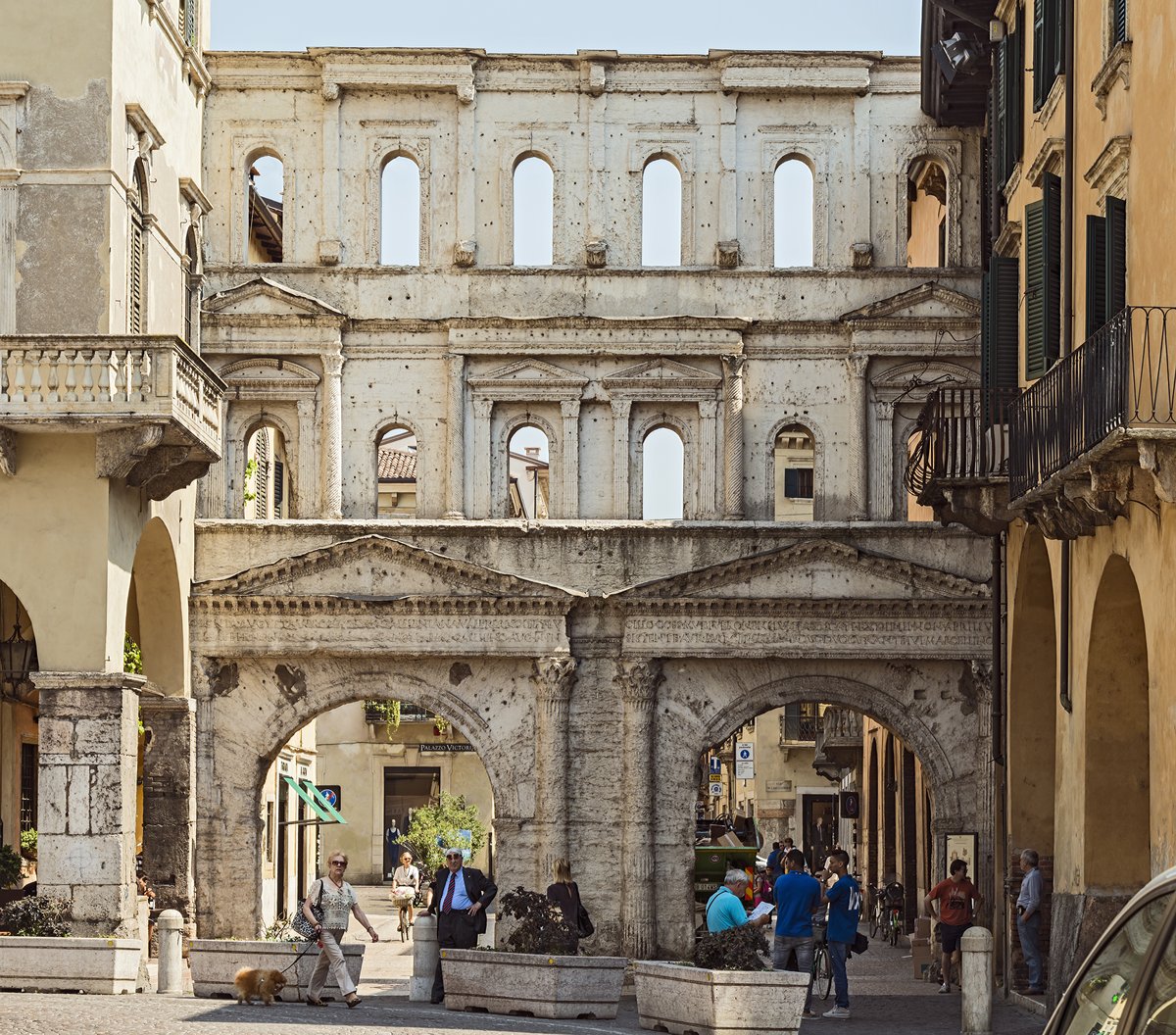 Continuing along Corso Cavour, you find yourself in front of a symbol that has marked the boundary between inside and outside for two thousand years. Porta Borsari, once called Porta Iovia for the nearby temple of Jupiter, was the main entrance to the Roman city. Its face of white Valpantena stone, about 13 meters high, is all that remains of a defensive structure with a courtyard and towers. Today you gaze at the imperial façade, with its two large arches framed by Corinthian half-columns, and above, two rows of windows – some set into aedicules with pediments. An inscription on the architrave recalls the work of Emperor Gallienus in 265 AD. The medieval name comes from the bursarii, the customs officers who collected taxes on goods. Passing through here means stepping on the same Roman decumanus maximus, today’s Corso Porta Borsari, which leads straight to Piazza delle Erbe. The gate is squeezed between ancient buildings, and the perspective is so perfect it looks like a Renaissance painting. It’s one of those places where time stands still, and you can almost hear the rumble of carts entering the city.
- Go to the page: Porta Borsari: Perfectly Preserved Roman Gate with Two White Stone Arches
- Corso Porta Borsari, Verona (VR)
- Open in Google Maps
- View on Google Images
You should go if…
Stop no. 4
Church of San Fermo Maggiore
 Leaving Porta Borsari behind, you walk along Stradone San Fermo and arrive at one of Verona’s most fascinating churches: San Fermo Maggiore. What appears to be a compact building actually hides two superimposed levels: the upper Gothic church, built by the Franciscans in the 14th century, and the lower Romanesque one, commissioned by the Benedictines between the 11th and 12th centuries. For €2.50 (or with the Verona Card) you can explore both. The incredible upside-down ship’s keel ceiling is decorated with 416 painted panels from the 14th century: meticulous craftsmanship. Among the frescoed walls, the Brenzoni Mausoleum stands out, a masterpiece of International Gothic with sculptures by Nanni di Bartolo and frescoes by Pisanello, who signed his first dated work here (1416). Descending into the lower church, the atmosphere changes: soft lighting, massive columns, and Romanesque frescoes. On the right, a stone marks the spot where, according to tradition, Saints Fermo and Rustico were beheaded. A place that blends art, history, and spirituality.
- Go to the page: San Fermo Maggiore Church: Romanesque and Gothic Superimposed
- Stradone San Fermo, Verona (VR)
- Open in Google Maps
- View on Google Images
You should go if…
Stop no. 5
Cathedral of Santa Maria Matricolare
 Continuing towards the religious heart of Verona, you arrive at Piazza Duomo and find yourself in front of the Cathedral of Santa Maria Matricolare, the city’s cathedral. The building stands on the traces of a 4th-century paleochristian basilica, commissioned by Bishop Zeno, then destroyed by the earthquake of 1117 and rebuilt between 1120 and 1187. The façade mixes Gothic and Romanesque styles, with a tufa porch and a central rose window. Inside, three naves with pillars in red Verona marble and an absolute masterpiece: the Assumption of the Virgin by Titian (1535), the only painting by the master in the city. Don’t miss the Baptistery of San Giovanni in Fonte, with the octagonal baptismal font by Brioloto (1220), and the church of Sant’Elena, which houses paleochristian remains and a 15th-century wooden choir. The bell tower, 75 meters high, is unfinished but offers an unmistakable profile. With a single ticket (€6) you can also visit San Zeno, Santa Anastasia, and San Fermo. A place that tells centuries of faith and art.
- Go to the page: Cathedral of Santa Maria Matricolare: Guide to Visiting Verona’s Duomo
- Piazza Duomo, Verona (VR)
- http://www.cattedralediverona.it/
- Open in Google Maps
- View on Google Images
You should go if…
Stop no. 6
Basilica of Sant’Anastasia: Veronese Gothic Between Hunchbacks and Pisanello
 A few steps from the Duomo, on Via Don Bassi, stands the imposing Basilica of Sant’Anastasia, the largest church in Verona and the finest example of civic Gothic. Work began in 1290 at the behest of the Dominicans, with the support of the Scaligeri, but the brick facade remained unfinished – that contrast between the richly decorated portal and the bare brickwork gives it a special charm. Upon entering, the interior with three naves and columns of red Verona marble envelops you in a solemn atmosphere. You’ll immediately notice the two “hunchbacks” holding the holy water stoups: touching them brings good luck, they say. But the real treasure is in the Pellegrini Chapel: Pisanello’s fresco “Saint George and the Princess” (1433–1438), a masterpiece of International Gothic with fairy-tale details. Don’t miss the equestrian monument to Cortesia Serego and the frescoes by Altichiero in the Cavalli Chapel. Entry costs about €4–5 (free with the Verona Card), and if you love Gothic art, here you’ll find a concentration of history and beauty.
- Go to the page: Sant’Anastasia Church: Gothic, Art, and Lucky Hunchbacks
- Via Don Bassi, Verona (VR)
- https://www.chieseverona.it/it/
- Open in Google Maps
- View on Google Images
You should go if…
Stop no. 7
Torre dei Lamberti: The Best Panoramic View of Verona
 It’s impossible to miss: the Torre dei Lamberti rises 84 meters above Piazza delle Erbe, the tallest tower in Verona. Built in 1172 by the Lamberti family, its history is marked by lightning and restorations: in 1403, lightning struck off its top, and it wasn’t until between 1448 and 1464 that it was raised to its current height, with the addition of the octagonal bell chamber in marble and brick. Climbing the 368 steps (or taking the glass elevator) brings you to the panoramic terrace. From up there, the view is 360°: red rooftops, bell towers, the Arena, Castel San Pietro, and the Adige River. If the sky is clear, you can also see the hills and Lake Garda. The tower houses two historic bells: the Marangona (which marked working hours) and the Rengo (for summoning the city council). An 18th-century clock still works. Tickets cost €6 (or free with Verona Card, stairs only). Open daily, last entry 45 minutes before closing.
- Cortile del Mercato Vecchio, Verona (VR)
- https://www.torredeilamberti.it/
- Open in Google Maps
- View on Google Images
You should go if…
Stop no. 8
Giusti Garden: A Dive into the Renaissance
 Leave the squares and bustle behind: Giusti Garden is a true oasis of peace that transports you back in time. Created in the 16th century at the behest of Agostino Giusti, a knight of the Venetian Republic, this Italian-style garden is still owned by the family. As you enter, a long avenue of cypresses leads you to a stone mask that once spouted fire and smoke to amaze guests. A bit further on, the labyrinth – one of the oldest in Europe – invites you to get lost among the hedges. But the real spectacle awaits at the top: climb to the belvedere and one of the most beautiful views of Verona unfolds before you, with rooftops, bell towers, and the profile of the hills. Unfortunately, the famous Goethe’s cypress (visited by the poet in 1786) was felled by a storm in August 2020, but the rest of the garden retains all its charm, with mythological statues, fountains, and Roman artifacts. A place that enchanted Mozart, Cosimo de’ Medici, and Tsar Alexander I. Take your time: it’s the perfect spot for a rejuvenating break before ending your day.
- Via Giardino Giusti, Verona (VR)
- https://giardinogiusti.com/
- Open in Google Maps
- View on Google Images
You should go if…


