If you have just one day to visit Ravenna, this walking itinerary leads you to discover its most iconic treasures. We start with the Byzantine mosaics of San Vitale and the nearby Mausoleum of Galla Placidia, UNESCO masterpieces that will leave you speechless. We continue to the Neonian Baptistery and the Basilica of Sant’Apollinare Nuovo, other gems of incredible beauty. After a lunch break in the center, we visit Dante’s Tomb and the Church of San Francesco, ending with the Rocca Brancaleone, a Venetian fortress that offers a perfect panorama. This route is designed to optimize time and include the 7 must-see stops, without rush but with rhythm. Ideal for those who want to experience Ravenna in one day and take home unforgettable memories of art, history, and UNESCO mosaics.
🗺️ Your trip at a glance
In one day, Ravenna offers a concentrated dose of Byzantine art and medieval history. A walking itinerary that combines UNESCO mosaics with the evocative Rocca Brancaleone, perfect for those with little time but a great desire for wonder.
- Ideal for art and history enthusiasts, city-breakers seeking culture, and curious families.
- Highlights: UNESCO mosaics, 100% pedestrian route, stop at Rocca Brancaleone with a view.
- For those who want an intense yet relaxed day, among timeless masterpieces and authentic corners.
Itinerary stops
Stop no. 1
Rocca Brancaleone
 Start the day with a dive into history: Rocca Brancaleone, built by the Venetians starting in 1457, is one of the most tangible traces of their rule over Ravenna. Today it is a huge public park covering 17,000 square meters, where the mighty walls and the four round towers of the Ridotto blend with lawns, playgrounds, and sandstone pathways. Admission is free and you can wander freely. In the most fortified part, the actual fortress, there is an open-air theater that hosts concerts and films in summer – it is here that Ravenna Jazz and the Ravenna Festival were born. The visit is quick, but it is the right place to understand how the city transitioned from Byzantine to Venetian rule. An excellent appetizer before immersing yourself in the mosaics.
- Via Gastone De Foix, Ravenna (RA)
- Open in Google Maps
- View on Google Images

You should go if…
Stop no. 2
Basilica of San Vitale: Masterpiece of Byzantine Mosaics
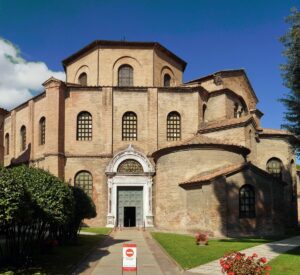
 After the Neonian Baptistery, the absolute gem of Ravenna awaits you: the Basilica of San Vitale. Built between 532 and 547, it is a masterpiece of early Christian and Byzantine art, declared a UNESCO World Heritage Site in 1996. As soon as you enter, the atmosphere envelops you: the octagonal plan, the light filtering through the windows, and then the explosion of golden mosaics covering the apse and the presbytery. It’s impossible not to be awestruck by the famous processions of Emperor Justinian and Empress Theodora, depicted in sumptuous robes against a gold background, accompanied by dignitaries and soldiers. In the apse, Christ Pantocrator, beardless and solemn, sits on a blue globe among angels and saints. Don’t miss the marble labyrinth on the presbytery floor: a symbolic path of purification. Admission requires a cumulative ticket, but it is absolutely worth it. Prepare to be enchanted.
- Go to the page: Basilica of San Vitale: Masterpiece of Byzantine Mosaics
- Piazzetta Luigi Legnani, Ravenna (RA)
- Open in Google Maps
- View on Google Images
You should go if…
Stop no. 3
Mausoleum of Galla Placidia
 Just steps from the Basilica of San Vitale, you come across a building that looks almost unremarkable from the outside, made of red brick. But as soon as you cross the threshold, you’re left speechless. The Mausoleum of Galla Placidia, built around 425 AD, is an early Christian gem declared a UNESCO World Heritage Site in 1996. Its Latin cross plan and dome hidden by a tiburium conceal something incredible: the magical atmosphere created by mosaics covering every surface. Light filters through alabaster windows, making the gold and enamel tiles shimmer. On the dome, a starry blue sky with a golden cross at the center, surrounded by the symbols of the evangelists. In the lunettes, apostles, doves drinking, and the Good Shepherd above the entrance. It all tells the story of life’s victory over death. It’s one of those places that gets under your skin and never lets go: here you understand why Ravenna is so special. Admission is combined with the other monuments, but if you’re short on time, don’t skip it.
- Go to the page: Mausoleum of Galla Placidia: The Starry Sky of Mosaics
- Via Galla Placidia, Ravenna (RA)
- Open in Google Maps
- View on Google Images
You should go if…
Stop no. 4
Ravenna Cathedral
 After the mosaic splendor of the Mausoleum, get ready for a dive into the Baroque: Ravenna Cathedral stands where the ancient 5th-century Ursiana Basilica once stood. The current cathedral, built between 1734 and 1745 to a design by Giovan Francesco Buonamici, is an example of Baroque style with Neoclassical influences. The red-brick exterior is embellished by a portico and one of Ravenna’s symbols: the 10th-century cylindrical bell tower, 35 meters high. The Latin-cross interior houses treasures such as the ambo of Bishop Agnello (557–570 AD), decorated with 36 animal reliefs, and the Chapel of the Madonna of the Sweat, featuring a 14th-century panel that legend says sweated blood in 1512. Don’t miss the Chapel of the Blessed Sacrament with an altarpiece by Guido Reni. Admission is free, making it a peaceful oasis in the heart of the city.
- Go to the page: Ravenna Cathedral: Baroque, Pulpit, and Chapels Not to Be Missed
- Via Don Angelo Lolli, Ravenna (RA)
- Open in Google Maps
- View on Google Images
You should go if…
Stop no. 5
Archbishop’s Museum
 Just steps from the Duomo, you’ll find the Archbishop’s Museum, a hidden gem that few expect. I found it fascinating: here you breathe the history of early Christian Ravenna. The museum was founded in 1734 by Archbishop Maffeo Niccolò Farsetti, who decided to gather the treasures of the old Ursiana Basilica before it was demolished. Enter, and you come face to face with the Throne of Maximian, the only 6th-century ivory throne in existence: a masterpiece that leaves you breathless. Then head upstairs to discover the Chapel of St. Andrew, a private oratory of Bishop Peter II (5th century) adorned with extraordinary mosaics: Christ the Warrior crushing evil, angels supporting Christ’s monogram. It is the only early Christian bishop’s chapel to have survived intact, a UNESCO World Heritage site since 1996. Don’t miss the mosaics of Saint Barbatianus and the Praying Virgin, fragments of the lost Ursian apse. The ticket is cumulative with other monuments (€14.50 for 5 sites), valid for 7 days. Open daily 10am-5pm (winter) or 9am-7pm (summer). A place to visit at a leisurely pace.
- Piazza Arcivescovado, Ravenna (RA)
- Open in Google Maps
- View on Google Images
You should go if…
Stop no. 6
Dante’s Tomb
 After the Archbishop’s Museum, you’ll find yourself in the Zona del Silenzio, where the Dante’s Tomb stands. Here lies the father of the Italian language, who died in exile in Ravenna in 1321. The neoclassical mausoleum, designed by Camillo Morigia between 1780 and 1781, is simple yet elegant: a small dome, the architrave with the inscription “Dantis Poetae Sepulcrum”, and inside, the Roman sarcophagus containing the poet’s bones. Above, the bas-relief by Pietro Lombardo from 1483 depicts a pensive Dante at a lectern. A votive lamp burns perpetually, fueled by oil from the Tuscan hills, offered annually by Florence. At the foot of the sarcophagus, a bronze and silver garland donated by the Italian army after World War I. Adjacent is the Quadrarco di Braccioforte with two Roman sarcophagi and the mound where the bones were hidden during World War II. Admission is free, open daily 10-18 (winter) or 10-19 (summer), closed on December 25. A place of peace that leaves you speechless.
- Go to the page: Dante’s Tomb in Ravenna: The Neoclassical Temple of 1780 and Florence’s Votive Lamp
- Via Guido Da Polenta, Ravenna (RA)
- Open in Google Maps
- View on Google Images
You should go if…
Stop no. 7
Basilica of Sant’Apollinare Nuovo
 The last stop on our tour, but perhaps the most impressive. The Basilica of Sant’Apollinare Nuovo, built by the Gothic king Theodoric in 505 as an Arian palatine chapel, is a riot of mosaics that leaves you speechless. The walls of the nave are covered by three decorative bands: at the top, the 26 Christological scenes from the Theodoric period, the largest New Testament mosaic cycle ever created; in the center, saints and prophets on a gold background; at the bottom, two famous processions: the virgins led by the Magi towards the Madonna and the martyrs advancing towards Christ. Don’t miss the Palace of Theodoric with the removed figures (you can still see the hands!) and the view of the port of Classe with three ships. The exterior is simple: brick facade, 16th-century portico, and cylindrical bell tower. With the same cumulative ticket you can also visit San Vitale and the other monuments. You enter, and for a moment you are suspended between heaven and earth.
- Go to the page: Basilica of Sant’Apollinare Nuovo: Mosaics and Imperial History
- Via San Giovanni Bosco, Ravenna (RA)
- Open in Google Maps
- View on Google Images
You should go if…