Evocative Introduction
Perched on a cliff overlooking the sea, between Naregno Beach and Capo Perla, the Capo Focardo Lighthouse is one of those places that leaves you breathless. Its octagonal pink limestone tower stands out against the blue of the Tyrrhenian Sea, and the white light it emits every 15 seconds is visible up to 16 nautical miles. It’s not just a landmark for sailors: it’s a piece of Elba Island’s history worth a stop. Getting there is an adventure, but the view of Porto Azzurro and Cima del Monte rewards every step.
Evocative Introduction
Perched on a cliff overlooking the sea, between Naregno Beach and Capo Perla, the Capo Focardo Lighthouse is one of those places that leaves you breathless. Its octagonal pink limestone tower stands out against the blue of the Tyrrhenian Sea, and the white light it emits every 15 seconds is visible up to 16 nautical miles. It’s not just a landmark for sailors: it’s a piece of Elba Island’s history worth a stop. Getting there is an adventure, but the view of Porto Azzurro and Cima del Monte rewards every step.
Historical Notes
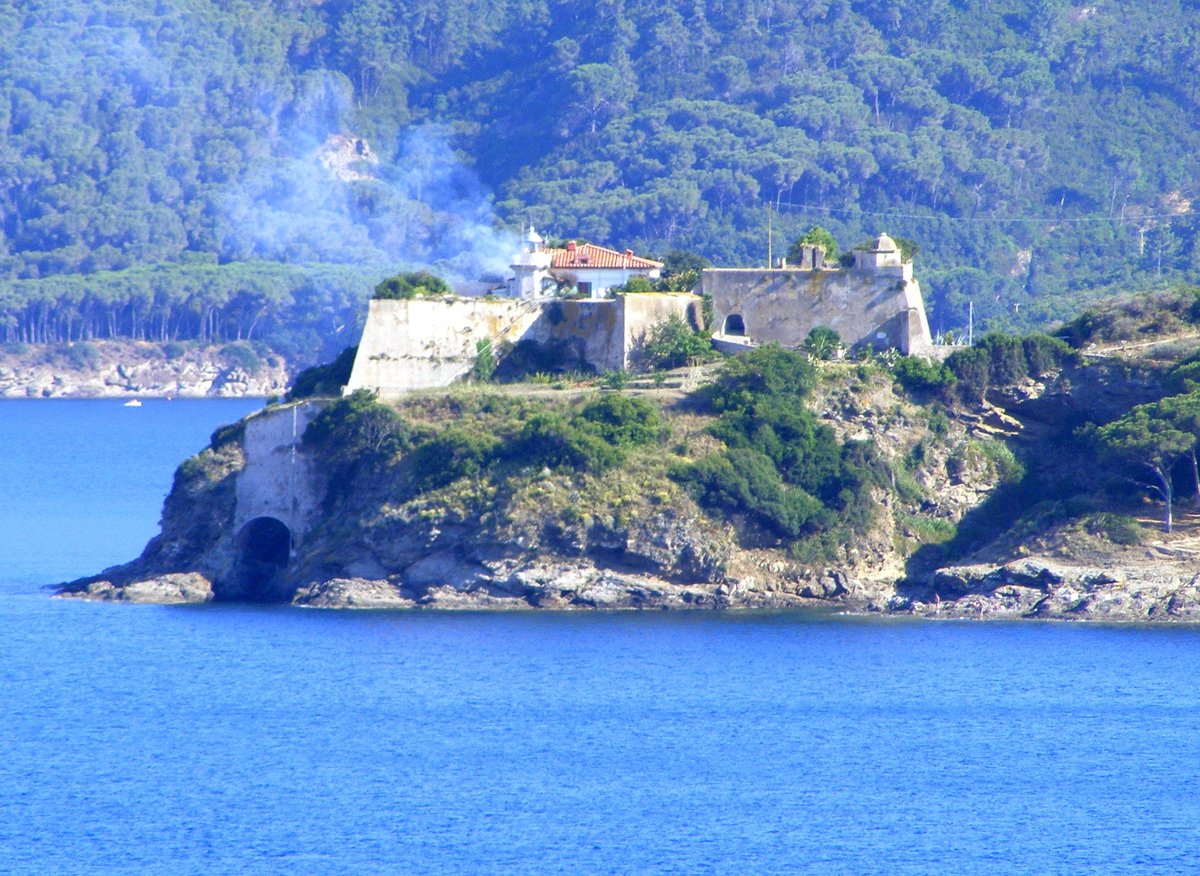
The lighthouse stands within Fort Focardo, a Spanish fortification built in 1678 by Governor Don Ferdinando Gioachino Foscardo. The lighthouse was inaugurated in 1863 to illuminate the coastal stretch of Porto Azzurro, and in 1870 it was classified as fourth category acetylene with a range of 18 miles. Today it is automated and owned by the Italian Navy. In 2018, a conservation restoration was announced for nearly 465,000 euros, a sign of the site’s importance. In the 1920s, the father of writer Raffaello Brignetti lived there; Brignetti spent his youth in the lighthouse and drew inspiration for his works.
Historical Notes
The lighthouse stands within Fort Focardo, a Spanish fortification built in 1678 by Governor Don Ferdinando Gioachino Foscardo. The lighthouse was inaugurated in 1863 to illuminate the coastal stretch of Porto Azzurro, and in 1870 it was classified as fourth category acetylene with a range of 18 miles. Today it is automated and owned by the Italian Navy. In 2018, a conservation restoration was announced for nearly 465,000 euros, a sign of the site’s importance. In the 1920s, the father of writer Raffaello Brignetti lived there; Brignetti spent his youth in the lighthouse and drew inspiration for his works.
Breathtaking Architecture and Views
The tower stands 13 meters tall, with walls of pink limestone from the Portoferraio quarries and a granite spiral staircase leading to the octagonal walkway. The metal lantern houses a 1000 W halogen lamp that emits three white flashes every 15 seconds, with a range of 16 nautical miles. From the surrounding square, you can enjoy an incredible view: to the northeast, Porto Azzurro and Forte San Giacomo, with Cima del Monte in the background. The contrast between the pink limestone and the green Mediterranean scrub is perfect for photos.
Breathtaking Architecture and Views
The tower stands 13 meters tall, with walls of pink limestone from the Portoferraio quarries and a granite spiral staircase leading to the octagonal walkway. The metal lantern houses a 1000 W halogen lamp that emits three white flashes every 15 seconds, with a range of 16 nautical miles. From the surrounding square, you can enjoy an incredible view: to the northeast, Porto Azzurro and Forte San Giacomo, with Cima del Monte in the background. The contrast between the pink limestone and the green Mediterranean scrub is perfect for photos.
How to get there and what to see
Reaching the lighthouse is an experience: you can get there by car up to a dirt road starting from via Capo Perla, or on foot via a path that begins from Naregno beach through a pine forest. The fort is not open to visit inside, but the exterior is free to explore. Don’t forget your camera: the sunset here is truly unique, with the light illuminating the pink limestone. If you have time, head down to the small beach below the fort or continue to Capo Perla for a refreshing swim.
How to get there and what to see
Reaching the lighthouse is an experience: you can get there by car up to a dirt road starting from via Capo Perla, or on foot via a path that begins from Naregno beach through a pine forest. The fort is not open to visit inside, but the exterior is free to explore. Don’t forget your camera: the sunset here is truly unique, with the light illuminating the pink limestone. If you have time, head down to the small beach below the fort or continue to Capo Perla for a refreshing swim.
Why Visit It
Three concrete reasons: first, it’s a perfect blend of history and nature, with a 19th-century lighthouse on a 17th-century fortress; second, the view is postcard-perfect, with the Tyrrhenian Sea stretching to the horizon; third, it’s not crowded, ideal for those seeking peace away from the busier beaches. Plus, it’s free: external access is free and no tickets required. Bring binoculars and enjoy the spectacle of passing ships.
Why Visit It
Three concrete reasons: first, it’s a perfect blend of history and nature, with a 19th-century lighthouse on a 17th-century fortress; second, the view is postcard-perfect, with the Tyrrhenian Sea stretching to the horizon; third, it’s not crowded, ideal for those seeking peace away from the busier beaches. Plus, it’s free: external access is free and no tickets required. Bring binoculars and enjoy the spectacle of passing ships.
When to go
The best time? Sunset, without a doubt. The warm light enhances the tower’s color and the sea turns shades of orange. In spring and autumn, the weather is perfect for a walk, with fewer crowds. Summer can be hot, but the sea breeze helps. If you wake up early, the sunrise is equally magical, with the sun rising behind the tower. Avoid the midday hours in hot months: the sun is strong and there’s no shade.
When to go
The best time? Sunset, without a doubt. The warm light enhances the tower’s color and the sea turns shades of orange. In spring and autumn, the weather is perfect for a walk, with fewer crowds. Summer can be hot, but the sea breeze helps. If you wake up early, the sunrise is equally magical, with the sun rising behind the tower. Avoid the midday hours in hot months: the sun is strong and there’s no shade.
Nearby
Just a few steps away, Naregno beach is perfect for a dip after the visit. If you love trekking, the path along the cliff towards Capo Perla offers wild views. Don’t miss Capoliveri, the medieval village three kilometers away: narrow alleys, artisan shops, and excellent seafood restaurants. For fortification enthusiasts, Forte San Giacomo in Porto Azzurro is another interesting historical stop.
Nearby
Just a few steps away, Naregno beach is perfect for a dip after the visit. If you love trekking, the path along the cliff towards Capo Perla offers wild views. Don’t miss Capoliveri, the medieval village three kilometers away: narrow alleys, artisan shops, and excellent seafood restaurants. For fortification enthusiasts, Forte San Giacomo in Porto Azzurro is another interesting historical stop.