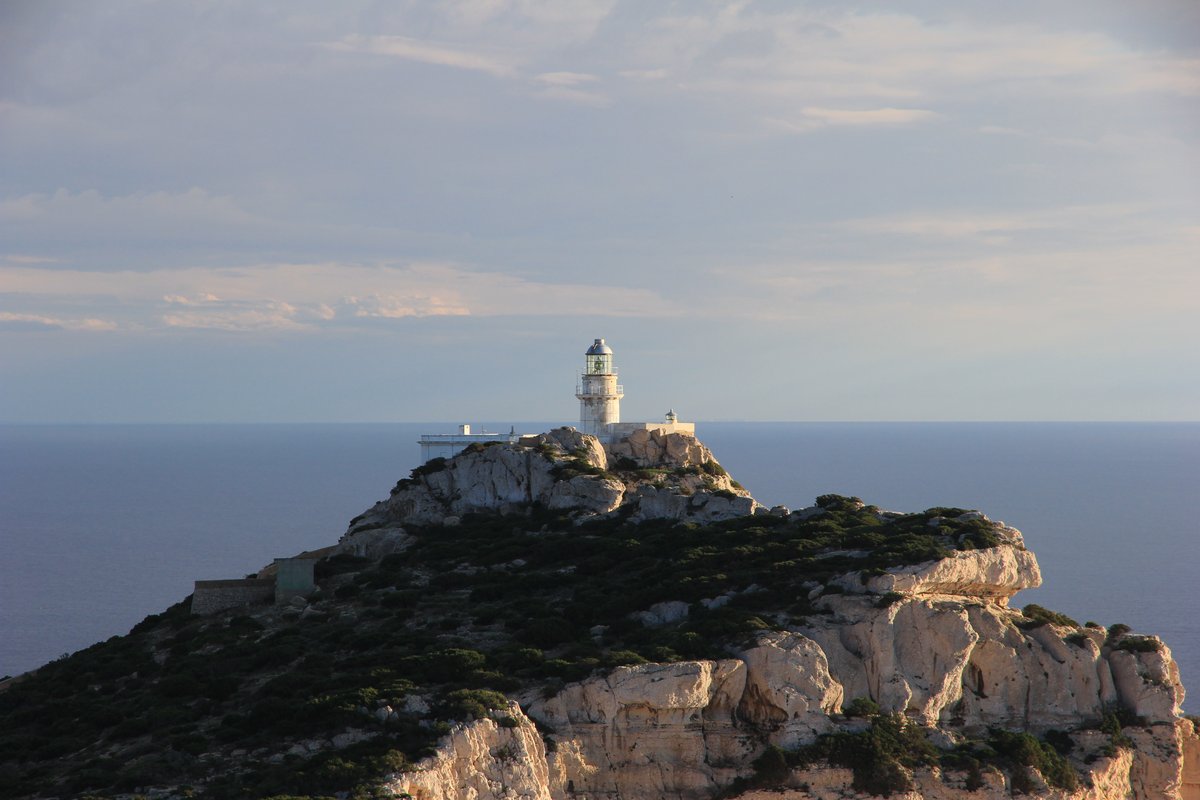
Capo Caccia Lighthouse is one of the symbols of Alghero, perched on the promontory of the same name at 186 meters high. Built in 1864, it emits a light visible up to 34 nautical miles, guiding sailors in the Mediterranean. Although the area is partly military and access to the lighthouse is forbidden, the view from the scenic road is spectacular. You can admire the sunset and watch the lantern light up, while the sea breeze envelops you. Here’s what awaits you:
– Historic lighthouse: one of the oldest and most powerful in Italy, with Fresnel lenses from 1951.
– Breathtaking view: over the Coral Riviera, Neptune’s Grotto, and the island of Piana.
– Legends and mysteries: tales of pirates, treasures, and a ghost knocking at the keeper’s door.
– Protected nature: the Capo Caccia – Isola Piana marine protected area offers a unique ecosystem.
Introduction
The Capo Caccia Lighthouse is not just a lighthouse: it is a giant of light dominating the sea from 186 meters high, one of the most powerful in the Mediterranean. Built in 1864 on the limestone cliff of the promontory, it is a symbol of Alghero. You cannot enter – it’s a military zone – but seeing it from afar is enough to enchant you. At night, its white flash every 5 seconds guides sailors and illuminates the bay. I saw it for the first time at sunset: the white silhouette against the orange sky, the sea crashing below. A spectacle you won’t forget.
Introduction
The Capo Caccia Lighthouse is not just a lighthouse: it is a giant of light dominating the sea from 186 meters high, one of the most powerful in the Mediterranean. Built in 1864 on the limestone cliff of the promontory, it is a symbol of Alghero. You cannot enter – it’s a military zone – but seeing it from afar is enough to enchant you. At night, its white flash every 5 seconds guides sailors and illuminates the bay. I saw it for the first time at sunset: the white silhouette against the orange sky, the sea crashing below. A spectacle you won’t forget.
Historical Notes
The lighthouse was built in 1864, the same year as the Capo Sandalo lighthouse. Initially it used acetylene, then petroleum vapors, and finally electricity from 1961. The rotating optic with 4-panel Fresnel lenses (built in Paris in 1951) is still in operation, with a 1000W halogen lamp. The last keeper, Luigi Critelli, arrived on December 21, 1994 with his family. He told of strange nocturnal knocking that was never explained. Today it is automated, but its history fascinates. Here are the key moments:
Historical Notes
The lighthouse was built in 1864, the same year as the Capo Sandalo lighthouse. Initially it used acetylene, then petroleum vapors, and finally electricity from 1961. The rotating optic with 4-panel Fresnel lenses (built in Paris in 1951) is still in operation, with a 1000W halogen lamp. The last keeper, Luigi Critelli, arrived on December 21, 1994 with his family. He told of strange nocturnal knocking that was never explained. Today it is automated, but its history fascinates. Here are the key moments:
- 1864: Construction of the original lighthouse
- c. 1880: Switch from acetylene to petroleum vapor
- 1950: Reconstruction after war damage
- 1961: Full electrification
- 1994: Arrival of the last keeper Luigi Critelli
- 1864: Construction of the original lighthouse
- c. 1880: Switch from acetylene to petroleum vapor
- 1950: Reconstruction after war damage
- 1961: Full electrification
- 1994: Arrival of the last keeper Luigi Critelli
A lighthouse to admire from afar
The structure is a three-story white building with a 24-meter tower, typical of the Italian Civil Engineering style. Protected by a Faraday cage, it appears wrapped in a metal grid. You can’t enter, but the scenic road from Alghero leads to a hill behind it offering a breathtaking view: the cliff plunging into the sea, the Coral Riviera, and Isola Piana. I visited with a drone – it’s the best way to appreciate its position. At night, its beam is visible from the city, a landmark that makes you feel small.
A lighthouse to admire from afar
The structure is a three-story white building with a 24-meter tower, typical of the Italian Civil Engineering style. Protected by a Faraday cage, it appears wrapped in a metal grid. You can’t enter, but the scenic road from Alghero leads to a hill behind it offering a breathtaking view: the cliff plunging into the sea, the Coral Riviera, and Isola Piana. I visited with a drone – it’s the best way to appreciate its position. At night, its beam is visible from the city, a landmark that makes you feel small.
Legends and Traditions
The promontory of Capo Caccia is shrouded in tales of pirates and hidden treasures. It is said that corsairs once took refuge in the caves below, and that some chest may still be there. Then there’s the ‘sleeping giant’: the profile of the promontory seen from Alghero resembles a reclining man, especially evocative at sunset. The lighthouse itself has a mysterious atmosphere. The keeper, Critelli, recounted hearing knocking and voices while resting, but upon waking found no one. Who knows if these are true stories or just the wind playing tricks…
Legends and Traditions
The promontory of Capo Caccia is shrouded in tales of pirates and hidden treasures. It is said that corsairs once took refuge in the caves below, and that some chest may still be there. Then there’s the ‘sleeping giant’: the profile of the promontory seen from Alghero resembles a reclining man, especially evocative at sunset. The lighthouse itself has a mysterious atmosphere. The keeper, Critelli, recounted hearing knocking and voices while resting, but upon waking found no one. Who knows if these are true stories or just the wind playing tricks…
Why Visit
Three good reasons not to miss it:
- Picture-perfect sunset: The lighthouse lights up exactly at sunset, creating a stunning contrast between artificial and natural light.
- Unique viewpoint: Even if you don’t go inside, the view from the road or the sea is spectacular, with Alghero and Porto Conte bay in the background.
- Close to Neptune’s Grotto: After admiring the lighthouse, you can descend the 654 steps of the Cabirol staircase to visit one of Italy’s most famous sea caves.
Why Visit
Three good reasons not to miss it:
- Picture-perfect sunset: The lighthouse lights up exactly at sunset, creating a stunning contrast between artificial and natural light.
- Unique viewpoint: Even if you don’t go inside, the view from the road or the sea is spectacular, with Alghero and Porto Conte bay in the background.
- Close to Neptune’s Grotto: After admiring the lighthouse, you can descend the 654 steps of the Cabirol staircase to visit one of Italy’s most famous sea caves.
When to Go
The best time? Late afternoon, around 5-6 PM in summer, when the sun starts to set. The golden light illuminates the cliff, and the lighthouse stands out against the sky. Then, as evening falls, you see the first white flash: it’s magical. Throughout the year, spring and autumn offer clear skies and fewer crowds. If you go in summer, expect heat but also very long sunsets. Bring binoculars or a telephoto lens, because from afar the lighthouse is small but powerful.
When to Go
The best time? Late afternoon, around 5-6 PM in summer, when the sun starts to set. The golden light illuminates the cliff, and the lighthouse stands out against the sky. Then, as evening falls, you see the first white flash: it’s magical. Throughout the year, spring and autumn offer clear skies and fewer crowds. If you go in summer, expect heat but also very long sunsets. Bring binoculars or a telephoto lens, because from afar the lighthouse is small but powerful.
Nearby
In addition to the lighthouse, the promontory offers two unmissable experiences.
- Neptune’s Grotto: accessible by sea or via the spectacular Cabirol staircase (654 steps carved into the rock). Inside, stalactites and underground lakes.
- Capo Caccia – Isola Piana Marine Reserve: perfect for snorkeling and diving, with red coral and rich marine life.
Both places are easily reachable from Alghero and complete a day of sea and nature.
Nearby
In addition to the lighthouse, the promontory offers two unmissable experiences.
- Neptune’s Grotto: accessible by sea or via the spectacular Cabirol staircase (654 steps carved into the rock). Inside, stalactites and underground lakes.
- Capo Caccia – Isola Piana Marine Reserve: perfect for snorkeling and diving, with red coral and rich marine life.
Both places are easily reachable from Alghero and complete a day of sea and nature.