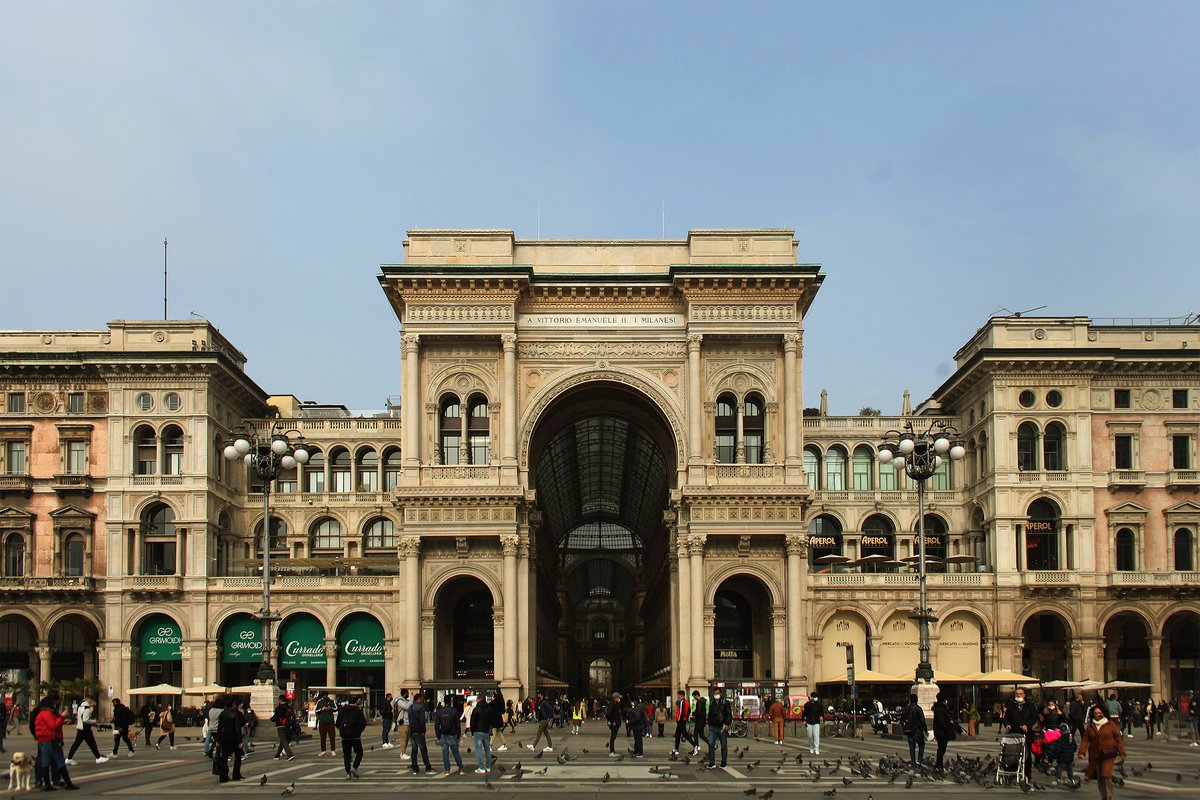
The Galleria Vittorio Emanuele II, known as the ‘drawing room of Milan’, is a masterpiece of 19th-century iron and glass architecture. It connects Piazza del Duomo to Piazza della Scala and is a landmark for luxury shopping and Milanese history. Visiting means immersing yourself in a unique atmosphere among historic shops, elegant cafés, and fascinating mosaics.
Neoclassical architecture with a 47-meter-high glass dome
Luxury boutiques like Prada, Gucci, and Louis Vuitton
Bull tradition: three spins on the mosaic for good luck
Historic venues like Caffè Biffi and Camparino in Galleria
Introduction
Stepping into the Galleria Vittorio Emanuele II is like diving into Milan’s timeless elegance. With its enormous glass and iron roof filtering the light, mosaic floors, and luxury boutiques, it captivates you instantly. The Milanese call it the city’s “drawing room,” and for good reason: people meet here, chat over a coffee at Camparino, and soak in a unique atmosphere blending history and modernity. It is one of the oldest covered shopping arcades in the world, a neo-Renaissance masterpiece connecting Piazza del Duomo with Piazza della Scala. Get ready to walk with your head up, because every detail deserves a look.
Introduction
Stepping into the Galleria Vittorio Emanuele II is like diving into Milan’s timeless elegance. With its enormous glass and iron roof filtering the light, mosaic floors, and luxury boutiques, it captivates you instantly. The Milanese call it the city’s “drawing room,” and for good reason: people meet here, chat over a coffee at Camparino, and soak in a unique atmosphere blending history and modernity. It is one of the oldest covered shopping arcades in the world, a neo-Renaissance masterpiece connecting Piazza del Duomo with Piazza della Scala. Get ready to walk with your head up, because every detail deserves a look.
Historical Background
The construction began in 1865 based on a design by Giuseppe Mengoni, who won a competition to redevelop the area around the Duomo. The first stone was laid by King Victor Emmanuel II on March 7, 1865. Already inaugurated in 1867, it was only completed in 1877, when the monumental arch on Piazza Duomo was opened.
Mengoni tragically died falling from scaffolding on December 30, 1877, just on the eve of the final inauguration. Despite his absence, the Galleria immediately became a symbol of progress and national unity, with its innovative iron and glass structure that anticipated modern shopping malls. Here is a timeline of key events:
- 1865: laying of the first stone
- 1867: partial inauguration
- 1877: completion and death of Mengoni
- 1921: replacement of paintings with mosaics
- 2015: opening of Highline Galleria
- 2026: reopening of Highline Milano
Historical Background
The construction began in 1865 based on a design by Giuseppe Mengoni, who won a competition to redevelop the area around the Duomo. The first stone was laid by King Victor Emmanuel II on March 7, 1865. Already inaugurated in 1867, it was only completed in 1877, when the monumental arch on Piazza Duomo was opened.
Mengoni tragically died falling from scaffolding on December 30, 1877, just on the eve of the final inauguration. Despite his absence, the Galleria immediately became a symbol of progress and national unity, with its innovative iron and glass structure that anticipated modern shopping malls. Here is a timeline of key events:
- 1865: laying of the first stone
- 1867: partial inauguration
- 1877: completion and death of Mengoni
- 1921: replacement of paintings with mosaics
- 2015: opening of Highline Galleria
- 2026: reopening of Highline Milano
Architecture and Decorations
The Gallery has a cross-shaped plan with two perpendicular arms measuring 196 and 105 meters long respectively, each 14.5 meters wide. At the center lies the Octagon, topped by a glass and iron dome 47 meters high and 39 meters in diameter. The internal facades are in neoclassical style, with superimposed orders, caryatids, telamons, and stuccoes. At the base of the dome, four semi-lunettes depict the continents (Europe, Asia, Africa, America), originally painted on canvas and now mosaics created in 1921. The floor is a mosaic of fine marbles, featuring the coat of arms of the House of Savoy and those of the kingdom’s capitals (Milan, Turin, Florence, Rome). A detail not to be missed: the famous mosaic of the bull, symbol of Turin.
Architecture and Decorations
The Gallery has a cross-shaped plan with two perpendicular arms measuring 196 and 105 meters long respectively, each 14.5 meters wide. At the center lies the Octagon, topped by a glass and iron dome 47 meters high and 39 meters in diameter. The internal facades are in neoclassical style, with superimposed orders, caryatids, telamons, and stuccoes. At the base of the dome, four semi-lunettes depict the continents (Europe, Asia, Africa, America), originally painted on canvas and now mosaics created in 1921. The floor is a mosaic of fine marbles, featuring the coat of arms of the House of Savoy and those of the kingdom’s capitals (Milan, Turin, Florence, Rome). A detail not to be missed: the famous mosaic of the bull, symbol of Turin.
Traditions and Curiosities
The most famous tradition involves the bull mosaic: spinning three times with your right heel on its attributes brings good luck. The ritual is so popular that the mosaic wears out and must be periodically restored (last in 2026). Another curiosity is the “rattìn,” the mobile device that lit gas lamps, nicknamed “topolino” (little mouse) by Milanese. Little known: originally the Galleria housed 24 plaster statues of illustrious figures like Leonardo da Vinci and Dante, but they were removed between 1892 and 1902 because they deteriorated due to humidity. Today only the medallions depicting them remain on the facades. Finally, since 2026, Highline Milano has been open again, a panoramic walkway on the rooftops 40 meters high.
Traditions and Curiosities
The most famous tradition involves the bull mosaic: spinning three times with your right heel on its attributes brings good luck. The ritual is so popular that the mosaic wears out and must be periodically restored (last in 2026). Another curiosity is the “rattìn,” the mobile device that lit gas lamps, nicknamed “topolino” (little mouse) by Milanese. Little known: originally the Galleria housed 24 plaster statues of illustrious figures like Leonardo da Vinci and Dante, but they were removed between 1892 and 1902 because they deteriorated due to humidity. Today only the medallions depicting them remain on the facades. Finally, since 2026, Highline Milano has been open again, a panoramic walkway on the rooftops 40 meters high.
Why visit it
It’s not just a shopping gallery: it’s an experience that combines history, art, and luxury. Here are two reasons not to miss it:
- Highline Milano: if you want a breathtaking view of the Duomo and the city, climb up to the panoramic rooftop walkway (paid access). The recently restored Clock Room is worth a visit for its temporary exhibitions.
- Historical cafés: stop by Camparino or Savini, where the aperitif is a ritual. You don’t have to spend a fortune: a coffee at the counter lets you breathe in the atmosphere of old Milan.
Why visit it
It’s not just a shopping gallery: it’s an experience that combines history, art, and luxury. Here are two reasons not to miss it:
- Highline Milano: if you want a breathtaking view of the Duomo and the city, climb up to the panoramic rooftop walkway (paid access). The recently restored Clock Room is worth a visit for its temporary exhibitions.
- Historical cafés: stop by Camparino or Savini, where the aperitif is a ritual. You don’t have to spend a fortune: a coffee at the counter lets you breathe in the atmosphere of old Milan.
When to go
To avoid crowds, early morning (around 9 AM) or late afternoon on weekdays are ideal. The light filtering through the dome is most beautiful during the midday hours, while in the evening the artificial lighting creates a magical atmosphere. During the Christmas period, the Galleria is filled with decorations and a large Swarovski tree, but it is also very crowded. If you want to take photos without too many tourists, choose a rainy day: the covered gallery is almost empty.
When to go
To avoid crowds, early morning (around 9 AM) or late afternoon on weekdays are ideal. The light filtering through the dome is most beautiful during the midday hours, while in the evening the artificial lighting creates a magical atmosphere. During the Christmas period, the Galleria is filled with decorations and a large Swarovski tree, but it is also very crowded. If you want to take photos without too many tourists, choose a rainy day: the covered gallery is almost empty.
Nearby
Step out of the Galleria and you find yourself in two extraordinary squares. On one side, Piazza del Duomo with its monumental Milan Cathedral, which you can climb to admire the spires. On the other, Piazza della Scala with the Teatro alla Scala, where you can visit the theater museum and maybe book an opera. If you have time, stroll towards the Fashion Quadrilateral (via Montenapoleone) or the Sforzesco Castle. A few minutes’ walk away is also the Museo del Novecento, with masterpieces of contemporary art.
Nearby
Step out of the Galleria and you find yourself in two extraordinary squares. On one side, Piazza del Duomo with its monumental Milan Cathedral, which you can climb to admire the spires. On the other, Piazza della Scala with the Teatro alla Scala, where you can visit the theater museum and maybe book an opera. If you have time, stroll towards the Fashion Quadrilateral (via Montenapoleone) or the Sforzesco Castle. A few minutes’ walk away is also the Museo del Novecento, with masterpieces of contemporary art.