A First Look at Novara Cathedral
Arriving in Piazza della Repubblica, the Duomo of Novara strikes you immediately with its majestic pronaos, featuring four Corinthian columns that seem to have stepped out of a Greek temple. Yet, this is just the neoclassical facade designed by Alessandro Antonelli, the architect of the nearby cupola of San Gaudenzio. Inside, the three-nave interior envelops you with its tall yellow-ochre columns and barrel vault. But the real surprise is discovering that beneath this 19th-century exterior hide ancient treasures: a 12th-century Romanesque floor mosaic, medieval frescoes, and even an early Christian baptistery. It’s a journey through time, all in one place.
A First Look at Novara Cathedral
Arriving in Piazza della Repubblica, the Duomo of Novara strikes you immediately with its majestic pronaos, featuring four Corinthian columns that seem to have stepped out of a Greek temple. Yet, this is just the neoclassical facade designed by Alessandro Antonelli, the architect of the nearby cupola of San Gaudenzio. Inside, the three-nave interior envelops you with its tall yellow-ochre columns and barrel vault. But the real surprise is discovering that beneath this 19th-century exterior hide ancient treasures: a 12th-century Romanesque floor mosaic, medieval frescoes, and even an early Christian baptistery. It’s a journey through time, all in one place.
Historical Notes
The history of the Duomo dates back to ancient times: between 350 and 400 AD, the first bishop, Saint Gaudentius, built a basilica on a pagan temple dedicated to Jupiter. That church was replaced by a Romanesque one, consecrated by Pope Innocent II on April 17, 1132. Over the centuries, additions and restorations transformed it into Baroque, until in the mid-19th century Antonelli designed its current neoclassical appearance, completed in 1869. Of the medieval structure, the bell tower, the Chapel of Saint Syrus, and the precious mosaic of the presbytery remain. A restoration lasting 12 years concluded in 2009, while in 2021 a new LED lighting system designed by Andrea Carson was installed.
Historical Notes
The history of the Duomo dates back to ancient times: between 350 and 400 AD, the first bishop, Saint Gaudentius, built a basilica on a pagan temple dedicated to Jupiter. That church was replaced by a Romanesque one, consecrated by Pope Innocent II on April 17, 1132. Over the centuries, additions and restorations transformed it into Baroque, until in the mid-19th century Antonelli designed its current neoclassical appearance, completed in 1869. Of the medieval structure, the bell tower, the Chapel of Saint Syrus, and the precious mosaic of the presbytery remain. A restoration lasting 12 years concluded in 2009, while in 2021 a new LED lighting system designed by Andrea Carson was installed.
The Romanesque Mosaic of the Presbytery
As you climb the steps of the presbytery, you find yourself in front of a stone carpet that tells millennia-old stories. It is the Romanesque floor mosaic, created between 1130 and 1140, cut at the height of the staircase when the neoclassical choir was built. Divided into three registers, the central panel shows Adam and Eve on either side of the Tree of Knowledge, while the four rivers of the Garden of Eden flow from the corners. The symbols of the Evangelists and geometric patterns complete the decoration. It is a masterpiece of medieval art, surviving centuries of transformations. Restored in the 19th century, it retains its expressive power intact.
The Romanesque Mosaic of the Presbytery
As you climb the steps of the presbytery, you find yourself in front of a stone carpet that tells millennia-old stories. It is the Romanesque floor mosaic, created between 1130 and 1140, cut at the height of the staircase when the neoclassical choir was built. Divided into three registers, the central panel shows Adam and Eve on either side of the Tree of Knowledge, while the four rivers of the Garden of Eden flow from the corners. The symbols of the Evangelists and geometric patterns complete the decoration. It is a masterpiece of medieval art, surviving centuries of transformations. Restored in the 19th century, it retains its expressive power intact.
The Chapel of San Siro and the Frescoes
Descending into the lower sacristy, you enter a hidden gem: the Chapel of San Siro. Carved out of rooms from the 11th-century ancient Archbishop’s Palace, it is a small nave with a shallow dome. The walls are covered with Romanesque frescoes commissioned by Bishop Bonifacio (1172-1194), which only emerged in 1930. The scenes tell the Stories of San Siro, with a Crucifixion from the 13th-14th century, and above, a Christ Pantocrator surrounded by angels dominates the vault. It is an intimate place, far from the noise of the square, where medieval painting speaks directly to you. A restoration in the 1970s preserved its colors.
The Chapel of San Siro and the Frescoes
Descending into the lower sacristy, you enter a hidden gem: the Chapel of San Siro. Carved out of rooms from the 11th-century ancient Archbishop’s Palace, it is a small nave with a shallow dome. The walls are covered with Romanesque frescoes commissioned by Bishop Bonifacio (1172-1194), which only emerged in 1930. The scenes tell the Stories of San Siro, with a Crucifixion from the 13th-14th century, and above, a Christ Pantocrator surrounded by angels dominates the vault. It is an intimate place, far from the noise of the square, where medieval painting speaks directly to you. A restoration in the 1970s preserved its colors.
Why Visit
Three good reasons: 1. The Romanesque mosaic: a rare example of medieval flooring, with unique biblical scenes. 2. Antonelli’s neoclassical architecture: the pronaos and high altar (1832–1836) in polychrome marble are considered among the finest works of his period. 3. The Early Christian Baptistery: just steps from the cathedral, it is the oldest monument in Novara (4th–5th century), featuring apocalyptic frescoes and an octagonal plan. Plus, admission is free and the cathedral is centrally located and well-connected.
Why Visit
Three good reasons: 1. The Romanesque mosaic: a rare example of medieval flooring, with unique biblical scenes. 2. Antonelli’s neoclassical architecture: the pronaos and high altar (1832–1836) in polychrome marble are considered among the finest works of his period. 3. The Early Christian Baptistery: just steps from the cathedral, it is the oldest monument in Novara (4th–5th century), featuring apocalyptic frescoes and an octagonal plan. Plus, admission is free and the cathedral is centrally located and well-connected.
When to Go
If you want to avoid the crowds, I suggest a weekday afternoon around 4:00 PM: the light filtering through the rose window illuminates the interior in a striking way. During liturgical celebrations, especially the 11:00 AM Sunday Mass, the atmosphere is more solemn but also more vibrant. For art lovers, the best time is spring, when the city is less chaotic and the weather allows you to comfortably visit the Baptistery and the cloister as well. In winter, on the other hand, the cold makes the warmth of the illuminated naves feel more intense.
When to Go
If you want to avoid the crowds, I suggest a weekday afternoon around 4:00 PM: the light filtering through the rose window illuminates the interior in a striking way. During liturgical celebrations, especially the 11:00 AM Sunday Mass, the atmosphere is more solemn but also more vibrant. For art lovers, the best time is spring, when the city is less chaotic and the weather allows you to comfortably visit the Baptistery and the cloister as well. In winter, on the other hand, the cold makes the warmth of the illuminated naves feel more intense.
Nearby
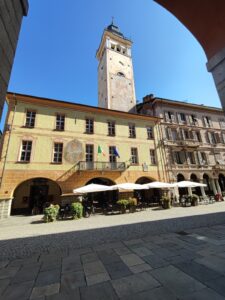
Just steps from the Duomo, don’t miss the Basilica of San Gaudenzio with its Antonelliana dome, a symbol of Novara. The Broletto, a medieval complex now home to exhibitions and the Civic Museum, is a few minutes’ walk away. If you have time, also visit Novara Castle, with its park and historic walls. For a sweet treat, the center offers historic cafés and pastry shops with the famous Novara biscuits.
Nearby
Just steps from the Duomo, don’t miss the Basilica of San Gaudenzio with its Antonelliana dome, a symbol of Novara. The Broletto, a medieval complex now home to exhibitions and the Civic Museum, is a few minutes’ walk away. If you have time, also visit Novara Castle, with its park and historic walls. For a sweet treat, the center offers historic cafés and pastry shops with the famous Novara biscuits.