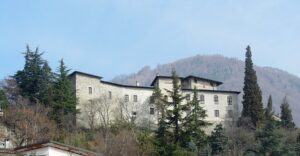
The Castello Visconti di San Vito is not just a single castle: it’s three, enclosed within one quadrangle. In Somma Lombardo, in the province of Varese, this historic residence opens its doors on Sundays from April to October, revealing 17th-century frescoes, a unique collection of shaving dishes, and artifacts from the Golasecca civilization. A journey through porticoed courtyards, frescoed halls, and panoramic towers.
• Three castles with independent courtyards and separate entrances
• Late Mannerist frescoes and a ballroom
• Collection of over 400 shaving dishes and Spanish weapons
• Accessible guided tours with LIS and sensory paths
Introduction
Imagine a castle that is actually three. The Castello Visconti di San Vito in Somma Lombardo is a unique complex: a quadrangle enclosing three independent homes, each with its own courtyard and portico. It’s like visiting three eras and three styles in one go. As soon as you enter, the elegance of the Baroque frescoes and the silence of the courtyards strike you. The towers offer a breathtaking view of the Alps and Monte Rosa. It’s not a cold museum: you can still feel the family life here.
Introduction
Imagine a castle that is actually three. The Castello Visconti di San Vito in Somma Lombardo is a unique complex: a quadrangle enclosing three independent homes, each with its own courtyard and portico. It’s like visiting three eras and three styles in one go. As soon as you enter, the elegance of the Baroque frescoes and the silence of the courtyards strike you. The towers offer a breathtaking view of the Alps and Monte Rosa. It’s not a cold museum: you can still feel the family life here.
Historical Notes
The origins date back to the 9th century as a defensive fortress. The real leap forward took place in 1448, when the brothers Francesco and Guido Visconti took refuge here and transformed the stronghold into a noble residence. In 1473, the property was divided between the two Visconti branches. Only in the 1950s did Marquis Don Alberto reunify everything. Today it is managed by the Visconti di San Vito Onlus Foundation.
- 1251: first document attesting the Visconti here.
- 1448: Francesco and Guido begin the transformation.
- 1473: division between the Visconti di San Vito and Visconti di Modrone branches.
- 1997: Visconti di San Vito Onlus Foundation.
Historical Notes
The origins date back to the 9th century as a defensive fortress. The real leap forward took place in 1448, when the brothers Francesco and Guido Visconti took refuge here and transformed the stronghold into a noble residence. In 1473, the property was divided between the two Visconti branches. Only in the 1950s did Marquis Don Alberto reunify everything. Today it is managed by the Visconti di San Vito Onlus Foundation.
- 1251: first document attesting the Visconti here.
- 1448: Francesco and Guido begin the transformation.
- 1473: division between the Visconti di San Vito and Visconti di Modrone branches.
- 1997: Visconti di San Vito Onlus Foundation.
Three Castles in One
This complex is a large quadrilateral with three courtyards. The oldest part, belonging to Guido, features an elegant portico supported by octagonal granite pillars adorned with family crests; here, vintage carriages are displayed. On the other side, Francesco’s garden leads to a portico containing the stump of the legendary thousand-year-old cypress. As you ascend the staircase, 17th-century frescoes take you by the hand. Each courtyard has its own atmosphere: from the more intimate and medieval to the airier and Baroque. It’s like walking through centuries of architecture.
Three Castles in One
This complex is a large quadrilateral with three courtyards. The oldest part, belonging to Guido, features an elegant portico supported by octagonal granite pillars adorned with family crests; here, vintage carriages are displayed. On the other side, Francesco’s garden leads to a portico containing the stump of the legendary thousand-year-old cypress. As you ascend the staircase, 17th-century frescoes take you by the hand. Each courtyard has its own atmosphere: from the more intimate and medieval to the airier and Baroque. It’s like walking through centuries of architecture.
Frescoes and Precious Collections
The ballroom is a spectacle: mythological and religious frescoes from the early 1600s attributed to the Procaccini, 17th-century furniture, bronzes, and a chandelier shaped like a sailboat. From here, you access the Chapel of the Assumption with an altarpiece by Cerano. An unmissable curiosity: the Shaving Bowl Room, over 400 basins from around the world (silver, ceramic, copper) started by Marquis Carlo Ermes. There is also a Royal Chamber with a canopy bed for the kings of Italy, 16th-century Spanish weapons, and artifacts from the Golasecca civilization. A true wunderkammer.
Frescoes and Precious Collections
The ballroom is a spectacle: mythological and religious frescoes from the early 1600s attributed to the Procaccini, 17th-century furniture, bronzes, and a chandelier shaped like a sailboat. From here, you access the Chapel of the Assumption with an altarpiece by Cerano. An unmissable curiosity: the Shaving Bowl Room, over 400 basins from around the world (silver, ceramic, copper) started by Marquis Carlo Ermes. There is also a Royal Chamber with a canopy bed for the kings of Italy, 16th-century Spanish weapons, and artifacts from the Golasecca civilization. A true wunderkammer.
Why Visit It
There are three good reasons. First: variety. In one place you find medieval and baroque architecture as well as eclectic collections – from shaving bowls to Iron Age urns. Second: it’s still alive. It’s not a static museum: the castle is used for events, and the family lived there until a few decades ago. Third: accessibility. Although privately owned, it is open from April to October with guided tours, also for people with disabilities, and sensory paths for the blind. A tailor-made experience.
Why Visit It
There are three good reasons. First: variety. In one place you find medieval and baroque architecture as well as eclectic collections – from shaving bowls to Iron Age urns. Second: it’s still alive. It’s not a static museum: the castle is used for events, and the family lived there until a few decades ago. Third: accessibility. Although privately owned, it is open from April to October with guided tours, also for people with disabilities, and sensory paths for the blind. A tailor-made experience.
When to Go
The castle is open on Sundays from April to October, with guided tours (last entry at 5 PM). The best time? Late spring, when the gardens are in bloom and the weather is mild. Arrive early in the morning, around 10 AM, to enjoy the silence in the courtyards before the crowds arrive. Autumn is equally beautiful: the park’s colors ignite and the low light illuminates the frescoes magically. Avoid summer if you don’t like the heat.
When to Go
The castle is open on Sundays from April to October, with guided tours (last entry at 5 PM). The best time? Late spring, when the gardens are in bloom and the weather is mild. Arrive early in the morning, around 10 AM, to enjoy the silence in the courtyards before the crowds arrive. Autumn is equally beautiful: the park’s colors ignite and the low light illuminates the frescoes magically. Avoid summer if you don’t like the heat.
In the Surroundings
Somma Lombardo is just the start. A short walk away, the historic center is worth a stroll: the Church of Sant’Agnese and the medieval alleyways. If you love nature, the Ticino Park is just steps away: perfect for a hike along the river through woods and farmhouses. For a dive into history, the nearby Museo della Volpe (Fox Museum) in Lonate Pozzolo tells the story of hunting tradition. Don’t miss stopping at one of the local trattorias for a plate of polenta and braised meat.
In the Surroundings
Somma Lombardo is just the start. A short walk away, the historic center is worth a stroll: the Church of Sant’Agnese and the medieval alleyways. If you love nature, the Ticino Park is just steps away: perfect for a hike along the river through woods and farmhouses. For a dive into history, the nearby Museo della Volpe (Fox Museum) in Lonate Pozzolo tells the story of hunting tradition. Don’t miss stopping at one of the local trattorias for a plate of polenta and braised meat.