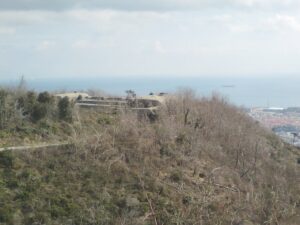
Forte Centrale del Melogno is an impressive 19th-century fortification located on Colle del Melogno (1028 m), in the province of Savona. Built between 1883 and 1895 to defend the Lower Piedmont from attacks from the coast, today it is a fascinating destination for hikers and history enthusiasts. The semi-abandoned fort retains traces of the original structure such as the barrel vaults and cannon emplacements.
• Loop trail of about 7.92 km with 260 m of elevation gain.
• Visit to the Barbottina Forest, one of the best beech forests in Italy.
• Panorama from Bric Merizzo.
• Easily reachable by car up to the Colle.
Introduction
Arriving at the Melogno Pass is a leap into the past. The Central Fort, with its polygonal shape and moat, emerges among the trees of the Barbottina Forest. It’s not a museum, but a piece of history you can touch. And then, the 7.9 km loop trek is the perfect excuse to explore the surroundings. A mix of military archaeology and wild nature that few places can offer.
Introduction
Arriving at the Melogno Pass is a leap into the past. The Central Fort, with its polygonal shape and moat, emerges among the trees of the Barbottina Forest. It’s not a museum, but a piece of history you can touch. And then, the 7.9 km loop trek is the perfect excuse to explore the surroundings. A mix of military archaeology and wild nature that few places can offer.
Historical Overview
Built between 1883 and 1895 by the Royal Army to defend Lower Piedmont from a hypothetical French invasion, the fort was part of the ‘Melogno Barrage’, together with the forts Tortagna and Merizzo. Today it is state-owned and protected as a cultural heritage site. Its strategic position at the pass at 1,028 meters made it a key point for controlling the route between the coast and the hinterland.
- 1883–1895: construction of the fort
- Second half of the 19th century: post-unification planning
- 1939: protected under Law 1089
Historical Overview
Built between 1883 and 1895 by the Royal Army to defend Lower Piedmont from a hypothetical French invasion, the fort was part of the ‘Melogno Barrage’, together with the forts Tortagna and Merizzo. Today it is state-owned and protected as a cultural heritage site. Its strategic position at the pass at 1,028 meters made it a key point for controlling the route between the coast and the hinterland.
- 1883–1895: construction of the fort
- Second half of the 19th century: post-unification planning
- 1939: protected under Law 1089
Fort Architecture
The polygonal structure is entirely surrounded by a moat. The two-story barracks still retain their original metal fixtures and brick windows. On the ground floor, a long corridor opens onto small internal courtyards; on the upper floor, traces of the wooden floor and barrel vaults remain, though the building is in a state of disrepair. The four heavy cannon emplacements are on a separate knoll, once reachable by a now-vanished drawbridge. Today, access is via a tunnel under the moat, but the second drawbridge is in dangerous condition. Do not attempt to step onto the footbridge: it is unstable.
Fort Architecture
The polygonal structure is entirely surrounded by a moat. The two-story barracks still retain their original metal fixtures and brick windows. On the ground floor, a long corridor opens onto small internal courtyards; on the upper floor, traces of the wooden floor and barrel vaults remain, though the building is in a state of disrepair. The four heavy cannon emplacements are on a separate knoll, once reachable by a now-vanished drawbridge. Today, access is via a tunnel under the moat, but the second drawbridge is in dangerous condition. Do not attempt to step onto the footbridge: it is unstable.
The Loop Trek
The route starts from the parking lot near the pass and winds for 7.9 km with an elevation gain of 260 m. You walk through the Barbottina Forest, one of Italy’s finest beech forests with trees reaching up to 50 meters. A must-stop at the Barbottina Fountain to stock up on water, then climb to Bric Merizzo for a panorama stretching from the sea to the Alps. The trail is mostly unpaved and natural, with a few short asphalt sections. Trekking shoes and water are essential; the estimated time is about 2.5 hours, but if you stop to take photos… I can’t guarantee a quick time.
The Loop Trek
The route starts from the parking lot near the pass and winds for 7.9 km with an elevation gain of 260 m. You walk through the Barbottina Forest, one of Italy’s finest beech forests with trees reaching up to 50 meters. A must-stop at the Barbottina Fountain to stock up on water, then climb to Bric Merizzo for a panorama stretching from the sea to the Alps. The trail is mostly unpaved and natural, with a few short asphalt sections. Trekking shoes and water are essential; the estimated time is about 2.5 hours, but if you stop to take photos… I can’t guarantee a quick time.
Why Visit It
Three good reasons to climb to the Colle del Melogno. 1. Military History: it’s a rare example of a 19th-century polygonal fortification, still intact in its structure. 2. Nature: the Barbottina Forest is a little gem, with monumental beech trees and a silence that fills the soul. 3. Ease of Access: the fort is easily reached by car, and the trekking is within reach of many, offering spectacular views without requiring super training. Plus, it’s free and not crowded: guaranteed peace.
Why Visit It
Three good reasons to climb to the Colle del Melogno. 1. Military History: it’s a rare example of a 19th-century polygonal fortification, still intact in its structure. 2. Nature: the Barbottina Forest is a little gem, with monumental beech trees and a silence that fills the soul. 3. Ease of Access: the fort is easily reached by car, and the trekking is within reach of many, offering spectacular views without requiring super training. Plus, it’s free and not crowded: guaranteed peace.
When to go
The best time? Spring, when the beech forest dresses in tender green, or autumn, with warm colors and mushrooms. In summer it’s cooler than on the coast, but afternoon thunderstorms happen. My advice: early morning. The light filtering through the trees is magical, and you’ll meet few hikers. In winter, if there’s snow, the landscape is spectacular but the trail can be slippery – better with snowshoes.
When to go
The best time? Spring, when the beech forest dresses in tender green, or autumn, with warm colors and mushrooms. In summer it’s cooler than on the coast, but afternoon thunderstorms happen. My advice: early morning. The light filtering through the trees is magical, and you’ll meet few hikers. In winter, if there’s snow, the landscape is spectacular but the trail can be slippery – better with snowshoes.
In the Surroundings
If you have time, don’t limit yourself to the fort. Forte Tortagna and Forte Merizzo are a short distance away and complete the defensive system. For an immersive walk, the Barbottina Forest is worth a longer detour. And after the history, treat yourself to a dip at Finale Ligure: the sea is half an hour away, perfect for cooling off after the hike.
In the Surroundings
If you have time, don’t limit yourself to the fort. Forte Tortagna and Forte Merizzo are a short distance away and complete the defensive system. For an immersive walk, the Barbottina Forest is worth a longer detour. And after the history, treat yourself to a dip at Finale Ligure: the sea is half an hour away, perfect for cooling off after the hike.