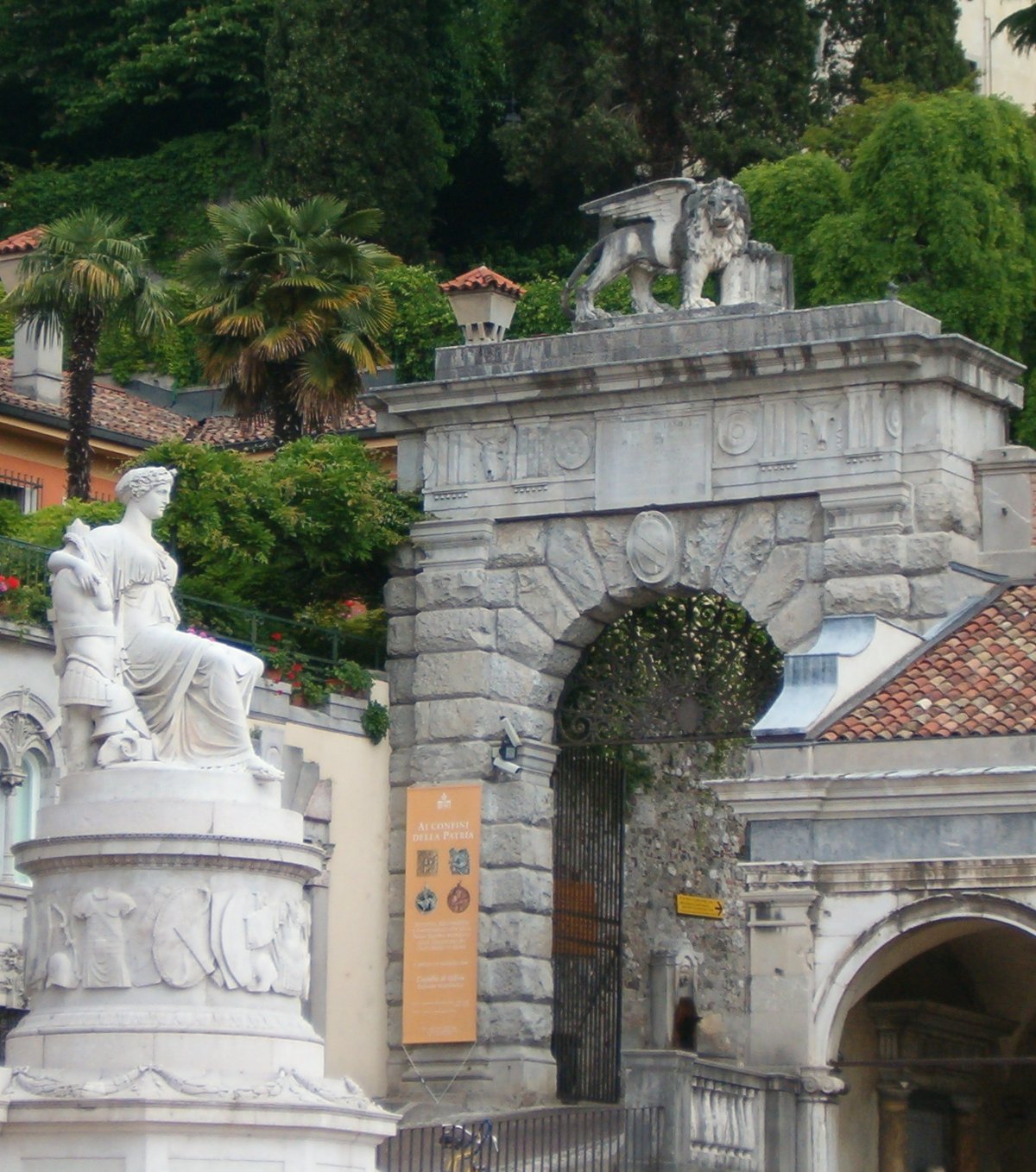
Arco Bollani is a Renaissance monument in Udine, at the foot of the hill leading to the Castle. Designed by Andrea Palladio in 1556, it is his first work in Friuli. Commissioned by Lieutenant Domenico Bollani to celebrate the end of the plague and assert Venetian dominion, the arch features rustic ashlar and a sculpted entablature. At the top stands the Lion of Saint Mark, symbol of the Serenissima, restored in 1953 after its removal by the French.
What makes Arco Bollani special?
– Palladio’s Work: it is his first piece in Friuli, with architecture combining strength and refinement.
– Fascinating History: built in 1556 to give thanks for the end of the plague and symbolize Venetian power.
– Lion of Saint Mark: the current lion made of Vicenza stone is a 1953 copy, after the original was destroyed by the French in 1797.
– Recent Restoration: in 2022, it underwent a conservative restoration funded by the Danieli Group, which cleaned and protected the stone surfaces.
Introduction
Here is the Arco Bollani, a gateway that seems to have stepped out of a Renaissance dream. Designed by Andrea Palladio in 1556, it is the monumental entrance to the Castle of Udine. I was immediately struck by the contrast between the rough ashlar stonework and the delicacy of the carved cornice. At the top, the Lion of Saint Mark gazes at you proudly: it is a symbol of the Most Serene Republic that remains intact here. It is not just an arch, it is a piece of Venetian history set in the heart of Friuli.
Introduction
Here is the Arco Bollani, a gateway that seems to have stepped out of a Renaissance dream. Designed by Andrea Palladio in 1556, it is the monumental entrance to the Castle of Udine. I was immediately struck by the contrast between the rough ashlar stonework and the delicacy of the carved cornice. At the top, the Lion of Saint Mark gazes at you proudly: it is a symbol of the Most Serene Republic that remains intact here. It is not just an arch, it is a piece of Venetian history set in the heart of Friuli.
Historical Notes
The arch was commissioned by the Venetian lieutenant
Domenico Bollani in 1556 to give thanks for the end of a plague epidemic and to assert Venetian dominion. Work began in April and finished in four months with the installation of the copper lion.
Palladio, at his debut in Friuli, also oversaw the access road in 1563. In 1797 the French removed the original lion. It was only in 1953, after the damage of World War II, that a new lion, sculpted by Emilio Caldana, was reinstalled. In the 2000s there have been restorations: the most recent in 2022 thanks to a donation from Danieli & C.
- 1556: construction of the arch
- 1797: removal of the lion by the French
- 1953: reinstallation of the lion after the war
- 2022: conservative restoration
Historical Notes
The arch was commissioned by the Venetian lieutenant
Domenico Bollani in 1556 to give thanks for the end of a plague epidemic and to assert Venetian dominion. Work began in April and finished in four months with the installation of the copper lion.
Palladio, at his debut in Friuli, also oversaw the access road in 1563. In 1797 the French removed the original lion. It was only in 1953, after the damage of World War II, that a new lion, sculpted by Emilio Caldana, was reinstalled. In the 2000s there have been restorations: the most recent in 2022 thanks to a donation from Danieli & C.
- 1556: construction of the arch
- 1797: removal of the lion by the French
- 1953: reinstallation of the lion after the war
- 2022: conservative restoration
Rusticated Ashlar and Cornice
The real strength of this arch lies in the details. The rusticated ashlar is so pronounced you can almost feel it: each stone seems carved with energy. Then you look up and discover the cornice, with triglyphs, paterae, and bucrania alternating in perfect rhythm. It’s Palladio’s touch, who knew how to combine power and grace. Up close, you can also see traces of the 2022 restoration: the stone was cleaned and treated, but without erasing the marks of time. A balance between history and conservation.
Rusticated Ashlar and Cornice
The real strength of this arch lies in the details. The rusticated ashlar is so pronounced you can almost feel it: each stone seems carved with energy. Then you look up and discover the cornice, with triglyphs, paterae, and bucrania alternating in perfect rhythm. It’s Palladio’s touch, who knew how to combine power and grace. Up close, you can also see traces of the 2022 restoration: the stone was cleaned and treated, but without erasing the marks of time. A balance between history and conservation.
The Lion of St. Mark: History and Symbol
The arch is crowned by a lion that is not the original. The one from 1556, with copper wings, was destroyed by the French in 1797. For nearly 150 years the arch remained mutilated. Then, in 1953, the director of the Civic Museums, Carlo Someda de Marco, commissioned Emilio Caldana to create a new lion, carved from a three-cubic-meter block of Vicenza stone. It weighs 3,500 kg and today watches over the city. It is the last Lion of St. Mark to return to its place in Udine: the other two are on the Clock Tower and on the column in the square.
The Lion of St. Mark: History and Symbol
The arch is crowned by a lion that is not the original. The one from 1556, with copper wings, was destroyed by the French in 1797. For nearly 150 years the arch remained mutilated. Then, in 1953, the director of the Civic Museums, Carlo Someda de Marco, commissioned Emilio Caldana to create a new lion, carved from a three-cubic-meter block of Vicenza stone. It weighs 3,500 kg and today watches over the city. It is the last Lion of St. Mark to return to its place in Udine: the other two are on the Clock Tower and on the column in the square.
Why Visit It
Three good reasons? First: it is Palladio’s only work in Friuli, and it’s worth seeing in person to grasp the architect’s mastery. Second: it symbolizes the bond between Udine and Venice, with that lion telling stories of power and plagues. Third: the location is perfect for a photo: it frames the climb to the castle and stands out against the sky. If you like architecture, you’ll appreciate it; if not, enjoy the atmosphere of Piazza Libertà, one of the most beautiful in Italy.
Why Visit It
Three good reasons? First: it is Palladio’s only work in Friuli, and it’s worth seeing in person to grasp the architect’s mastery. Second: it symbolizes the bond between Udine and Venice, with that lion telling stories of power and plagues. Third: the location is perfect for a photo: it frames the climb to the castle and stands out against the sky. If you like architecture, you’ll appreciate it; if not, enjoy the atmosphere of Piazza Libertà, one of the most beautiful in Italy.
When to Go
To avoid crowds, come in the late afternoon, when the low sun lights up the rusticated stonework and the lion seems gilded. Early morning is quiet, but the arch is in shadow until midday. In spring and autumn the weather is mild and the light is softer. Avoid summer at noon: the sun beats down and the stone is hot. However, the arch is open Tuesday to Sunday, from 10 am to 6 pm, but it’s also great to enjoy from the outside.
When to Go
To avoid crowds, come in the late afternoon, when the low sun lights up the rusticated stonework and the lion seems gilded. Early morning is quiet, but the arch is in shadow until midday. In spring and autumn the weather is mild and the light is softer. Avoid summer at noon: the sun beats down and the stone is hot. However, the arch is open Tuesday to Sunday, from 10 am to 6 pm, but it’s also great to enjoy from the outside.
Nearby
Just beyond the arch, climb to the Castle of Udine: the civic museum is interesting and the view over the city is spectacular. Before going up, wander around Piazza Libertà: the Loggia del Lionello, the Clock Tower, and the fountain are all just a few steps away. If you have time, also visit the Cathedral, a two-minute walk away. The entire historic center is a gem, with arcades and cafes where you can stop for an aperitif.
Nearby
Just beyond the arch, climb to the Castle of Udine: the civic museum is interesting and the view over the city is spectacular. Before going up, wander around Piazza Libertà: the Loggia del Lionello, the Clock Tower, and the fountain are all just a few steps away. If you have time, also visit the Cathedral, a two-minute walk away. The entire historic center is a gem, with arcades and cafes where you can stop for an aperitif.