The Arch of Augustus stands majestically at the entrance to Rimini’s historic center, a witness to over 2,000 years of history. Built in 27 BC to celebrate Emperor Augustus, it is the oldest surviving Roman arch outside of Rome. Today, you can admire it in all its grandeur, with detailed sculptures and medieval battlements that make it unique.
Why visit:
– Free monument always open, perfect for a cultural stop without a reservation.
– Unique details: shields with Jupiter, Apollo, Neptune, and the goddess Roma, and the nail marking the crossroads of Via Flaminia and Via Emilia.
– City symbol along with the Tiberius Bridge, it appears on Rimini’s coat of arms.
– Accessible to all with free parking nearby and a bus stop just steps away.
Introduction
The Arch of Augustus is the oldest Roman arch in northern Italy still standing. You are in Rimini, at the intersection of Via Flaminia and Via Emilia, and this monument welcomes you with its Istrian stone and decorations. Built in 27 BC, it is not a simple gate: it is a symbol of peace and power. Walking under its arch makes you feel history, even if surrounded by modern traffic. It is free, always accessible, and truly worth a stop.
Introduction
The Arch of Augustus is the oldest Roman arch in northern Italy still standing. You are in Rimini, at the intersection of Via Flaminia and Via Emilia, and this monument welcomes you with its Istrian stone and decorations. Built in 27 BC, it is not a simple gate: it is a symbol of peace and power. Walking under its arch makes you feel history, even if surrounded by modern traffic. It is free, always accessible, and truly worth a stop.
Historical Background
Erected in 27 BC by the Roman Senate to celebrate Augustus, the arch marked the end of the Via Flaminia, restored by the emperor. Originally flanked by two towers and the city walls, it was isolated in the 1930s. In the Middle Ages, battlements were added, while the original attic collapsed at some unknown time. The inscription above the archway, though damaged, recalls the dedication to Caesar Octavian. It has survived wars and earthquakes, and is the symbol of Rimini together with the Tiberius Bridge.
– 27 BC – construction by decree of the Senate
– 10th century – addition of medieval battlements
– 1937-1938 – demolition of lateral towers
– 1997 – redevelopment of green area
– 2022 – conservation restoration
Historical Background
Erected in 27 BC by the Roman Senate to celebrate Augustus, the arch marked the end of the Via Flaminia, restored by the emperor. Originally flanked by two towers and the city walls, it was isolated in the 1930s. In the Middle Ages, battlements were added, while the original attic collapsed at some unknown time. The inscription above the archway, though damaged, recalls the dedication to Caesar Octavian. It has survived wars and earthquakes, and is the symbol of Rimini together with the Tiberius Bridge.
– 27 BC – construction by decree of the Senate
– 10th century – addition of medieval battlements
– 1937-1938 – demolition of lateral towers
– 1997 – redevelopment of green area
– 2022 – conservation restoration
Architecture and Materials
The arch is entirely made of Istrian stone, like the nearby Tiberius Bridge. It has a single archway nearly 9 meters wide, so broad that it could not have had doors: a message of peace (Pax Augusta). The half-columns with Corinthian capitals support a tympanum. On the sides, sculpted clipei: Jupiter, Apollo, Neptune, and the goddess Roma. Above the opening, two ox skulls (bucrania) symbolize strength and prosperity. The brick battlements are medieval. Look at the remains of the ancient walls on the sides: they are made of local stone blocks, remnants of the 3rd century BC city wall.
Architecture and Materials
The arch is entirely made of Istrian stone, like the nearby Tiberius Bridge. It has a single archway nearly 9 meters wide, so broad that it could not have had doors: a message of peace (Pax Augusta). The half-columns with Corinthian capitals support a tympanum. On the sides, sculpted clipei: Jupiter, Apollo, Neptune, and the goddess Roma. Above the opening, two ox skulls (bucrania) symbolize strength and prosperity. The brick battlements are medieval. Look at the remains of the ancient walls on the sides: they are made of local stone blocks, remnants of the 3rd century BC city wall.
Symbolism and Decorations
Every detail tells a story. The deities on the shields are not random: Apollo and Jupiter face Rome, while Neptune and the goddess Roma face the city. It is a political message: Augustus brought peace and prosperity. The bucrania (ox heads) recall the founding rites of Roman colonies. The inscription in bronze letters (now lost) was gilded, hence the medieval name Porta Aurea. The absence of doors emphasizes the security of the Pax Augusta. At the top, there may have been a bronze statue of Augustus on a quadriga, but this is speculative.
Symbolism and Decorations
Every detail tells a story. The deities on the shields are not random: Apollo and Jupiter face Rome, while Neptune and the goddess Roma face the city. It is a political message: Augustus brought peace and prosperity. The bucrania (ox heads) recall the founding rites of Roman colonies. The inscription in bronze letters (now lost) was gilded, hence the medieval name Porta Aurea. The absence of doors emphasizes the security of the Pax Augusta. At the top, there may have been a bronze statue of Augustus on a quadriga, but this is speculative.
Why Visit It
First: it’s free and always open, perfect for a quick stop while exploring the city center. Second: it’s the oldest Roman arch in Northern Italy—a unique piece of history. Third: it’s located in a green pedestrian area, ideal for taking photos. Plus, it’s close to Corso d’Augusto (the shopping street) and the Tiberius Bridge: you can combine both stops in a 10-minute walk. No reservation needed—just bring your curiosity.
Why Visit It
First: it’s free and always open, perfect for a quick stop while exploring the city center. Second: it’s the oldest Roman arch in Northern Italy—a unique piece of history. Third: it’s located in a green pedestrian area, ideal for taking photos. Plus, it’s close to Corso d’Augusto (the shopping street) and the Tiberius Bridge: you can combine both stops in a 10-minute walk. No reservation needed—just bring your curiosity.
When to Go
The arch can be seen at any time, but I recommend late afternoon. The low light illuminates the Istrian stone and the sculptures, creating shadows that enhance the reliefs. If you’re lucky, the sunset colors the sky behind the monument. In summer, the evenings are pleasant for a walk. Avoid the midday hours in peak summer: the sun is harsh and there is no shade, but the arch is still an open-air monument. Spring and autumn are perfect for the mild climate.
When to Go
The arch can be seen at any time, but I recommend late afternoon. The low light illuminates the Istrian stone and the sculptures, creating shadows that enhance the reliefs. If you’re lucky, the sunset colors the sky behind the monument. In summer, the evenings are pleasant for a walk. Avoid the midday hours in peak summer: the sun is harsh and there is no shade, but the arch is still an open-air monument. Spring and autumn are perfect for the mild climate.
Nearby
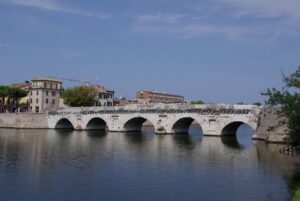
Just a few steps away is the Tiberius Bridge, another Roman jewel in Istrian stone, completed in 21 AD. Continue along Corso d’Augusto to Piazza Tre Martiri, the heart of the city. If you feel like it, visit the Tempio Malatestiano, a 5-minute walk away: a Renaissance masterpiece by Leon Battista Alberti. And for food, the area is full of places serving piadina and local Romagna specialties.
Nearby
Just a few steps away is the Tiberius Bridge, another Roman jewel in Istrian stone, completed in 21 AD. Continue along Corso d’Augusto to Piazza Tre Martiri, the heart of the city. If you feel like it, visit the Tempio Malatestiano, a 5-minute walk away: a Renaissance masterpiece by Leon Battista Alberti. And for food, the area is full of places serving piadina and local Romagna specialties.