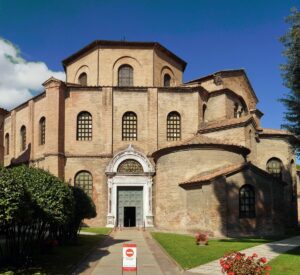
St. Peter’s Cathedral is the religious heart of Bologna, often overshadowed by the more famous San Petronio but rich in unmissable treasures. Here you’ll find masterpieces by Ludovico Carracci, Prospero Fontana, and Donato Creti, a 12th-century Romanesque Crucifix, and the renowned Lamentation over the Dead Christ by Alfonso Lombardi. Free admission and visits to the bell tower to admire the Nonna Bell, one of Italy’s largest hand-played bells.
Key points:
– Artworks: frescoes by Carracci and Fontana, sculptures by Lombardi.
– Bell tower: 70 meters, with the 33-quintal Nonna Bell and panoramic view.
– Treasury: sacred furnishings from the 15th to 20th centuries, by appointment.
– Annual event: in May, arrival of the Madonna di San Luca in procession.
A Baroque Gem in the Heart of Bologna
Just steps from Piazza Maggiore, St. Peter’s Cathedral is often overshadowed by the more famous Basilica of San Petronio, but it’s absolutely worth a visit. Its Baroque façade in red brick and white marble, designed by Alfonso Torreggiani between 1743 and 1747, is striking in its grandeur. Inside, the space is immense: the central nave is 25 meters wide and almost 90 long, with a luminous barrel-vaulted ceiling. But the real surprise is the bell tower: at 70 meters high, it’s the second tallest in the city after the Asinelli Tower, and it houses a unique sonic gem. This is not just a church – it’s an experience that blends art, faith, and bell-ringing tradition.
A Baroque Gem in the Heart of Bologna
Just steps from Piazza Maggiore, St. Peter’s Cathedral is often overshadowed by the more famous Basilica of San Petronio, but it’s absolutely worth a visit. Its Baroque façade in red brick and white marble, designed by Alfonso Torreggiani between 1743 and 1747, is striking in its grandeur. Inside, the space is immense: the central nave is 25 meters wide and almost 90 long, with a luminous barrel-vaulted ceiling. But the real surprise is the bell tower: at 70 meters high, it’s the second tallest in the city after the Asinelli Tower, and it houses a unique sonic gem. This is not just a church – it’s an experience that blends art, faith, and bell-ringing tradition.
Historical Notes: From Origins to Baroque
The history of the cathedral begins in the 4th-5th century with an early Christian church. After a fire in 906, it was rebuilt within the selenite walls. Another fire in 1141 destroyed it, and the reconstruction, entrusted to Magister Albertus, was consecrated by Pope Lucius III in 1184. An earthquake in 1222 caused the roof to collapse. The turning point came in 1582, when Pope Gregory XIII elevated it to a metropolitan cathedral. Starting in 1575, a radical Baroque renovation – led by Tibaldi, Magenta, and finally Torreggiani – erased the Romanesque forms, giving us its current appearance. Every corner tells centuries of transformations.
Historical Notes: From Origins to Baroque
The history of the cathedral begins in the 4th-5th century with an early Christian church. After a fire in 906, it was rebuilt within the selenite walls. Another fire in 1141 destroyed it, and the reconstruction, entrusted to Magister Albertus, was consecrated by Pope Lucius III in 1184. An earthquake in 1222 caused the roof to collapse. The turning point came in 1582, when Pope Gregory XIII elevated it to a metropolitan cathedral. Starting in 1575, a radical Baroque renovation – led by Tibaldi, Magenta, and finally Torreggiani – erased the Romanesque forms, giving us its current appearance. Every corner tells centuries of transformations.
La Nonna and the Bell Tower
The bell tower is a masterpiece of medieval engineering: begun in 1184 and completed in 1426, it incorporates a 10th-century paleo-Christian tower with a round base. Its belfry houses four bells, but the queen is “la Nonna”, cast in 1594 and weighing 33 quintals (3,300 kg). It is the largest bell rung “alla bolognese”, a system that requires the complete rotation of the bell. It takes 23 bell ringers to maneuver it! Climbing to the top (by reservation) offers a spectacular view of Bologna’s red rooftops, but even just listening to the deep sound of la Nonna during one of the rare performances with all four bells is a unique emotion.
La Nonna and the Bell Tower
The bell tower is a masterpiece of medieval engineering: begun in 1184 and completed in 1426, it incorporates a 10th-century paleo-Christian tower with a round base. Its belfry houses four bells, but the queen is “la Nonna”, cast in 1594 and weighing 33 quintals (3,300 kg). It is the largest bell rung “alla bolognese”, a system that requires the complete rotation of the bell. It takes 23 bell ringers to maneuver it! Climbing to the top (by reservation) offers a spectacular view of Bologna’s red rooftops, but even just listening to the deep sound of la Nonna during one of the rare performances with all four bells is a unique emotion.
Baroque Masterpieces and Hidden Treasures
Inside, the eye immediately goes to the apse: above the high altar stands out the Annunciation by Ludovico Carracci (1619), his last work. Higher up, the fresco of the Eternal Father by Prospero Fontana. But the true gem is the sculptural group of the Lamentation over the Dead Christ by Alfonso Lombardi (1522-1526), in terracotta, in the chapel of the Blessed Nicolò Albergati. Also not to be missed is the Romanesque Crucifixion in cedar wood from the 12th century on the high altar, and the crypt with the tomb of Giovanni Acquaderni. The Cathedral Treasury (visit by appointment) houses vestments and goldsmith works from the 15th to the 20th century, donated by popes such as Benedict XIV.
Baroque Masterpieces and Hidden Treasures
Inside, the eye immediately goes to the apse: above the high altar stands out the Annunciation by Ludovico Carracci (1619), his last work. Higher up, the fresco of the Eternal Father by Prospero Fontana. But the true gem is the sculptural group of the Lamentation over the Dead Christ by Alfonso Lombardi (1522-1526), in terracotta, in the chapel of the Blessed Nicolò Albergati. Also not to be missed is the Romanesque Crucifixion in cedar wood from the 12th century on the high altar, and the crypt with the tomb of Giovanni Acquaderni. The Cathedral Treasury (visit by appointment) houses vestments and goldsmith works from the 15th to the 20th century, donated by popes such as Benedict XIV.
Why You Should Visit
Three good reasons to step inside: 1) Baroque art at your fingertips – works by Carracci, Fontana, Creti, and Lombardi in a free, uncrowded setting. 2) The Nonna bell – a unique sonic experience you might be lucky enough to hear rung in the traditional “scappata” style. 3) The view from the bell tower – one of the best panoramas of the city, with red rooftops and the Two Towers on the horizon. Unlike the crowds at San Petronio, here you’ll find a more intimate and authentic atmosphere, perfect for discovering the lesser-known side of Bologna.
Why You Should Visit
Three good reasons to step inside: 1) Baroque art at your fingertips – works by Carracci, Fontana, Creti, and Lombardi in a free, uncrowded setting. 2) The Nonna bell – a unique sonic experience you might be lucky enough to hear rung in the traditional “scappata” style. 3) The view from the bell tower – one of the best panoramas of the city, with red rooftops and the Two Towers on the horizon. Unlike the crowds at San Petronio, here you’ll find a more intimate and authentic atmosphere, perfect for discovering the lesser-known side of Bologna.
When to go
The best time? Saturday afternoon, when the bell tower is open and you can combine visiting the cathedral with climbing it. If you’re lucky, you might catch a bell-ringing rehearsal – the sound of the Nonna is powerful and enveloping. In spring or autumn, the light filtering through the stained glass illuminates the frescoes magically. Avoid mass times (especially Sunday morning) if you want to explore at your own pace. A tip: arrive around 2 p.m., visit the church, then climb the bell tower and enjoy the view with the late afternoon light.
When to go
The best time? Saturday afternoon, when the bell tower is open and you can combine visiting the cathedral with climbing it. If you’re lucky, you might catch a bell-ringing rehearsal – the sound of the Nonna is powerful and enveloping. In spring or autumn, the light filtering through the stained glass illuminates the frescoes magically. Avoid mass times (especially Sunday morning) if you want to explore at your own pace. A tip: arrive around 2 p.m., visit the church, then climb the bell tower and enjoy the view with the late afternoon light.
Nearby
The cathedral is located on Via Indipendenza, a few steps from Piazza Maggiore with the Basilica of San Petronio, the Fountain of Neptune, and Palazzo Re Enzo. A stop at the Civic Archaeological Museum (Via dell’Archiginnasio 2) is a must to see the Egyptian and Etruscan collections. If you have time, walk to the Two Towers (Torre degli Asinelli and Garisenda) 5 minutes away: climbing the Torre degli Asinelli will give you a different perspective of the city, with red roofs and porticoes stretching to the horizon.
Nearby
The cathedral is located on Via Indipendenza, a few steps from Piazza Maggiore with the Basilica of San Petronio, the Fountain of Neptune, and Palazzo Re Enzo. A stop at the Civic Archaeological Museum (Via dell’Archiginnasio 2) is a must to see the Egyptian and Etruscan collections. If you have time, walk to the Two Towers (Torre degli Asinelli and Garisenda) 5 minutes away: climbing the Torre degli Asinelli will give you a different perspective of the city, with red roofs and porticoes stretching to the horizon.