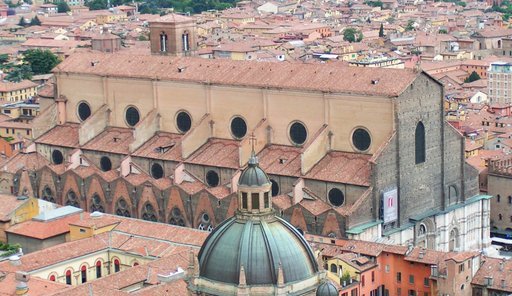
The Basilica of San Petronio is the most imposing church in Bologna, a symbol of Italian Gothic. At 132 meters long, it is the sixth in Europe and the largest built of brick. Admission is free, and inside you’ll find masterpieces like Cassini’s sundial and the oldest organ in the world.
• Admire the world’s longest sundial (67.27 m) in the left nave.
• Discover Giovanni da Modena’s frescoes of Hell in the Bolognini Chapel.
• Hear the 1470 organ by Lorenzo da Prato, still functioning.
• Climb to the terrace for a unique view of Bologna (Friday to Sunday only).
Introduction
Stepping into Piazza Maggiore and standing before the Basilica of San Petronio is a breathtaking experience: its unfinished facade, half marble and half brick, tells centuries of history. It is the largest Gothic brick church in the world, the sixth largest in Europe. It feels like a gentle giant watching over the city. The interior, with three naves and 22 side chapels, holds masterpieces that leave you speechless. But the real spectacle is the longest sundial in the world, cutting across the floor like a timeline. Here, art, science, and faith merge into a unique experience.
Introduction
Stepping into Piazza Maggiore and standing before the Basilica of San Petronio is a breathtaking experience: its unfinished facade, half marble and half brick, tells centuries of history. It is the largest Gothic brick church in the world, the sixth largest in Europe. It feels like a gentle giant watching over the city. The interior, with three naves and 22 side chapels, holds masterpieces that leave you speechless. But the real spectacle is the longest sundial in the world, cutting across the floor like a timeline. Here, art, science, and faith merge into a unique experience.
Historical Notes
The first stone was laid on
June 7, 1390 by order of the City Council, not the Church. Architect
Antonio di Vincenzo designed a Latin cross plan, but construction stopped several times. In 1514, Arduino degli Arriguzzi proposed a project that would have surpassed St. Peter’s in Rome, but Pope Pius IV blocked the expansion by building the Archiginnasio. In 1655, astronomer
Giandomenico Cassini created the sundial. In 1929, the basilica passed from the State to the Diocese, and was only consecrated in 1954. Here are the key moments:
- 1388: decree of the Council of Six Hundred
- 1390: start of construction
- 1479: end of first phase
- 1530: coronation of Charles V
- 1655: Cassini’s sundial
- 1954: consecration
Historical Notes
The first stone was laid on
June 7, 1390 by order of the City Council, not the Church. Architect
Antonio di Vincenzo designed a Latin cross plan, but construction stopped several times. In 1514, Arduino degli Arriguzzi proposed a project that would have surpassed St. Peter’s in Rome, but Pope Pius IV blocked the expansion by building the Archiginnasio. In 1655, astronomer
Giandomenico Cassini created the sundial. In 1929, the basilica passed from the State to the Diocese, and was only consecrated in 1954. Here are the key moments:
- 1388: decree of the Council of Six Hundred
- 1390: start of construction
- 1479: end of first phase
- 1530: coronation of Charles V
- 1655: Cassini’s sundial
- 1954: consecration
The Longest Sundial in the World
In the left aisle, a marble line 67.27 meters long runs across the floor: it is the longest sundial in an enclosed space. Created by Egnazio Danti in 1576 and refined by Cassini in 1655, it corresponds to the 600,000th part of the Earth’s meridian. Each day, a ray of sunlight enters through a hole 27 meters high and indicates the exact time. Watching the beam of light slowly slide along the line is almost hypnotic: it combines astronomy and architecture in a spectacular way.
The Longest Sundial in the World
In the left aisle, a marble line 67.27 meters long runs across the floor: it is the longest sundial in an enclosed space. Created by Egnazio Danti in 1576 and refined by Cassini in 1655, it corresponds to the 600,000th part of the Earth’s meridian. Each day, a ray of sunlight enters through a hole 27 meters high and indicates the exact time. Watching the beam of light slowly slide along the line is almost hypnotic: it combines astronomy and architecture in a spectacular way.
Chapels and Hidden Masterpieces
The 22 chapels are a treasure trove of art. The Cappella Bolognini (also known as the Chapel of the Magi) astonishes with frescoes by Giovanni da Modena: a Dantean Inferno with a monstrous Satan, Paradise, and the Stories of the Magi. Next to it, the wooden polyptych by Jacopo di Paolo. In Chapel V, Lorenzo Costa painted a Madonna enthroned. Parmigianino’s San Rocco (1527) is considered by Vasari as «very beautiful». Don’t miss the organ by Lorenzo da Prato (1470), the oldest functioning organ in the world. Each chapel tells a different story.
Chapels and Hidden Masterpieces
The 22 chapels are a treasure trove of art. The Cappella Bolognini (also known as the Chapel of the Magi) astonishes with frescoes by Giovanni da Modena: a Dantean Inferno with a monstrous Satan, Paradise, and the Stories of the Magi. Next to it, the wooden polyptych by Jacopo di Paolo. In Chapel V, Lorenzo Costa painted a Madonna enthroned. Parmigianino’s San Rocco (1527) is considered by Vasari as «very beautiful». Don’t miss the organ by Lorenzo da Prato (1470), the oldest functioning organ in the world. Each chapel tells a different story.
Why Visit It
Three reasons not to miss San Petronio: 1) Unique sundial in the world: watching the sunbeam mark the time is an experience blending art and science. 2) 1470 organ: hearing this historic instrument is like stepping into the Middle Ages. 3) Free entry: unlike many Italian churches, entry is free here. If you want a stunning view, climb up to the panoramic terrace (54 meters) for a full panorama of Bologna. All in the very center, steps away from everything.
Why Visit It
Three reasons not to miss San Petronio: 1) Unique sundial in the world: watching the sunbeam mark the time is an experience blending art and science. 2) 1470 organ: hearing this historic instrument is like stepping into the Middle Ages. 3) Free entry: unlike many Italian churches, entry is free here. If you want a stunning view, climb up to the panoramic terrace (54 meters) for a full panorama of Bologna. All in the very center, steps away from everything.
When to Go
The magical moment is early morning, when the sun’s rays stream through the window and light up the sundial: if you’re lucky, you’ll see the beam of light cutting across the floor. Alternatively, late afternoon offers a warm light on the unfinished façade, perfect for photos. Avoid lunchtime if you’re seeking silence; in winter, the church is emptier and more intimate. In summer, mornings are cooler and less crowded.
When to Go
The magical moment is early morning, when the sun’s rays stream through the window and light up the sundial: if you’re lucky, you’ll see the beam of light cutting across the floor. Alternatively, late afternoon offers a warm light on the unfinished façade, perfect for photos. Avoid lunchtime if you’re seeking silence; in winter, the church is emptier and more intimate. In summer, mornings are cooler and less crowded.
In the Surroundings
Step outside and you’re already in Piazza Maggiore: admire the Palazzo del Podestà and Giambologna’s Neptune Fountain. A few steps away, the Archiginnasio (former university seat) is worth a visit for its wooden anatomical theater. If you love art, the Musei Civici d’Arte Antica in Palazzo d’Accursio house works from the Middle Ages to the 19th century. All on foot, at a leisurely pace.
In the Surroundings
Step outside and you’re already in Piazza Maggiore: admire the Palazzo del Podestà and Giambologna’s Neptune Fountain. A few steps away, the Archiginnasio (former university seat) is worth a visit for its wooden anatomical theater. If you love art, the Musei Civici d’Arte Antica in Palazzo d’Accursio house works from the Middle Ages to the 19th century. All on foot, at a leisurely pace.