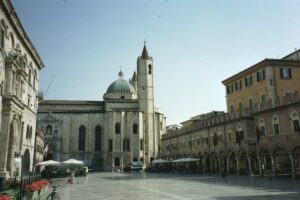
The National Gallery of the Marche is located in the splendid Ducal Palace of Urbino, a Renaissance masterpiece commissioned by Federico da Montefeltro. It houses masterpieces by Piero della Francesca, Raphael, Titian, and many others, across 73 rooms on the main floor. Open Tuesday to Sunday (8:30 AM–7:15 PM), with full ticket at €12 and reduced at €2.
• Absolute masterpieces: Flagellation and Madonna of Senigallia by Piero, La Muta by Raphael, Ideal City
• Renaissance architecture: courtyard of honor, torricini towers, inlaid studiolo
• Location: Piazza Rinascimento, Urbino, easily reachable
• Services: bookshop, cloakroom, guided tours by reservation
Welcome to the Heart of the Renaissance
Stepping into the Galleria Nazionale delle Marche means immersing yourself in the dream of Federico da Montefeltro, the condottiero who transformed Urbino into one of the most brilliant centers of the Renaissance. The palace itself is a masterpiece: the courtyard of honor by Luciano Laurana, the facade with its turrets, the inlays of the studiolo. But it is the artworks that leave you breathless: the Flagellation by Piero della Francesca, the Madonna of Senigallia, the mysterious Ideal City. Every room tells a story, and the atmosphere is that of a cultured and refined court. A journey into art that is worth the trip to Urbino.
Welcome to the Heart of the Renaissance
Stepping into the Galleria Nazionale delle Marche means immersing yourself in the dream of Federico da Montefeltro, the condottiero who transformed Urbino into one of the most brilliant centers of the Renaissance. The palace itself is a masterpiece: the courtyard of honor by Luciano Laurana, the facade with its turrets, the inlays of the studiolo. But it is the artworks that leave you breathless: the Flagellation by Piero della Francesca, the Madonna of Senigallia, the mysterious Ideal City. Every room tells a story, and the atmosphere is that of a cultured and refined court. A journey into art that is worth the trip to Urbino.
A Renaissance Dream: The Story
Construction of the Ducal Palace began around 1450 under the guidance of Maso di Bartolomeo, but it was
Luciano Laurana who gave it the form we know today, organizing the spaces around the courtyard and creating the Torricini façade.
Francesco di Giorgio Martini completed the work with the hanging garden and the duchess’s apartment. Federico obtained the ducal title in 1474, and the palace became a symbol of his power. After the end of the duchy (1631), the original collections were dispersed. The
National Gallery was established in 1912 and today houses works from all over the Marche. Here are the key moments:
- 1444: Federico da Montefeltro becomes lord of Urbino
- c. 1450: Start of palace construction
- 1474: Federico appointed duke
- 1912: Establishment of the National Gallery of the Marche
A Renaissance Dream: The Story
Construction of the Ducal Palace began around 1450 under the guidance of Maso di Bartolomeo, but it was
Luciano Laurana who gave it the form we know today, organizing the spaces around the courtyard and creating the Torricini façade.
Francesco di Giorgio Martini completed the work with the hanging garden and the duchess’s apartment. Federico obtained the ducal title in 1474, and the palace became a symbol of his power. After the end of the duchy (1631), the original collections were dispersed. The
National Gallery was established in 1912 and today houses works from all over the Marche. Here are the key moments:
- 1444: Federico da Montefeltro becomes lord of Urbino
- c. 1450: Start of palace construction
- 1474: Federico appointed duke
- 1912: Establishment of the National Gallery of the Marche
Unmissable Masterpieces
The gallery houses works that have made art history. At the top is Piero della Francesca’s Flagellation, an enigmatic painting that divides scholars. Then Piero’s Madonna of Senigallia, with its suspended light. In the Sala degli Angeli, the Ideal City stands out, attributed to Leon Battista Alberti or Laurana: a square without human figures, pure ideal architecture. Don’t miss Raphael’s Portrait of a Gentlewoman (La Muta) and the Saint Catherine of Alexandria, perhaps his early work. Titian is present with the Last Supper and the Resurrection. Every room is a surprise.
Unmissable Masterpieces
The gallery houses works that have made art history. At the top is Piero della Francesca’s Flagellation, an enigmatic painting that divides scholars. Then Piero’s Madonna of Senigallia, with its suspended light. In the Sala degli Angeli, the Ideal City stands out, attributed to Leon Battista Alberti or Laurana: a square without human figures, pure ideal architecture. Don’t miss Raphael’s Portrait of a Gentlewoman (La Muta) and the Saint Catherine of Alexandria, perhaps his early work. Titian is present with the Last Supper and the Resurrection. Every room is a surprise.
The Architecture of the Ducal Palace
The palace is a total work of art. Laurana’s Cortile d’Onore, with its columned portico and the inscription FE-DUX, is the beating heart. From here you access Federico’s Studiolo, paneled with wooden inlays that simulate bookshelves, musical instruments, and weapons, the work of Baccio Pontelli and Sandro Botticelli. The walls are frescoed with portraits of Illustrious Men by Justus of Ghent and Pedro Berruguete. The Monumental Staircase leads to the piano nobile, where a succession of rooms is decorated with gilt stuccoes, tapestries, and frescoes. Don’t miss the Cappella del Perdono and the Tempietto delle Muse, gems of Renaissance intimacy.
The Architecture of the Ducal Palace
The palace is a total work of art. Laurana’s Cortile d’Onore, with its columned portico and the inscription FE-DUX, is the beating heart. From here you access Federico’s Studiolo, paneled with wooden inlays that simulate bookshelves, musical instruments, and weapons, the work of Baccio Pontelli and Sandro Botticelli. The walls are frescoed with portraits of Illustrious Men by Justus of Ghent and Pedro Berruguete. The Monumental Staircase leads to the piano nobile, where a succession of rooms is decorated with gilt stuccoes, tapestries, and frescoes. Don’t miss the Cappella del Perdono and the Tempietto delle Muse, gems of Renaissance intimacy.
Three Good Reasons to Visit
First: seeing the masterpieces of Piero della Francesca in person, which are preserved here in a setting that enhances their beauty. Second: immersing yourself in the architecture of the Ducal Palace, which in itself is worth the trip: every room is a work of art, from the study to the reception halls. Third: the unique atmosphere of Urbino, a UNESCO World Heritage city, which retains its Renaissance character intact. The gallery also offers high-level temporary exhibitions, such as the recently staged one on Federico Barocci. In short, an experience that combines art, history, and architecture in one go.
Three Good Reasons to Visit
First: seeing the masterpieces of Piero della Francesca in person, which are preserved here in a setting that enhances their beauty. Second: immersing yourself in the architecture of the Ducal Palace, which in itself is worth the trip: every room is a work of art, from the study to the reception halls. Third: the unique atmosphere of Urbino, a UNESCO World Heritage city, which retains its Renaissance character intact. The gallery also offers high-level temporary exhibitions, such as the recently staged one on Federico Barocci. In short, an experience that combines art, history, and architecture in one go.
The Best Time to Visit
If you have a choice, aim for early morning, shortly after opening at 8:30: the low light illuminates the courtyard and rooms with a magical atmosphere, and you avoid the queues. Avoid Mondays, the closing day, and prefer weekdays for a quieter visit. In summer, from July 1 to September 30, the gallery is also open on Monday afternoons, a great opportunity if you’re in the area. The first Sunday of the month offers free entry, but it’s crowded. For photographers, the late afternoon provides warm light on the brick facades.
The Best Time to Visit
If you have a choice, aim for early morning, shortly after opening at 8:30: the low light illuminates the courtyard and rooms with a magical atmosphere, and you avoid the queues. Avoid Mondays, the closing day, and prefer weekdays for a quieter visit. In summer, from July 1 to September 30, the gallery is also open on Monday afternoons, a great opportunity if you’re in the area. The first Sunday of the month offers free entry, but it’s crowded. For photographers, the late afternoon provides warm light on the brick facades.
Around the Palace
Inside the Ducal Palace itself, don’t miss the Museum of Ceramics on the second floor, featuring splendid examples of 16th-century Urbino majolica. Next to it, a rich collection of drawings and prints. If you want an outdoor break, the Giardino del Pasquino offers a beautiful view of the city and is accessible from the first floor (wheelchair accessible). From here you can admire the profile of Urbino and the surrounding hills. For history enthusiasts, the Superintendence of Artistic Heritage and the Lapidary Archaeological Museum are housed in the same building.
Around the Palace
Inside the Ducal Palace itself, don’t miss the Museum of Ceramics on the second floor, featuring splendid examples of 16th-century Urbino majolica. Next to it, a rich collection of drawings and prints. If you want an outdoor break, the Giardino del Pasquino offers a beautiful view of the city and is accessible from the first floor (wheelchair accessible). From here you can admire the profile of Urbino and the surrounding hills. For history enthusiasts, the Superintendence of Artistic Heritage and the Lapidary Archaeological Museum are housed in the same building.