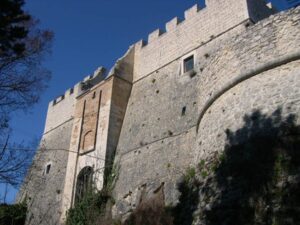
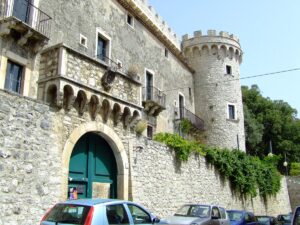
Castello D’Alessandro towers over Pescolanciano with its imposing hexagonal layout. Built in the 10th century and later transformed into a noble residence, it is linked to the history of fencing thanks to the treatise of Giuseppe d’Alessandro. Inside, admire the private chapel from 1628 with Baroque altars. Open by appointment or during the festival on August 26.
Highlights:
– Hexagonal layout and strategic position along the tratturo.
– Baroque chapel with polychrome marbles from the Neapolitan school.
– Connection to fencing: a foundational treatise was born here in 1723.
– Special events: sword and foil tournament in 2023.
A plunge into the Middle Ages
Perched on a rocky spur, Castello D’Alessandro dominates the Trigno valley with its imposing silhouette. As soon as you see it, you know it’s no ordinary castle: a pentagonal layout, sheer walls, and a drawbridge that takes you centuries back in time. You can feel the history here, made of battles, intrigues, and passions. And then, inside, a Baroque surprise awaits you, one you’d never expect.
A plunge into the Middle Ages
Perched on a rocky spur, Castello D’Alessandro dominates the Trigno valley with its imposing silhouette. As soon as you see it, you know it’s no ordinary castle: a pentagonal layout, sheer walls, and a drawbridge that takes you centuries back in time. You can feel the history here, made of battles, intrigues, and passions. And then, inside, a Baroque surprise awaits you, one you’d never expect.
Historical Notes
The origins of the castle date back to the 10th century, when it was a Samnite fortification later remodeled by the Lombards and Franks. Passed from the Carafa to the D’Alessandro family in 1567, the castle was transformed into a noble residence.
The 1805 earthquake severely damaged it, but it was restored. During the world wars, it served as a prison and headquarters. Today, it is a restored gem. Here are the key moments:
- 573 – Original main tower (uncertain date)
- 10th century – Construction of the castle
- 1567 – Acquired by the D’Alessandro family
- 1628 – Completion of the family chapel
- 1723 – Giuseppe d’Alessandro writes the fencing treatise
- 1805 – Damaging earthquake
- 1996 – Start of restoration
Historical Notes
The origins of the castle date back to the 10th century, when it was a Samnite fortification later remodeled by the Lombards and Franks. Passed from the Carafa to the D’Alessandro family in 1567, the castle was transformed into a noble residence.
The 1805 earthquake severely damaged it, but it was restored. During the world wars, it served as a prison and headquarters. Today, it is a restored gem. Here are the key moments:
- 573 – Original main tower (uncertain date)
- 10th century – Construction of the castle
- 1567 – Acquired by the D’Alessandro family
- 1628 – Completion of the family chapel
- 1723 – Giuseppe d’Alessandro writes the fencing treatise
- 1805 – Damaging earthquake
- 1996 – Start of restoration
The Baroque Chapel: A Hidden Gem
As you enter the castle, don’t miss the 1628 family chapel. Two Baroque altars with inlaid colored marble from the Neapolitan school: an explosion of elegance contrasting with the fortress’s ruggedness. The relics of Saint Alexander the Martyr arrived here in 1673. Every detail is carefully crafted, as if it were a small cathedral. Too bad a crack on the northwest side threatens the structure – hopefully restoration will secure it.
The Baroque Chapel: A Hidden Gem
As you enter the castle, don’t miss the 1628 family chapel. Two Baroque altars with inlaid colored marble from the Neapolitan school: an explosion of elegance contrasting with the fortress’s ruggedness. The relics of Saint Alexander the Martyr arrived here in 1673. Every detail is carefully crafted, as if it were a small cathedral. Too bad a crack on the northwest side threatens the structure – hopefully restoration will secure it.
Fencing and History: Giuseppe d’Alessandro’s Treatise
In 1723, during a forced exile, Giuseppe d’Alessandro wrote “The Art of the Sword Profession and Other Exercises”, a treatise that became foundational for modern fencing. Today, the castle honors this tradition: in September 2023, it hosted the first sword and foil tournament, with athletes from the Italian national team. If you are passionate about the history of fencing, here you’ll find a unique connection between the walls and the blade.
Fencing and History: Giuseppe d’Alessandro’s Treatise
In 1723, during a forced exile, Giuseppe d’Alessandro wrote “The Art of the Sword Profession and Other Exercises”, a treatise that became foundational for modern fencing. Today, the castle honors this tradition: in September 2023, it hosted the first sword and foil tournament, with athletes from the Italian national team. If you are passionate about the history of fencing, here you’ll find a unique connection between the walls and the blade.
Why Visit It
Three good reasons: first, it is a rare example of a castle that combines military architecture and baroque art – the chapel is unique. Second, the connection to fencing: it’s a piece of sports history. Third, it’s off the beaten path: no crowds, only authenticity. And if you go on August 26, the feast of St. Alexander enlivens the village with events.
Why Visit It
Three good reasons: first, it is a rare example of a castle that combines military architecture and baroque art – the chapel is unique. Second, the connection to fencing: it’s a piece of sports history. Third, it’s off the beaten path: no crowds, only authenticity. And if you go on August 26, the feast of St. Alexander enlivens the village with events.
When to Go
The best time? August 26 for the Feast of Saint Alexander, when the castle opens its doors and the town comes alive. But also in autumn: the colors of the Trigno valley provide a perfect backdrop. If you prefer tranquility, book a visit in spring – the light is soft and the crowds are zero.
When to Go
The best time? August 26 for the Feast of Saint Alexander, when the castle opens its doors and the town comes alive. But also in autumn: the colors of the Trigno valley provide a perfect backdrop. If you prefer tranquility, book a visit in spring – the light is soft and the crowds are zero.
In the Surroundings
Just a stone’s throw from the castle, the Castel di Sangro-Lucera sheep track takes you back in time: an ancient transhumance route. And if you’re in the mood for archaeology, visit Pietrabbondante with its Samnite theater – a site that even the researchers hosted at the castle have studied. Two stops that complete the journey into Molise’s history.
In the Surroundings
Just a stone’s throw from the castle, the Castel di Sangro-Lucera sheep track takes you back in time: an ancient transhumance route. And if you’re in the mood for archaeology, visit Pietrabbondante with its Samnite theater – a site that even the researchers hosted at the castle have studied. Two stops that complete the journey into Molise’s history.