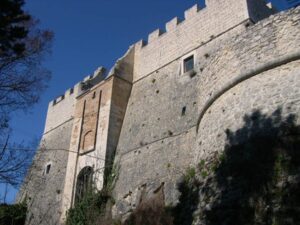
Discover the most authentic Molise with this 2-day itinerary through the lesser-known villages of Campobasso province. A journey that will take you to explore perfectly preserved medieval castles, living local traditions, and breathtaking views over the Molise hills. Start from Campobasso to explore villages like Gambatesa with its Angevin castle and Ferrazzano perched on a rocky spur. The second day awaits you with San Polo Matese with its ancient pastoral traditions and Ripalimosani with its characteristic historic center. This authentic Molise villages itinerary will introduce you to a region where time seems to have stood still, between genuine food and wine and sincere hospitality.
🗺️ Your trip at a glance
A 2-day itinerary to discover the lesser-known villages of Molise, among medieval castles, Romanesque churches, and mysterious symbols.
- Ideal for travelers looking for authenticity and history off the main tourist routes.
- Highlights: six well-defined stops, including three medieval castles, two historic churches, and an enigmatic symbol, with interactive maps for each location.
- Perfect for those who love art, local history, and hilly landscapes, with a focus on architectural details and cultural traditions.
Itinerary stops
Day 1 - Stop no. 1
Castello Di Capua
 The Castello Di Capua in Gambatesa is the ideal starting point for discovering the authentic villages of Molise. Located in Largo Castello, this 16th-century fortress rises imposingly on the hill, offering a panoramic view over the Tappino valley. Inside, the frescoes by Donato Decumbertino, known as the 'Painter of Gambatesa', depict mythological and allegorical scenes that narrate the local Renaissance culture. The halls preserve period furnishings and architectural details such as stone fireplaces and cross vaults. The castle, once the residence of the Di Capua family, is now a museum hosting temporary exhibitions and cultural events, connecting the past to the contemporary life of the village. Its strategic position makes it a privileged observatory for understanding the history of the Molise territory.
- Go to the page: Castello Di Capua: Renaissance Frescoes by Decumbertino and Views of the Tappino Valley
- Largo Castello, Gambatesa (CB)
- Open in Google Maps
- View on Google Images

You should go if...
Day 1 - Stop no. 2
Carafa Baronial Castle
 Leaving behind the first village of the itinerary, you reach Ferrazzano, where the Carafa Baronial Castle stands imposingly over Piazza Vincenzo Spensieri. Built between the 11th and 12th centuries, this fortress represents one of the best-preserved examples of Molisan military architecture. Its walls of local stone tell centuries of dominations, from the Lombards to the Carafa family, who held the fiefdom from the 16th century. Climbing the main tower, your gaze sweeps across the village rooftops and surrounding hills, offering a unique perspective on the territory. Inside, with its noble halls and patrol walkways, traces of frescoes and original defensive structures remain. Visiting means immersing yourself in a history made of battles and power, where every stone speaks of a past that has shaped the identity of these places.
- Piazza Vincenzo Spensieri, Ferrazzano (CB)
- Open in Google Maps
- View on Google Images
You should go if...
Day 1 - Stop no. 3
Castello D'Evoli
 Continuing the journey through the authentic villages of Molise, you arrive at Castropignano, where Castello D'Evoli stands majestically along Provincial Road 169 Molesana. Built in the 14th century, this castle represents a significant example of Molisan fortified architecture, with its cylindrical towers and stone walls bearing witness to a past of territorial control. Originally owned by the Evoli family, the castle has seen various dominations alternate, enriching it with historical layers. Inside, you can admire the remains of noble halls and defensive systems, while from the top of the towers you enjoy a panoramic view of the surrounding green hills, offering a unique glimpse of the Molisan rural landscape. Visiting it allows you to grasp the essence of an era when these fortresses were the beating heart of local life.
- Strada Provinciale 169 Molesana, Castropignano (CB)
- Open in Google Maps
- View on Google Images
You should go if...
Day 2 - Stop no. 1
Co-Cathedral of Saint Bartholomew
 Beginning the second day of the journey through the authentic villages of Molise, the Co-Cathedral of Saint Bartholomew in Bojano presents itself as a jewel of spirituality and history. Located in Largo Duomo, this church boasts ancient origins, with architectural elements ranging from Romanesque to Baroque, the result of subsequent reconstructions. Inside, the restored frescoes and the main altar stand out, while the crypt preserves artifacts from the Lombard era. Its position in the historic center of Bojano makes it a reference point for the community, with religious events that enliven local traditions. Visiting it offers an immersion in Molisan faith and art, enriching the itinerary with a touch of authentic sacredness.
- Largo Duomo, Bojano (CB)
- Open in Google Maps
- View on Google Images
You should go if...
Day 2 - Stop no. 2
Santa Maria della Strada
 Leaving the morning villages behind, you reach Santa Maria della Strada, a Romanesque abbey that emerges solitary among the cultivated fields of Matrice. The building dates back to the 12th century and represents one of the most intact examples of Benedictine architecture in Molise. The façade of local stone, sober and elegant, conceals an interior with three naves featuring carved capitals that tell biblical stories and medieval symbols. Particularly evocative is the central rose window, a stone tracery that filters light creating shadow plays on the main altar. Recent restorations have enhanced the fourteenth-century frescoes, including a Madonna and Child from the Umbrian-Marchigian school. The site, mentioned in documents from 1139, was a mandatory stop for pilgrims heading to the Sanctuary of Saint Michael the Archangel on Gargano. Today, the silence enveloping the church allows you to fully grasp the mystical atmosphere of the place, far from tourist flows.
- Strada Provinciale Matrice - Santa Maria della Strada, Matrice (CB)
- https://www.santamariadellastradacb.it/
- Open in Google Maps
- View on Google Images
You should go if...
Day 2 - Stop no. 3
Sator
 After leaving the solitary Abbey of Santa Maria della Strada, the route continues towards Acquaviva Collecroce, where in Piazza Nicola Neri you'll discover the mysterious Sator Square. This enigmatic palindrome, carved on a stone slab, represents one of the most fascinating symbols of Molise's heritage. The five Latin words - SATOR, AREPO, TENET, OPERA, ROTAS - form a grid that can be read in all directions, creating a rebus that for centuries has fueled both esoteric and Christian interpretations. The square, heart of the Croatian-Molise village, preserves the authentic atmosphere of a community that keeps alive unique linguistic and cultural traditions. The central position of the monument underscores its historical importance, while the simplicity of its presentation invites silent reflection on the hidden meaning of these ancient words.
- Piazza Nicola Neri - Kjaka Nikola Nera, Acquaviva Collecroce (CB)
- Open in Google Maps
- View on Google Images
You should go if...