Introduction
Beneath the modern Liceo Classico of Asti lies a true treasure trove of history: the Cripta e Museo di Sant’Anastasio. Just steps from the city center, you can walk on slabs of the Roman forum, observe Lombard tombs, and admire Romanesque capitals. It’s a vertical journey that takes you from Roman Asti to the 11th century, passing through Lombard worship. All within an intimate, almost cozy space that feels like a discovery. Entering means literally descending into history: the soft light, the reused columns, the stones worn by time. An unexpected place that speaks of layers and a city that has always known how to reinvent itself.
Introduction
Beneath the modern Liceo Classico of Asti lies a true treasure trove of history: the Cripta e Museo di Sant’Anastasio. Just steps from the city center, you can walk on slabs of the Roman forum, observe Lombard tombs, and admire Romanesque capitals. It’s a vertical journey that takes you from Roman Asti to the 11th century, passing through Lombard worship. All within an intimate, almost cozy space that feels like a discovery. Entering means literally descending into history: the soft light, the reused columns, the stones worn by time. An unexpected place that speaks of layers and a city that has always known how to reinvent itself.
Historical Overview
The origins of the crypt are linked to the Lombard king
Liutprand (712-744), who promoted the cult of Saint Anastasius the Persian. Here stood a
Benedictine nunnery, documented from 1008 but possibly already existing in the 8th century. The Romanesque church was later expanded in the 12th century. In the 17th century, it was almost entirely rebuilt in Baroque style, and in 1907, it was demolished to make way for a high school. During the excavations, the crypt and the remains of the previous phases emerged. An extraordinary recovery that today allows us to read 2000 years of history in a single site.
- 8th century: Lombard foundation of the sanctuary
- 1008: first mention of the Benedictine monastery
- 12th century: Romanesque expansion of the church
- 1597-1619: Baroque reconstruction
- 1802: Napoleonic suppression of the convent
- 1907: demolition and discovery of the crypt
Historical Overview
The origins of the crypt are linked to the Lombard king
Liutprand (712-744), who promoted the cult of Saint Anastasius the Persian. Here stood a
Benedictine nunnery, documented from 1008 but possibly already existing in the 8th century. The Romanesque church was later expanded in the 12th century. In the 17th century, it was almost entirely rebuilt in Baroque style, and in 1907, it was demolished to make way for a high school. During the excavations, the crypt and the remains of the previous phases emerged. An extraordinary recovery that today allows us to read 2000 years of history in a single site.
- 8th century: Lombard foundation of the sanctuary
- 1008: first mention of the Benedictine monastery
- 12th century: Romanesque expansion of the church
- 1597-1619: Baroque reconstruction
- 1802: Napoleonic suppression of the convent
- 1907: demolition and discovery of the crypt
The Romanesque Crypt
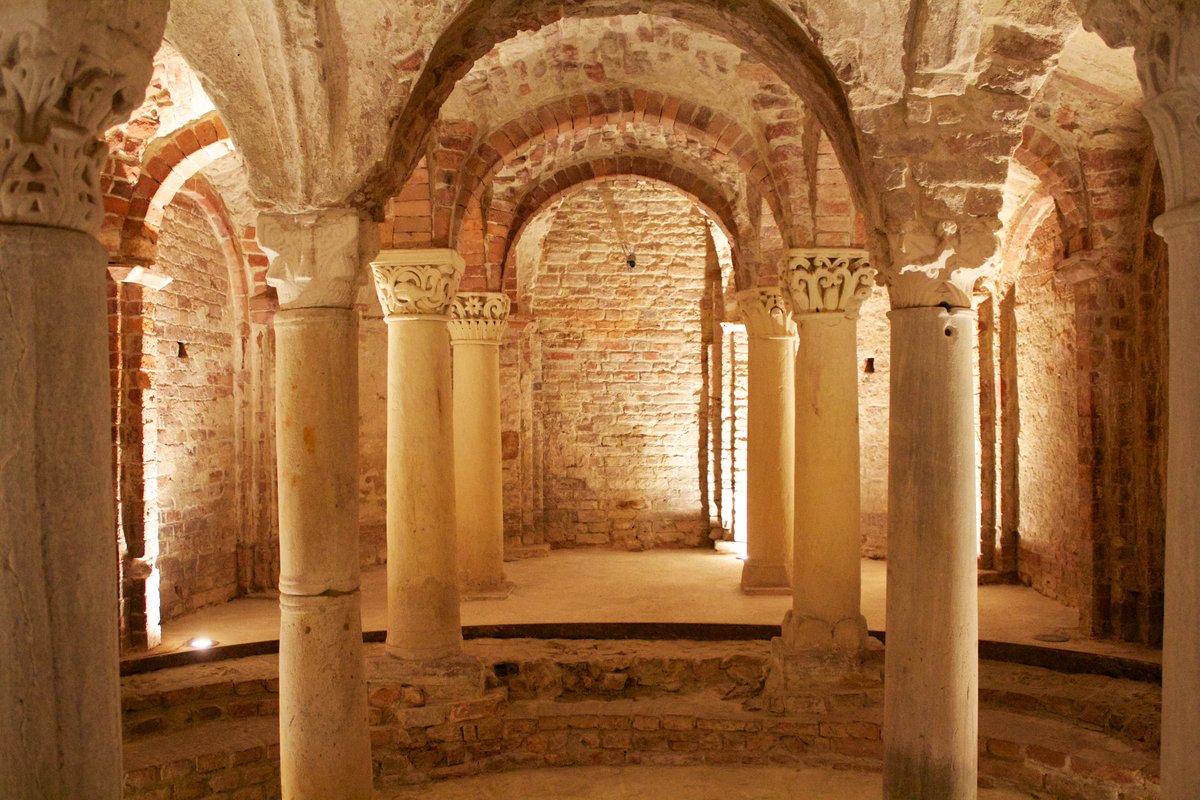
The heart of the complex is the basilica-plan crypt with three aisles and cross vaults. The first three bays date back to the year 1000 and reuse Roman materials: fluted columns, late Roman Corinthian capitals, and molded bases. The first north column stands out, with an early medieval capital (8th century) decorated with engraved Greek crosses. The eastern part is a 12th-century extension, with four sandstone columns carved with animal tendrils, leaves, and scrolls. Walking among these columns, with your feet on Roman slabs, is an almost mystical experience. Every detail tells a story: the marks of demolition picks, the crosses of monks, the wear of centuries.
The Romanesque Crypt
The heart of the complex is the basilica-plan crypt with three aisles and cross vaults. The first three bays date back to the year 1000 and reuse Roman materials: fluted columns, late Roman Corinthian capitals, and molded bases. The first north column stands out, with an early medieval capital (8th century) decorated with engraved Greek crosses. The eastern part is a 12th-century extension, with four sandstone columns carved with animal tendrils, leaves, and scrolls. Walking among these columns, with your feet on Roman slabs, is an almost mystical experience. Every detail tells a story: the marks of demolition picks, the crosses of monks, the wear of centuries.
The Lapidary Museum
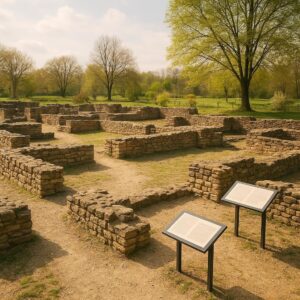
The museum (closed for reorganization, but the crypt is open to visitors) houses stone artifacts from the 7th to the 16th century. In addition to the Romanesque capitals of the church, you can admire elements from the Gothic church of La Maddalena (demolished in the 19th century), coats of arms of fortified houses, a 13th-14th century paliotto from the church of San Pietro in Consavia, and a Roman funerary stele from the 1st century AD discovered near San Secondo. Each piece is a fragment of the city’s history, from the towers of noble families to vanished churches. The western part of the site reveals the archaeological stratification: from the Roman forum with its opus caementicium pavement, to Lombard tombs, and up to the walls of later churches.
The Lapidary Museum
The museum (closed for reorganization, but the crypt is open to visitors) houses stone artifacts from the 7th to the 16th century. In addition to the Romanesque capitals of the church, you can admire elements from the Gothic church of La Maddalena (demolished in the 19th century), coats of arms of fortified houses, a 13th-14th century paliotto from the church of San Pietro in Consavia, and a Roman funerary stele from the 1st century AD discovered near San Secondo. Each piece is a fragment of the city’s history, from the towers of noble families to vanished churches. The western part of the site reveals the archaeological stratification: from the Roman forum with its opus caementicium pavement, to Lombard tombs, and up to the walls of later churches.
Why Visit
1. A Unique Historical Palimpsest: Within a few square meters, you encounter Roman, Lombard, Romanesque, and Baroque remains. It’s an open-air history textbook (or rather, indoors).
2. Authenticity and Atmosphere: It’s not a hyper-technological museum, but a place where you feel the weight of time. The filtered light, the silence, the original columns: it feels like stepping back a thousand years.
3. Off the Tourist Trail: Asti is not just wine and Palio. This site is rarely crowded, perfect for those seeking authentic experiences without queues.
Why Visit
1. A Unique Historical Palimpsest: Within a few square meters, you encounter Roman, Lombard, Romanesque, and Baroque remains. It’s an open-air history textbook (or rather, indoors).
2. Authenticity and Atmosphere: It’s not a hyper-technological museum, but a place where you feel the weight of time. The filtered light, the silence, the original columns: it feels like stepping back a thousand years.
3. Off the Tourist Trail: Asti is not just wine and Palio. This site is rarely crowded, perfect for those seeking authentic experiences without queues.
When to Go
The best time? Midday on a clear day, when sunlight streams through the small windows, illuminating the capitals and casting shadow patterns on the terracotta walls. Avoid rainy days: the humidity makes the atmosphere even gloomier and less photogenic. If you visit in spring or autumn, crowds are smaller and you can enjoy the site almost alone.
When to Go
The best time? Midday on a clear day, when sunlight streams through the small windows, illuminating the capitals and casting shadow patterns on the terracotta walls. Avoid rainy days: the humidity makes the atmosphere even gloomier and less photogenic. If you visit in spring or autumn, crowds are smaller and you can enjoy the site almost alone.
Nearby
Just a stone’s throw away is the Cathedral of Santa Maria Assunta, Gothic and imposing, with its beautiful bell tower. Also worth a visit is the Collegiate Church of San Secondo, patron saint of the city, with its Romanesque crypt. If you have time, stroll through the historic center: medieval towers, noble palaces, and the famous Troyana Tower with a view over the city. Perhaps end with a glass of Barbera in one of the wine bars in Piazza Alfieri.
Nearby
Just a stone’s throw away is the Cathedral of Santa Maria Assunta, Gothic and imposing, with its beautiful bell tower. Also worth a visit is the Collegiate Church of San Secondo, patron saint of the city, with its Romanesque crypt. If you have time, stroll through the historic center: medieval towers, noble palaces, and the famous Troyana Tower with a view over the city. Perhaps end with a glass of Barbera in one of the wine bars in Piazza Alfieri.