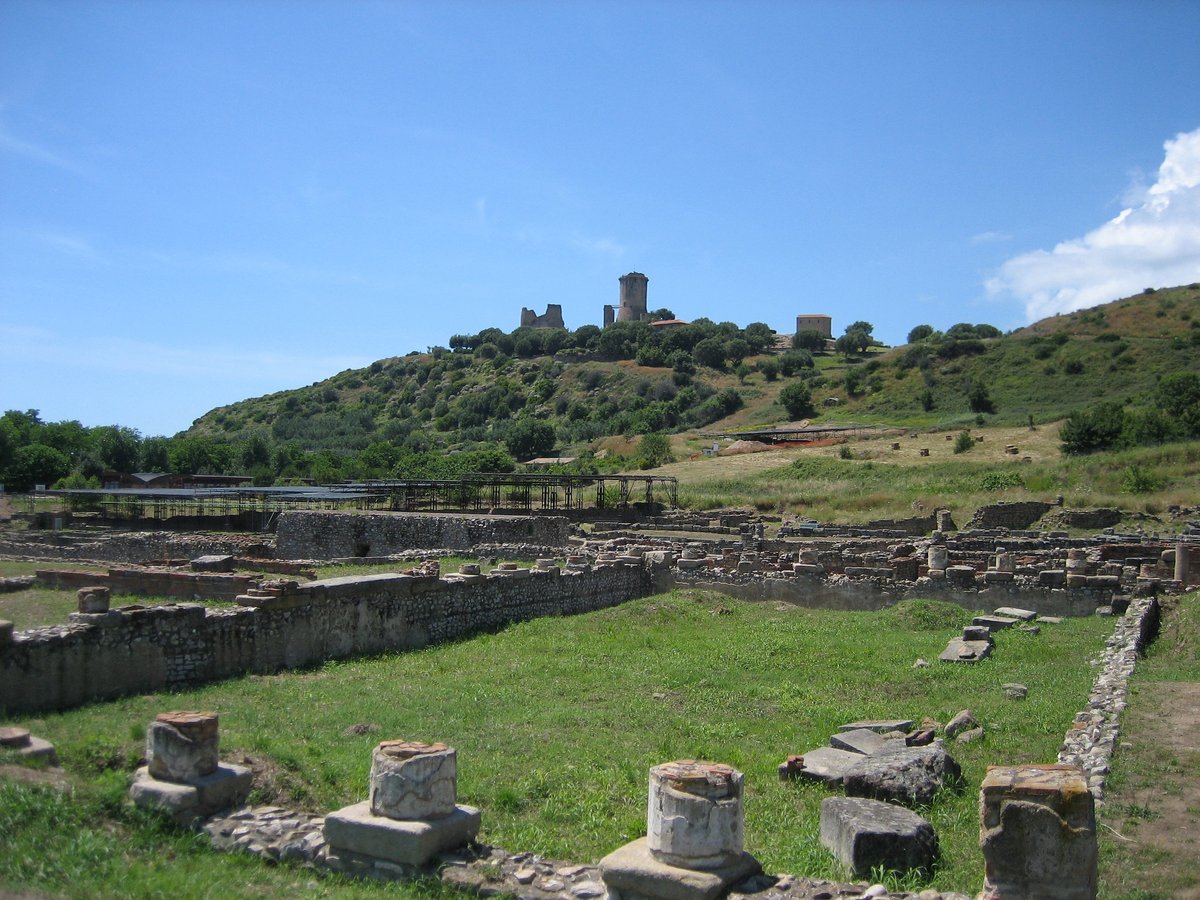
In the heart of Cilento, just steps from the sea, lies the Archaeological Park of Elea-Velia, the ancient Greek city that gave birth to the Eleatic school of philosophy. Strolling among the ruins, you can admire the famous Porta Rosa, the first full arch in Italy, and the Roman baths with mosaics. The route winds from the lower city to the acropolis, offering breathtaking views of the Tyrrhenian Sea.
Porta Rosa – unique example of a 4th-century BC Greek arch, discovered in 1964 by Mario Napoli.
Adriane Baths – black-and-white mosaics with marine animals.
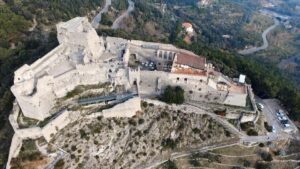
Acropolis with Angevin Tower – layers from the 6th century BC to the Middle Ages.
Combined Paestum+Velia ticket – valid for 3 days, includes guided tour.
Welcome to Elea-Velia: Where Philosophy Meets the Sea
Arriving at Elea-Velia is like stepping back 2500 years, but with the scent of the Cilentan sea accompanying you. The site winds through ancient olive trees and Mediterranean scrub, with a view of the Tyrrhenian Sea. The first thing that strikes you is the sense of tranquility: you can almost hear the voices of the philosophers who once strolled among these stones. The entrance is simple, with a small ticket booth and a gravel parking lot. But then you find yourself facing ruins that speak of a city that was powerful and refined. Parmenides and Zeno were born here, and the atmosphere is still charged with that ancient wisdom. Don’t expect queues and crowds: it’s still an authentic place where you can walk among the ruins in peace.
Welcome to Elea-Velia: Where Philosophy Meets the Sea
Arriving at Elea-Velia is like stepping back 2500 years, but with the scent of the Cilentan sea accompanying you. The site winds through ancient olive trees and Mediterranean scrub, with a view of the Tyrrhenian Sea. The first thing that strikes you is the sense of tranquility: you can almost hear the voices of the philosophers who once strolled among these stones. The entrance is simple, with a small ticket booth and a gravel parking lot. But then you find yourself facing ruins that speak of a city that was powerful and refined. Parmenides and Zeno were born here, and the atmosphere is still charged with that ancient wisdom. Don’t expect queues and crowds: it’s still an authentic place where you can walk among the ruins in peace.
Historical Notes: From Foundation to Rediscovery
Elea was founded around
540 BC by Greek refugees from Phocaea, fleeing after the Battle of Alalia. They called it Hyele, later Elea, and in Roman times Velia. It became famous for the
Eleatic school of philosophy, with Parmenides and Zeno. Unlike Paestum, Velia resisted the Lucanians and remained independent until the arrival of the Romans in 273 BC. Under Rome, it enjoyed a period of prosperity as a holiday resort, but decline came with marsh formation and the Via Popilia. In the Middle Ages, the settlement retreated to the acropolis, where a castle was built. Official excavations began in 1921 with Amedeo Maiuri, but the most sensational discovery was
Porta Rosa, brought to light in 1964 by Mario Napoli. A concise timeline:
- 540 BC – Foundation by the Phocaeans
- 5th century BC – Eleatic school
- 273 BC – Roman conquest
- 1st century AD – Decline due to marsh formation
- 1921 – Start of systematic excavations
- 1964 – Discovery of Porta Rosa
Historical Notes: From Foundation to Rediscovery
Elea was founded around
540 BC by Greek refugees from Phocaea, fleeing after the Battle of Alalia. They called it Hyele, later Elea, and in Roman times Velia. It became famous for the
Eleatic school of philosophy, with Parmenides and Zeno. Unlike Paestum, Velia resisted the Lucanians and remained independent until the arrival of the Romans in 273 BC. Under Rome, it enjoyed a period of prosperity as a holiday resort, but decline came with marsh formation and the Via Popilia. In the Middle Ages, the settlement retreated to the acropolis, where a castle was built. Official excavations began in 1921 with Amedeo Maiuri, but the most sensational discovery was
Porta Rosa, brought to light in 1964 by Mario Napoli. A concise timeline:
- 540 BC – Foundation by the Phocaeans
- 5th century BC – Eleatic school
- 273 BC – Roman conquest
- 1st century AD – Decline due to marsh formation
- 1921 – Start of systematic excavations
- 1964 – Discovery of Porta Rosa
Porta Rosa and the Secrets of Greek Architecture
Porta Rosa is the jewel of Elea-Velia. It is the oldest full arch in Italy built with Greek technique, dating back to the 4th-3rd century BC. Its uniqueness? It was buried after a landslide and rediscovered only in 1964. Climbing up to reach it, you find yourself in a gorge connecting two hills: a monumental passage that must have impressed anyone entering the city. The structure is made of sandstone blocks, and its perfect shape shows how advanced the Greeks were. Mario Napoli dedicated it to his wife Rosa – a romantic story that adds charm. Near the arch are the Hadrianic Baths, with a black and white mosaic depicting animals and sea monsters: a true spectacle for lovers of ancient details.
Porta Rosa and the Secrets of Greek Architecture
Porta Rosa is the jewel of Elea-Velia. It is the oldest full arch in Italy built with Greek technique, dating back to the 4th-3rd century BC. Its uniqueness? It was buried after a landslide and rediscovered only in 1964. Climbing up to reach it, you find yourself in a gorge connecting two hills: a monumental passage that must have impressed anyone entering the city. The structure is made of sandstone blocks, and its perfect shape shows how advanced the Greeks were. Mario Napoli dedicated it to his wife Rosa – a romantic story that adds charm. Near the arch are the Hadrianic Baths, with a black and white mosaic depicting animals and sea monsters: a true spectacle for lovers of ancient details.
A Glimpse into Ancient Daily Life
The lower city of Velia preserves incredible remains of how people lived. Strolling along Via di Porta Marina, you can see the foundations of houses, shops, and baths. The Hadrianic Baths (2nd century AD) are among the best preserved: imagine wealthy Romans relaxing in the mosaic-decorated frigidarium. Further on, the so-called Sanctuary of Asclepius (actually the agora) features a portico and a fountain that used water from the Hyele spring. The House of the Frescoes is another must-see: about 400 sqm with frescoed rooms. On the acropolis, besides the medieval Angevin Tower (accessible by elevator), there are two small churches housing little antiquaria with artifacts. And then there’s the Greek-Roman theater, which hosts performances in summer. Every corner tells a different story.
A Glimpse into Ancient Daily Life
The lower city of Velia preserves incredible remains of how people lived. Strolling along Via di Porta Marina, you can see the foundations of houses, shops, and baths. The Hadrianic Baths (2nd century AD) are among the best preserved: imagine wealthy Romans relaxing in the mosaic-decorated frigidarium. Further on, the so-called Sanctuary of Asclepius (actually the agora) features a portico and a fountain that used water from the Hyele spring. The House of the Frescoes is another must-see: about 400 sqm with frescoed rooms. On the acropolis, besides the medieval Angevin Tower (accessible by elevator), there are two small churches housing little antiquaria with artifacts. And then there’s the Greek-Roman theater, which hosts performances in summer. Every corner tells a different story.
Why Visit It
First: Porta Rosa is unique – you won’t find a Greek arch this ancient anywhere else in Italy. Second: the combined ticket with Paestum is a bargain: 3 days to visit two of Campania’s most important archaeological sites at a paltry cost (from €8 to €15 depending on the season). Third: the guided tour is included in the ticket, so you don’t have to worry about a thing: an archaeologist accompanies you for about 2 hours and explains everything, making the visit much more interesting. Plus, the site is immersed in the nature of the Cilento National Park: after the visit you can take a walk among olive trees and Mediterranean scrub with a sea view. In short, a perfect mix of culture and landscape.
Why Visit It
First: Porta Rosa is unique – you won’t find a Greek arch this ancient anywhere else in Italy. Second: the combined ticket with Paestum is a bargain: 3 days to visit two of Campania’s most important archaeological sites at a paltry cost (from €8 to €15 depending on the season). Third: the guided tour is included in the ticket, so you don’t have to worry about a thing: an archaeologist accompanies you for about 2 hours and explains everything, making the visit much more interesting. Plus, the site is immersed in the nature of the Cilento National Park: after the visit you can take a walk among olive trees and Mediterranean scrub with a sea view. In short, a perfect mix of culture and landscape.
When to Go
The best time? Spring and autumn, without a doubt. Temperatures are mild, the sun isn’t too harsh, and the light is perfect for photos. Avoid summer if you can: the site has many elevation changes, little shade, and the sea humidity is noticeable. If you come in summer, opt for early morning (it opens at 9) or late afternoon. In winter, it’s open only until sunset, and closed on Tuesdays, so plan accordingly. I went in mid-May: there were few people, a pleasant breeze, and the colors of the greenery and the sea were stunning. Tip: bring comfortable shoes and a water bottle, because the uphill walks take their toll.
When to Go
The best time? Spring and autumn, without a doubt. Temperatures are mild, the sun isn’t too harsh, and the light is perfect for photos. Avoid summer if you can: the site has many elevation changes, little shade, and the sea humidity is noticeable. If you come in summer, opt for early morning (it opens at 9) or late afternoon. In winter, it’s open only until sunset, and closed on Tuesdays, so plan accordingly. I went in mid-May: there were few people, a pleasant breeze, and the colors of the greenery and the sea were stunning. Tip: bring comfortable shoes and a water bottle, because the uphill walks take their toll.
In the Surroundings
Two unmissable stops. The first is Paestum, of course: 40 km away, with its spectacular Doric temples – and the cumulative ticket includes it. The second is Ascea Marina, the town just a stone’s throw away: a long sandy beach with a quiet promenade where you can stop for a seafood lunch. If you have more time, explore the Cilento: villages like Acciaroli or Pioppi (where the Mediterranean diet was born) are just a few kilometers away. Or take a walk on the Crinale degli Dei (Ridge of the Gods), a trek starting from Velia offering breathtaking views. In short, Elea-Velia is not just an archaeological site: it’s a starting point to discover a beautiful land.
In the Surroundings
Two unmissable stops. The first is Paestum, of course: 40 km away, with its spectacular Doric temples – and the cumulative ticket includes it. The second is Ascea Marina, the town just a stone’s throw away: a long sandy beach with a quiet promenade where you can stop for a seafood lunch. If you have more time, explore the Cilento: villages like Acciaroli or Pioppi (where the Mediterranean diet was born) are just a few kilometers away. Or take a walk on the Crinale degli Dei (Ridge of the Gods), a trek starting from Velia offering breathtaking views. In short, Elea-Velia is not just an archaeological site: it’s a starting point to discover a beautiful land.