Introduction
The Roman Amphitheatre of Cagliari is a place that takes your breath away. You walk among the steps carved into the rock and you can almost hear the sound of gladiators. It is half natural, half built: a miracle of ancient engineering that makes you reflect on how powerful Rome was. Today, with a ticket for just 3€, you can explore this archaeological gem in the heart of Casteddu. It’s not just a monument, it’s an experience that stays with you.
Introduction
The Roman Amphitheatre of Cagliari is a place that takes your breath away. You walk among the steps carved into the rock and you can almost hear the sound of gladiators. It is half natural, half built: a miracle of ancient engineering that makes you reflect on how powerful Rome was. Today, with a ticket for just 3€, you can explore this archaeological gem in the heart of Casteddu. It’s not just a monument, it’s an experience that stays with you.
Historical Notes
Built between the 1st and 2nd centuries AD, the amphitheatre was the center of entertainment in Roman Carales. It hosted venationes (hunts), executions, and munera (gladiator fights). With the rise of Christianity, Emperor Valentinian III banned the games in 438 AD, and the structure fell into ruin. For centuries, Byzantines and Pisans used it as a stone quarry. It was brought to light in the 19th century by Canon Giovanni Spano, who directed the excavations. Since 2017, after restoration, it has been open to the public again.
Historical Notes
Built between the 1st and 2nd centuries AD, the amphitheatre was the center of entertainment in Roman Carales. It hosted venationes (hunts), executions, and munera (gladiator fights). With the rise of Christianity, Emperor Valentinian III banned the games in 438 AD, and the structure fell into ruin. For centuries, Byzantines and Pisans used it as a stone quarry. It was brought to light in the 19th century by Canon Giovanni Spano, who directed the excavations. Since 2017, after restoration, it has been open to the public again.
Historical Timeline
- 1st-2nd century AD – Construction of the amphitheatre
- 438 AD – Prohibition of gladiator games
- Middle Ages – Used as a quarry for materials
- 1866-1868 – Excavations by Giovanni Spano
- 2000-2011 – Iron cover for concerts
- 2017 – Partial reopening to the public
Historical Timeline
- 1st-2nd century AD – Construction of the amphitheatre
- 438 AD – Prohibition of gladiator games
- Middle Ages – Used as a quarry for materials
- 1866-1868 – Excavations by Giovanni Spano
- 2000-2011 – Iron cover for concerts
- 2017 – Partial reopening to the public
Architecture Carved in Rock
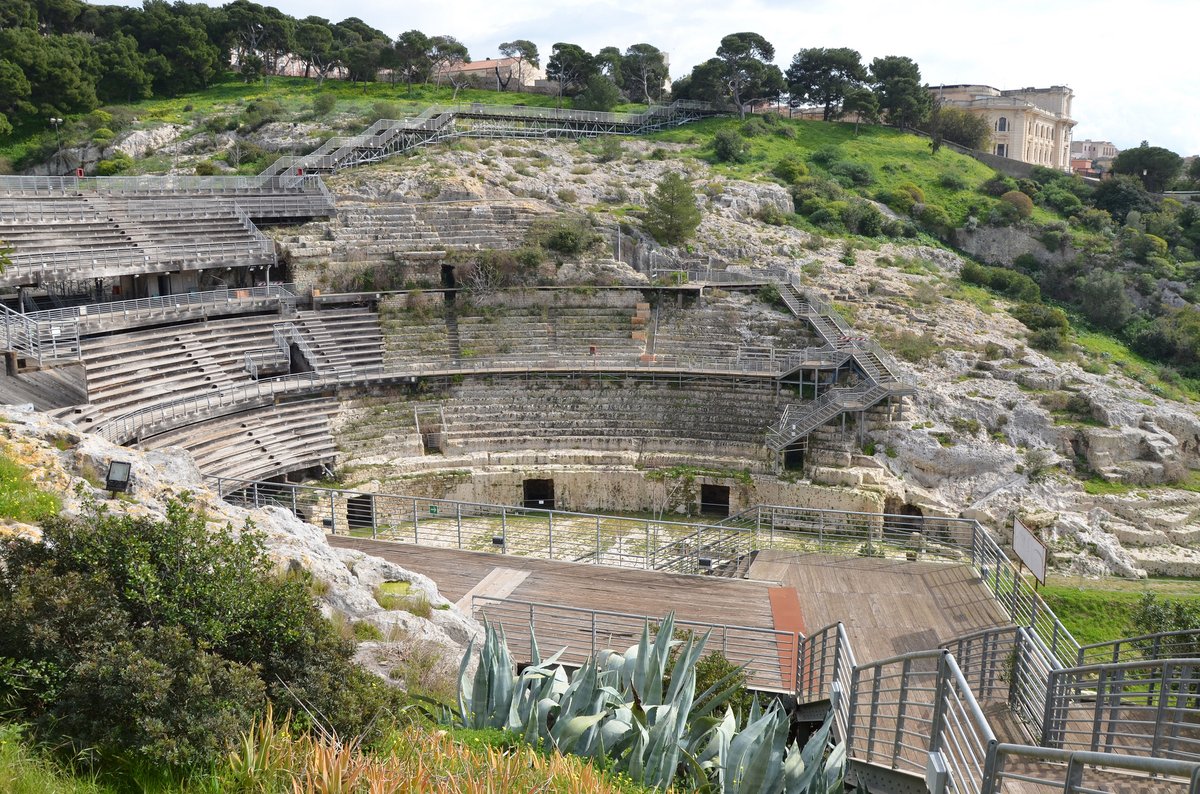
The uniqueness of the Roman Amphitheater lies in being largely carved into the rocky bank of Colle di Buon Cammino. The tiers, arena, and underground corridors (ambulacra) are cut into living stone, while the southern facade, now lost, was made of white limestone and exceeded 20 meters. The tiers are divided into three orders: ima, media, and summa cavea, to separate senators, knights, plebeians, and slaves. Beneath the arena, the crypts with cages for wild animals (claustra) and a 95-meter-long corridor leading to a cistern.
Architecture Carved in Rock
The uniqueness of the Roman Amphitheater lies in being largely carved into the rocky bank of Colle di Buon Cammino. The tiers, arena, and underground corridors (ambulacra) are cut into living stone, while the southern facade, now lost, was made of white limestone and exceeded 20 meters. The tiers are divided into three orders: ima, media, and summa cavea, to separate senators, knights, plebeians, and slaves. Beneath the arena, the crypts with cages for wild animals (claustra) and a 95-meter-long corridor leading to a cistern.
Games of the Arena
The arena was the stage for bloody spectacles: in the mornings, venationes with wild beasts imported from Africa; at noon, executions; in the evenings, gladiator fights (munera). Gladiators were often slaves or prisoners, but could become stars. Women and slaves watched from the top covered tiers, while the powerful sat on the podium. Today, walking through the arena, it’s hard to imagine the blood, but the history is tangible: the beast cells and service rooms remain.
Games of the Arena
The arena was the stage for bloody spectacles: in the mornings, venationes with wild beasts imported from Africa; at noon, executions; in the evenings, gladiator fights (munera). Gladiators were often slaves or prisoners, but could become stars. Women and slaves watched from the top covered tiers, while the powerful sat on the podium. Today, walking through the arena, it’s hard to imagine the blood, but the history is tangible: the beast cells and service rooms remain.
Why Visit
First: it’s a one-of-a-kind in Sardinia, the only Roman amphitheater carved into rock, with a history that envelops you. Second: it costs very little – €3 for a full ticket, or €8 for a combo that includes 5 other monuments (valid for 7 days). Third: it’s in the center of Cagliari, reachable on foot, and the visit is short but intense. Perfect for a cultural break between a city stroll and a gelato.
Why Visit
First: it’s a one-of-a-kind in Sardinia, the only Roman amphitheater carved into rock, with a history that envelops you. Second: it costs very little – €3 for a full ticket, or €8 for a combo that includes 5 other monuments (valid for 7 days). Third: it’s in the center of Cagliari, reachable on foot, and the visit is short but intense. Perfect for a cultural break between a city stroll and a gelato.
When to Go
The best time? Early morning, right when it opens at 10:00 AM, when the raking light illuminates the steps and there’s no crowd. In summer, avoid the midday heat and aim for late afternoon (3:00-7:00 PM). Spring and fall offer mild weather and warm colors on the stone. If you go in winter, the continuous hours (10-5) give you all the time to explore without rush.
When to Go
The best time? Early morning, right when it opens at 10:00 AM, when the raking light illuminates the steps and there’s no crowd. In summer, avoid the midday heat and aim for late afternoon (3:00-7:00 PM). Spring and fall offer mild weather and warm colors on the stone. If you go in winter, the continuous hours (10-5) give you all the time to explore without rush.
Nearby
Just a stone’s throw away is the Cagliari Botanical Garden, a green oasis with rare plants and Roman ruins (the Villa of Tigellio). Or, head up to the Citadel of Museums, home to the National Archaeological Museum and the Wax Museum. If you prefer a spiritual immersion, visit the Capuchin Convent, where the mummified body of Saint Ignatius of Laconi is preserved. All are within walking distance, for a morning or afternoon rich in history.
Nearby
Just a stone’s throw away is the Cagliari Botanical Garden, a green oasis with rare plants and Roman ruins (the Villa of Tigellio). Or, head up to the Citadel of Museums, home to the National Archaeological Museum and the Wax Museum. If you prefer a spiritual immersion, visit the Capuchin Convent, where the mummified body of Saint Ignatius of Laconi is preserved. All are within walking distance, for a morning or afternoon rich in history.