The Greek Theatre of Taormina is the city’s most famous monument, a masterpiece of ancient architecture offering breathtaking views of Mount Etna and the Ionian Sea. Built in the 3rd century BC and expanded by the Romans, it could hold up to 10,000 spectators and is still used today for concerts and festivals like Taormina Arte. The visit takes about 1-2 hours and offers a unique experience combining history, archaeology, and landscape.
– Second largest theatre in Sicily after that of Syracuse, with a diameter of 109 meters
– Panoramic view of Mount Etna, the Bay of Naxos, and the Ionian Sea
– Opening hours and tickets: open all year, admission €12 (reduced €6), free for under 18
– Summer events: Taormina Arte and Taormina Film Fest with evening performances
Introduction
If there’s one place that takes your breath away, it’s the Greek Theatre of Taormina. Not only because it’s the second largest ancient theatre in Sicily, but for that incredible view of Mount Etna that steals the show. You arrive, walk in, and find yourself facing a stone staircase that seems to plunge into the sea. You sit on a step and stay there, watching the volcano smoke, the Gulf of Naxos, and in the distance, Calabria. It’s a heart-stopper, I tell you. Built in the 3rd century BC and reworked by the Romans, today it hosts concerts and the Taormina Film Festival. But even empty, without performances, it’s worth every euro of the ticket.
Introduction
If there’s one place that takes your breath away, it’s the Greek Theatre of Taormina. Not only because it’s the second largest ancient theatre in Sicily, but for that incredible view of Mount Etna that steals the show. You arrive, walk in, and find yourself facing a stone staircase that seems to plunge into the sea. You sit on a step and stay there, watching the volcano smoke, the Gulf of Naxos, and in the distance, Calabria. It’s a heart-stopper, I tell you. Built in the 3rd century BC and reworked by the Romans, today it hosts concerts and the Taormina Film Festival. But even empty, without performances, it’s worth every euro of the ticket.
Historical Notes
The theater’s origins date back to the 3rd century BC, when the Greeks of Sicily carved it into the rock of Monte Tauro under the reign of Hieron II. At the time, it could hold about 5,400 spectators, later expanded to 10,000. With the arrival of the Romans in the 2nd century AD, the orchestra was transformed into an arena for gladiatorial games and venationes, and they added columns and porticoes. In the Middle Ages, the stage building became a private residence. It was rediscovered during the Grand Tour: Goethe visited it in 1787 and was enthralled. Today, after restorations, it hosts up to 4,500 people for summer events such as Taormina Arte and the David di Donatello awards.
Historical Notes
The theater’s origins date back to the 3rd century BC, when the Greeks of Sicily carved it into the rock of Monte Tauro under the reign of Hieron II. At the time, it could hold about 5,400 spectators, later expanded to 10,000. With the arrival of the Romans in the 2nd century AD, the orchestra was transformed into an arena for gladiatorial games and venationes, and they added columns and porticoes. In the Middle Ages, the stage building became a private residence. It was rediscovered during the Grand Tour: Goethe visited it in 1787 and was enthralled. Today, after restorations, it hosts up to 4,500 people for summer events such as Taormina Arte and the David di Donatello awards.
Historical Notes (Timeline)
- 3rd century BC – Initial Greek construction.
- 2nd century AD – Roman expansion and adaptation.
- Middle Ages – Reused as a private palace.
- 1787 – Visit by Goethe.
- 1955 – Modern restoration.
- 1983 – Start of the Taormina Arte festival.
- Today – Venue for events and main attraction of Taormina.
Historical Notes (Timeline)
- 3rd century BC – Initial Greek construction.
- 2nd century AD – Roman expansion and adaptation.
- Middle Ages – Reused as a private palace.
- 1787 – Visit by Goethe.
- 1955 – Modern restoration.
- 1983 – Start of the Taormina Arte festival.
- Today – Venue for events and main attraction of Taormina.
Architecture and Features
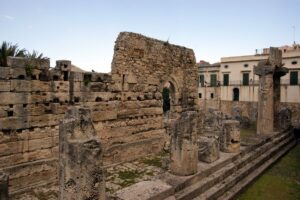
The theatre is a gem of ancient engineering. The cavea, carved into the rock, is divided into nine sectors by eight stairways, with wide steps for seating and a lower step for feet. At the top, a double portico with marble columns provided shade – today only traces remain. The stage, originally decorated with two orders of Corinthian columns (mostly removed to build the Cathedral), preserves niches and a partially open back wall. Under the orchestra, a hypogeum served for special effects in Roman combats. Next to the theatre, the Antiquarium houses artifacts such as a torso of Apollo and tablets with city accounts from the 2nd century BC.
Architecture and Features
The theatre is a gem of ancient engineering. The cavea, carved into the rock, is divided into nine sectors by eight stairways, with wide steps for seating and a lower step for feet. At the top, a double portico with marble columns provided shade – today only traces remain. The stage, originally decorated with two orders of Corinthian columns (mostly removed to build the Cathedral), preserves niches and a partially open back wall. Under the orchestra, a hypogeum served for special effects in Roman combats. Next to the theatre, the Antiquarium houses artifacts such as a torso of Apollo and tablets with city accounts from the 2nd century BC.
Visit Experience: What to Do in 45 Minutes
Enter through the main entrance on Via Teatro Greco and head straight up to the upper part of the cavea. From there, you’ll have the best view: Mount Etna framed by ancient stones. Then descend to the orchestra – touch the remains of the Roman drainage channels. Walk along the vaulted corridor that led to the hypogeum. If you have time, visit the Antiquarium in 10 minutes (well-displayed artifacts). For the perfect photo, stand between the columns of the stage and frame the sea in the background. In summer, prepare for the sun: there aren’t many shady spots, but the panorama is worth it. Tip: don’t just take a selfie, listen to the acoustics – a clap echoes like in a cathedral.
Visit Experience: What to Do in 45 Minutes
Enter through the main entrance on Via Teatro Greco and head straight up to the upper part of the cavea. From there, you’ll have the best view: Mount Etna framed by ancient stones. Then descend to the orchestra – touch the remains of the Roman drainage channels. Walk along the vaulted corridor that led to the hypogeum. If you have time, visit the Antiquarium in 10 minutes (well-displayed artifacts). For the perfect photo, stand between the columns of the stage and frame the sea in the background. In summer, prepare for the sun: there aren’t many shady spots, but the panorama is worth it. Tip: don’t just take a selfie, listen to the acoustics – a clap echoes like in a cathedral.
Why Visit
First: the view. No other theater in the world offers such a panorama: smoking Mount Etna, the blue sea, and the Calabrian coast. Second: the still perfect acoustics – if you’re lucky and there’s an event, you hear the music like 2,000 years ago. Third: living history. Here, Romans fought wild beasts, Greeks listened to Euripides, and today international artists perform. It’s a place that bridges different eras, and you can feel it in the air. Plus, it’s convenient: from Taormina’s center you’re there in a 5-minute walk, and in an hour you’ve seen the best of it.
Why Visit
First: the view. No other theater in the world offers such a panorama: smoking Mount Etna, the blue sea, and the Calabrian coast. Second: the still perfect acoustics – if you’re lucky and there’s an event, you hear the music like 2,000 years ago. Third: living history. Here, Romans fought wild beasts, Greeks listened to Euripides, and today international artists perform. It’s a place that bridges different eras, and you can feel it in the air. Plus, it’s convenient: from Taormina’s center you’re there in a 5-minute walk, and in an hour you’ve seen the best of it.
When to Go
The best time? Spring and autumn, when the weather is mild and there are fewer tourists. Summer is hot and the theater teems with people, but if you want to see a performance, June-July are packed with events. My advice: at dawn (even though it opens at 9) or at sunset, when the golden light lights up the stones and Etna turns red. In winter, the theater is almost empty: you can enjoy the view in solitude, but the wind can be annoying. Avoid the midday summer hours: the sun beats down hard and there’s no shade.
When to Go
The best time? Spring and autumn, when the weather is mild and there are fewer tourists. Summer is hot and the theater teems with people, but if you want to see a performance, June-July are packed with events. My advice: at dawn (even though it opens at 9) or at sunset, when the golden light lights up the stones and Etna turns red. In winter, the theater is almost empty: you can enjoy the view in solitude, but the wind can be annoying. Avoid the midday summer hours: the sun beats down hard and there’s no shade.
In the Vicinity
After leaving the theater, don’t miss Piazza IX Aprile, a 5-minute walk away: a panoramic terrace overlooking the coast with Mount Etna in the distance. For a trip back in time, head down to Castelmola, a village perched above Taormina with even broader views – reachable by car or a one-hour walk. If you’re in the mood for the sea, Mazzarò beach is connected to the city by a cable car (3 minutes) and offers clear waters and beach facilities. Alternatively, the Archaeological Park of Naxos in Giardini Naxos, just a few kilometers away, completes the journey into ancient Sicily.
In the Vicinity
After leaving the theater, don’t miss Piazza IX Aprile, a 5-minute walk away: a panoramic terrace overlooking the coast with Mount Etna in the distance. For a trip back in time, head down to Castelmola, a village perched above Taormina with even broader views – reachable by car or a one-hour walk. If you’re in the mood for the sea, Mazzarò beach is connected to the city by a cable car (3 minutes) and offers clear waters and beach facilities. Alternatively, the Archaeological Park of Naxos in Giardini Naxos, just a few kilometers away, completes the journey into ancient Sicily.