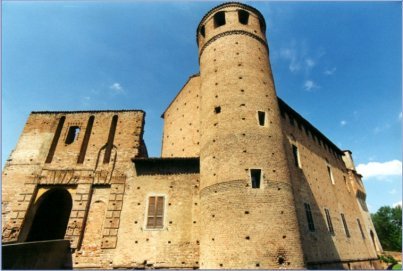
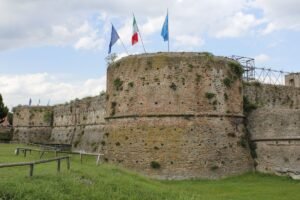
The Calendasco Castle is a mighty red-brick fortress that dominates the Piacenza countryside, just a few hundred metres from the Po River. Mentioned as early as 1187, it was contested by powerful families and today shows its trapezoidal layout with Guelph battlements, circular towers and a dried-up moat. A visit reveals halls with a caminata magna, coffered ceilings and sixteenth-century frescoes, witnesses to a turbulent past.
– Fourteenth-century architecture with sawtooth details and segmental arches.
– The large cylindrical tower towering over the main entrance.
– The recetto, the oldest core, with the coats of arms of the Confalonieri.
– Cultural events and reopenings after the 2021 restoration.
Introduction
The Calendasco Castle suddenly emerges from the farmland of the Piacenza plain, and the effect is exactly right: a mass of red brick dominating the flat landscape. It stands on a slight rise between two bends of the Po, just a few hundred metres from the river, and is the northernmost of the castles west of Piacenza. Its trapezoidal outline, Guelph merlons and cylindrical tower over the entrance all read at once, with no frills. Around it, the deep moat, now dry, still traces the boundary of the old village of Calendasco, which also included the recetto, the church and the pilgrims’ hospice. This is not a postcard castle with turrets everywhere: it is a fortress, and it shows. Walking along Via Castello, you get the clear sense of standing before a piece of Po Valley military history, built to control the river, the roads and the tolls.
Historical Background
The first settlement was the recetto, commissioned by the Bishop of Piacenza as a storehouse and refuge for farmers between the 10th and 11th centuries. The castle proper grew from the 12th century and is first mentioned in a document by Pope Urban II from 1187, which confirmed its possession to the monastery of San Salvatore in Quartazzola. In 1290 Saint Conrad Confalonieri was born there. Between the 13th and 14th centuries it passed to the Pallastrelli and Scotti families, until in 1346 it was destroyed by the Piacenza Ghibellines and in 1372 rebuilt by the Guelphs as an anti-Visconti stronghold. In 1412 Filippo Arcelli received it, then came the Confalonieri, who held it for almost two hundred years and also made it a lordly residence. In 1482 Ludovico il Moro besieged it; in 1572 Count Ludovico Confalonieri was killed in the bedroom. In 1690 the last feudal lord was Fabio Perletti.
- 10th–11th centuries: the recetto commissioned by the Bishop of Piacenza is founded
- 1187: first mention in a document by Pope Urban II
- 1290: Saint Conrad Confalonieri is born in the castle
- 1346: destruction by the Piacenza Ghibellines
- 1372: Guelph reconstruction as an anti-Visconti stronghold
- 1482: siege by Ludovico il Moro
- 1572: assassination of Count Ludovico Confalonieri
- 2021–2023: restoration and reopening to the public
A Little Fort All in Red Brick
Here, material is everything: brick upon brick, red bricks fired in the kilns at località Arena and by the Po at Mezzano. The building retains its fourteenth-century structure, with its sawtooth motif and a crowning row of small, low-arched windows. Its plan is trapezoidal, enclosed by crenellated curtain walls and by circular towers rising from them; to the south, a semicircular tower rises higher than the rest. There are three entrances: two still show the recesses for the drawbridges, now replaced by brick bridges, while the postern had its own drawbridge. The main entrance is dominated by the great cylindrical tower and leads to a courtyard with a double loggia and a three-arched portico. The northeast wing, with its battered base and rustic look, is later. The moat, deep but dry, still separates the fortress from the fortified enclosure—the oldest part—with its postern and watchtower. On the same piazza, the defensive stables still stand.
Inside the Castle: Fireplaces and Frescoes
Step through the entrance hall beneath the cross vault and you enter the heart of the building. Here, what strikes you most are the two large halls with fireplaces, known as the Upper Caminata Magna and the Lower Caminata Magna: spaces designed for warmth and hospitality, with wooden coffered ceilings. Beneath the entrance vault, 16th-century frescoes are preserved, now deteriorated but still legible; in the border appear the coats of arms of the Confalonieri, the same ones repeated on the wooden coffers of a room on the piano nobile. The great Grand Reception Hall, with its wooden coffered ceiling, is among the most atmospheric spaces revealed by the restoration work. The restoration begun in 2021 has brought to light the original terracotta floor, a fireplace that had remained hidden, and rooms at the base of a tower. The new lighting system enhances the architecture while telling the story of the place.
The Village, the River and the Via Francigena
Calendasco is not just its castle. In the late thirteenth century, the village was one of the most important stops on the Via Francigena in the Piacenza area, and the nearby port on the Po made the fortress a point for collecting tolls and keeping watch over the north-western plain. Around the fief there were as many as three river ports. Castle, fortified enclosure, church and pilgrims’ hospice formed what was the Borgo of Calendasco: a system rather than a single building. Nearby, you can still make out traces of a wide stretch of Roman centuriation and part of the ancient consular road. A curiosity: the castle never had a tunnel to Palazzo Farnese in Piacenza, as local legend claims. Better to trust the bricks than barroom stories.
Why it’s worth a visit
Three concrete reasons to stop here. First: it is one of the rare castles of the Po Valley where the entire defensive sequence can still be read, from the moat to the postern gate, from the drawbridge slots to the outer ward. Second: the interiors are not empty; among large fireplaces, coffered ceilings and sixteenth-century frescoes there is genuine material worth seeing. Third: its position on the Po and the Via Francigena tells part of the history of pilgrimage and trade, not only of war. Note, however: the castle is open on the occasion of events and cultural programmes, not every day, so it is worth checking in advance. The good news is that it is also accessible to people with disabilities and that after the 2021–2023 restoration it has come back to life with cultural and community activities.
When to Go
There’s no perfect moment, but late afternoon on a clear day always works well: the low light sets the red brick aglow and brings out the battlements and sawtooth rooflines, while the dry moat casts sharp shadows. If you can, choose a day when an event is on: it’s the only way to pass through the entrance hall and see the fireplaces and coffered ceilings in person. In autumn the surrounding countryside turns colour and the river is often shrouded in mist, creating a distinctly Po Valley atmosphere. In spring, with the fields green, the contrast with the brickwork is even stronger. I’d go back without rushing, perhaps taking in a cultural programme or the StarBene festival, dedicated to physical and mental wellbeing, which has brought life to the castle’s spaces.
In the Surroundings
Two concrete ideas for extending your visit. The first is to follow the route of the Via Francigena toward Piacenza, where the historic centre and Palazzo Farnese await: it closes the circle with the Farnese and with the story of the Confalonieri family that left its mark on the castle. The second is a detour among the villages of the Piacenza area, for example Grazzano Visconti, with its neo-medieval-style layout and castle, or the Castello di Rivalta at Gazzola, another fortress of the area. While in Calendasco, it is worth walking to the Po and imagining the river ports that made the fief rich: three, according to sources, linked precisely to this corner of the plain.