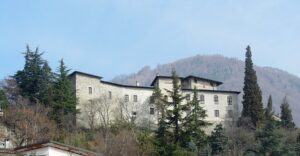
The Castle of Ponti sul Mincio is a medieval Scaliger fortress built between 1260 and 1276 on a hill overlooking the Mincio valley. Here you can climb the Clock Tower for an open panorama and walk among walls with five towers, battlements and arrow slits. Admission costs a few euros and is free for children under 14.
– Three shield towers, open toward the interior
– The keep and the old gate with traces of a drawbridge
– The Clock Tower with a view over the Mincio River
– The Mincio Park all around, 3.5 km from Peschiera
Introduction: Ponti sul Mincio Castle: a Scaliger Fortress
The Castle of Ponti sul Mincio is a medieval fortress visible from afar, perched on the hill above the village. Built between 1260 and 1276, it commands the Mincio valley just after the river leaves Lake Garda: five towers, battlements, and the Clock Tower, 3.5 km from Peschiera del Garda. It is not the usual intact fairy-tale castle: here you walk among real walls, river pebbles, and brick, with ruined sections and restorations that have cleared the perimeter of vegetation. The effect is authentic, a little rough, and all the more memorable for it. From the top, your gaze sweeps over the valley and the river, imagining its ancient lookout role. The visit is short but intense, suited to those who love history without too much rhetoric and to anyone seeking a different stop near Lake Garda. Please note: it is not accessible to wheelchairs or strollers, and it remains closed in bad weather.
Historical Background
The fortress was built at the behest of the Scaligeri, probably after the rise to power in Verona of
Mastino I della Scala around 1260. Its construction is dated between
1260 and 1276, the year in which the castle is first mentioned. It was part of the Scaliger defensive system along with Monzambano, Valeggio, Villafranca, Custoza and Sona, perhaps within the Serraglio, against Milanese and Mantuan incursions. In the Middle Ages it served as a refuge for the inhabitants. After Scaliger rule it passed to Verona and then to Venice. With heavy artillery it lost importance; from the 18th century it declined, inside the walls the aqueduct reservoir was built, now demolished, and the area became a vegetable garden. Restorations in the early 20th century and in the 1970s restored it. Today it is the symbol of the town.
- c. 1260 – Mastino I della Scala begins the fortification.
- 1276 – first documentary mention.
- 14th–15th century – role in the Scaliger and Venetian defensive system.
- 18th century – loses military function; reservoir and vegetable garden.
- c. 1900 and 1970s – consolidation and restoration.
- Today – castle open to visitors and entrance to the town.
A Walled Enclosure Castle with Shield Towers and Keep
The layout is irregular and elongated, adapted to the hill: a polygonal walled enclosure castle, not the classic quadrilateral. Five towers run along the walls. Three are “shield towers”—that is, simple outward folds of the curtain walls, open on the inside: a solution that prevented the enemy from barricading themselves inside and allowed them to be controlled from the other two towers. The two closed towers have a quadrilateral plan: the Clock Tower, lower, with a hipped roof, a large clock and a bell chamber; and the south-east tower, taller and crowned with battlements, defending the entrance. The keep, the tallest tower, stands near the old gate from the village, preceded by a ravelin with a chamber once connected to a drawbridge. The curtain walls are made of river pebbles and brick, with battlements and sections of patrol walkway within the thickness of the masonry. Saw-tooth edges and arrow slits can be seen.
Inside the fortress: atmosphere and visit
The castle is partially in ruins but open to visitors, both inside and out. After restoration, invasive vegetation was removed and the complex has become a gateway to the village. Access is via a single staircase: it is not suitable for wheelchairs or strollers, and some routes necessarily involve stairs. Animals are allowed. The guided tour lasts about twenty minutes and includes the climb up the Clock Tower, which offers sweeping views over the Mincio Valley. Finally, guided tours are by reservation only; audio guides are available in Italian, English, and German. In bad weather the castle remains closed. The atmosphere is quiet, a little suspended: low walls, battlements, the river below, and the village that still seems to protect it. Don’t expect a museum full of artifacts; here the place itself is what matters.
Why visit it
First reason: it is a rare example of a Scaliger walled castle with shield towers, a keep and traces of a drawbridge, included in the ‘Border Castles’ project. Second: the view over the Mincio Valley from the Clock Tower is worth the climb on its own, and you are just a step away from Peschiera del Garda. Third: it is a practical, inexpensive and quick visit, perfect for an impromptu outing; admission costs a few euros and is free for under-14s. Be aware, though: it is not accessible for wheelchairs or strollers, so it is best to plan ahead. If you are looking for a castle with a lived-in feel, with walls that show their age rather than just labels, this one is for you. What’s more, the village and the Mincio Park let you extend your walk without going far.
When to Go
There’s no single best time, but the light matters. In shoulder season, on clear days, the castle and the Mincio valley glow with soft colors. The early morning or late afternoon is best, when the sun is low and shadows stretch along the walls. On hotter days, avoid the middle hours: the climb to the Clock Tower is more tiring and the air stands still. On cold, crisp days, by contrast, the view is sharp, but the castle closes in bad weather and opening hours are reduced. Before setting out, always check times and bookings, because the site operates with guided tours and variable opening hours. The reward? A panorama that changes by the hour and a rare silence, just steps from the bustle of Lake Garda. If you can, choose a day without strong wind.
Nearby
The castle lies within the Mincio Park, a protected area since 1984: here you can walk among water and trees and go birdwatching. In Ponti sul Mincio, the Church of Sant’Antonio Abate is worth a stop, with 18th-century works such as the “Madonna and Child with Saints” by the Meves brothers and the Stations of the Cross. Not far away, the Molina Waterfalls add a fresh, natural note. If military history interests you, there is also Forte Ardietti, a 19th-century fortress that reveals another defensive era of the area. And then there is Peschiera del Garda, a fortified town on the lake, with walls, canals and a lakeside promenade: perfect for ending the day among cafés and strolls. You don’t need a rigid schedule; the beauty is in combining fortress, village and water. Online, Parco del Mincio and Visit Mantova are useful for getting your bearings.