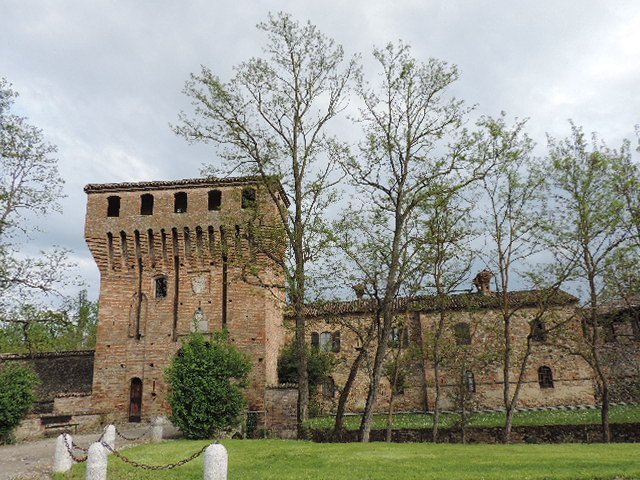
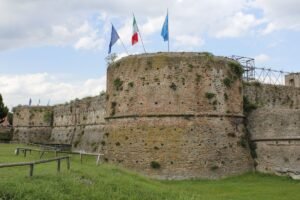
The Castello di Paderna in Pontenure, in the province of Piacenza, is a medieval stronghold with a water moat and the Tower in the Water. Inside, visitors can see the Romanesque Oratory of Santa Maria, the farm courtyard with an educational farm, and the indoor museums, including the armoury. It hosts the Frutti del Castello festival, with flowers, rare plants and heirloom fruits; guided tours at weekends from late April to September, closed in August.
– Moat and towers: water, drawbridge and arquebus loopholes.
– Oratory of Santa Maria: Greek cross and Roman columns.
– Frutti del Castello: flowers, rare plants and heirloom fruits.
– Info: Strada Paderna Montanaro 10, Pontenure; pet-friendly.
Castello di Paderna: An Introduction
The Castello di Paderna in Pontenure, in the province of Piacenza, is not your usual postcard castle. It is a lowland stronghold between the Nure and Riglio streams, with a moat still filled with water, brick towers and a farm courtyard that immediately tells you that here history has always gone hand in hand with work in the fields. Its outline is austere, but the whole is elegant: the tower in the water seems to float in the moat, the Romanesque oratory of Santa Maria preserves columns reused from Roman times, and the park is fragrant with old fruit trees. Visiting it means walking among walls, porticoes, haylofts and small museums, without losing that sense of a lived-in residence. What struck me was the calm: no crowds, just the sound of water and the greenery around. Perfect for anyone seeking an authentic place, far from the beaten track.
Historical background
The traces of Paderna are ancient: the settlement already appears in Roman times in the Tabula Alimentaria Traianea as “Curte Paterno”. The castle is documented in deeds from 817 and 900, when it depended on the cathedral of Piacenza. In 1028 a deed records the transfer by Hildeguarda to the rector of the local church; in 1041 the property passed to Oberto di Aghinone and then to the monks of San Savino, who held it for about four centuries. In 1216 the manor was destroyed by Parma troops and in 1247 by the forces of Frederick II of Swabia. In 1280 the abbot ordered the repair and raising of the main tower. In 1453 Melchiorre Marazzani bought the castle and transformed it into an agricultural and noble residence. In 1606 Lodovico Marazzani obtained the right to pass the fief down also to illegitimate children. At the end of the 19th century it passed by marriage to the Casali family. Timeline: 817/900 first records; 1028 deed; 1041 Oberto di Aghinone; 1216 destruction by Parma; 1247 Frederick II; 1280 tower repair; 1453 Marazzani; 1606 fief; late 19th century Casali.
Architecture and towers
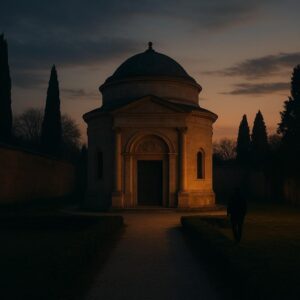
The layout is square, tending toward trapezoidal, oriented to the cardinal points, with a transverse wall dividing the residential area to the east from the agricultural area to the west. The moat surrounds all four sides and partially retains water. The entrance tower is square, entirely in brick, with a projecting upper structure and arquebus ports on all four sides; it had a double drawbridge, of which the bolt housings remain. The tower “in the water” is the highlight: built in the moat outside the castle, it served as a keep, lookout, command post, and last refuge. It rises four floors connected by a staircase cut into the wall. The Oratory of Santa Maria, the only surviving trace of the 11th-century castrum, has an inscribed Greek-cross plan, divided by four central columns into nine bays covered with cross vaults. Don’t miss the armoury in the keep and the old kitchens.
Frutti del Castello and Farm
The castle is also an educational farm with a kitchen garden and an organic farm focused on heritage varieties, including an apple orchard. For over twenty years it has hosted “Frutti del Castello”, a showcase of heritage fruits, flowers, plants, and agricultural and craft products. Launched in October 1996, it is one of Italy’s longest-running horticultural events. Since 2015, the autumn edition has been joined by a spring edition dedicated to gardening. The 11th spring edition is scheduled for Saturday 16 and Sunday 17 May 2026, from 9:00 to 19:00; the last autumn edition attracted 160 exhibitors and 14,000 visitors. The courtyard fills with heritage roses, rare plants, seeds, bulbs, aromatic herbs, and ornamental plants. The event is pet friendly. On opening weekends, visitors can tour the castle, park, church, and small museums inside.
Why visit it
There are at least three concrete reasons. First: the tower in the water and the still-full moat are a rarity that makes the castle instantly recognizable, with a visual impact unlike the usual dry manors. Second: the Romanesque oratory of Santa Maria, with columns in reused Roman stone and nine groin vaults, is an architectural gem that surprises for its restraint. Third: here, it’s not just about stones, but about land and biodiversity: ancient fruits, vegetable garden, apple orchard and educational farm tell of a way of inhabiting the castle that is still alive. Guided tours are included in the ticket and cover the armoury, kitchens, courtyards and park. The castle is pet-friendly and is part of the Castles of the Duchy of Parma, Piacenza and Pontremoli Association. In short: history, agriculture and rural atmosphere all in one.
When to go
The most atmospheric time is early morning, when the light is low and the moat reflects the towers without too much bustle. If you can, choose a day in late April or early autumn, with mild temperatures and the park at its best. Avoid the middle of the day on hotter days: the farmyard and brick courtyards can become muggy. The guided tour is short and best enjoyed at a relaxed pace, but if you arrive before opening you can enjoy the exterior and the castle’s silhouette from the entrance. A special occasion is the two editions of Frutti del Castello, in spring and autumn: the courtyard comes alive with nursery growers, rare plants, and enthusiasts. In August the castle is closed, so don’t count on it. If you’re looking for quiet, better a weekend that doesn’t coincide with crowded events.
In the Area
Pontenure is close to Piacenza, so it’s worth combining your visit with the provincial capital: Piazza Cavalli with its two bronze horses, the Palazzo Gotico and the Duomo tell of another Piacenza, more urban and monumental. If you like castles, you can continue to the Castello di Rivalta in Gazzola, another manor in the Piacenza area included in the Castles of the Duchy circuit, with frescoed halls and a garden. Alternatively, Grazzano Visconti, a neo-medieval-style village commissioned by the Visconti family, is a curious stop for those traveling with children: artisan workshops, lanes and a fairy-tale atmosphere. They are real destinations that can easily be linked into a day trip, without needing too much planning. I would choose Piacenza for culture and Rivalta to stay on the castle theme.