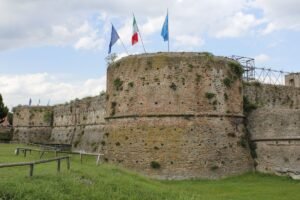
The Castle of San Pietro in Cerro is a 15th-century brick fortress overlooking the lower Val d’Arda, in the province of Piacenza, halfway between Piacenza and Cremona. Built by the Barattieri family in 1460 and completed in 1491, it has remained well preserved because it was not the main residence, and today it can be visited with a guide through frescoed halls, underground areas, and collections. It is part of the Castles of the Duchy of Parma, Piacenza, and Pontremoli circuit.
– Thirty furnished rooms with period furniture, two state salons, the kitchens, and the prisons.
– Hall of Arms with over 500 pieces: sabres, rifles, and curiosities such as the world’s smallest pistol.
– MiM – Museum in Motion in the attic, with over 1,600 contemporary artworks displayed on a rotating basis.
– Xi’an Warriors in the underground areas: 40 life-size copies authenticated by the Chinese government.
A fortress that looks like a postcard, but isn’t
There are castles that look like postcards and others that take you by surprise. The Castello di San Pietro in Cerro belongs to the second group: you find it amid the countryside of the lower Val d’Arda, on the border between the provinces of Piacenza, Parma and Cremona, and from the outside it is all brick, austere and compact, with its keep facing you and two round towers on the north side. Then you step into the courtyard and everything changes: a double 15th-century loggia that lends grace to what had seemed a mere fortress. It is a stronghold that has also been a country residence, and it shows. It is part of the Castles of the Duchy of Parma, Piacenza and Pontremoli circuit, is privately owned, and can be visited only by guided tour with a reservation: small groups, no crowds, which in my opinion is the right way to enjoy it.
Historical background: the Barattieri and firearms
The name to remember is
Bartolomeo Barattieri, a jurist and ambassador from Piacenza: in
1446 he bought the fief from Bianca Maria Visconti, and around
1460 he began work on the fortress, probably on the remains of an older structure, of which traces of a moat and ravelin survive. Here the Val d’Arda was borderland, a Piacenza outpost against raids by the Cremonese. After the fall of Constantinople in 1453, the defences were updated: two round towers were added alongside the keep for all-round control, with gun ports and loopholes protected by shutters. Work ended in
1491, as a stone inscription in the courtyard attests. The Barattieri family held the castle for almost five hundred years, until
1993, when it passed to the Spaggiari family; precisely because it was not their main residence, it has reached us almost intact.
- 1446 – Barattieri buys the fief from Bianca Maria Visconti
- 1460 – work begins on the fortress
- 1491 – the inscription records the completion of the works
- 1993 – the castle passes to the Spaggiari family
- 2001 – the MiM is created in the attic
- 2013 – the Xi’an Warriors in the basement
- 2017 – the Weapons Room opens
Thirty rooms, two halls, the kitchens and the prisons
The guided tour covers the ground floor, the piano nobile, the Hall of Arms, the MiM and the underground areas. It starts from the Courtyard of the Knights and from there you go up: more than thirty furnished rooms with period furniture, frescoes and coffered ceilings, plus two state halls (the Great Hall and the Pink Salon), the Music Room, the bedroom and the Chinese Room. There is also no shortage of service areas: the kitchens and the prisons, which say a lot about how people lived here. From the loggia you enter the Historic Library, with over two thousand volumes mainly on Piacenza history, including some 16th-century editions; it is usually closed, but can be consulted by appointment. A curiosity that struck me: on the tower there is still the chart used by marksmen to take aim, found during restoration work, a unique feature among the castles of the Duchy.
The Armoury, MiM and the Terracotta Warriors of Xi’an
There is more than one museum in here. The Armoury, opened in 2017, holds over 500 pieces: pistols from the 17th century to the early 20th century, rifles, sabres, swords, halberds and daggers, along with Japanese, Nepalese and Indian weapons and a section on the Italian colonial wars in Abyssinia. There is the world’s smallest pistol, gamblers’ pistols, one hidden in a walking stick and even an anti-theft device that fires. In the attic, along the patrol walkway, MiM – Museum in Motion displays post-Second World War art, with a focus on artists from Piacenza: the collection contains more than 1,600 works and only a portion is rotated into the display at any one time. In the basement, the Millennial China exhibition with the Terracotta Warriors of Xi’an: forty life-size terracotta statues, authorized copies authenticated by the Chinese government of the 3rd-century BC originals.
The Park, the Inn, and Agata’s Ghost
The castle is surrounded by a park spanning over 20,000 square meters, with centuries-old trees and scattered contemporary artworks: the moat was filled in specifically to create the garden. Inside the park, in the former stables, is the Locanda del Re Guerriero, twelve suites furnished with antiques and works from the MiM: you can practically sleep inside the tour. Since 2016 the castle has hosted civil wedding ceremonies, events, concerts and dinners; there are about ten event spaces, with a total of around 300 seats. And then there’s the legend, that of Agata’s ghost, a young maid in love with a squire, fought over by a count, ending in a murder, a hanging and a leap from the highest tower. A romantic and somewhat grim story, but it’s the detail that makes you look at the towers with different eyes.
Why visit it
First reason: in a single visit you see things that are usually spread across three different museums—an armory with five hundred pieces, a contemporary art collection with over 1,600 works, and forty terracotta warriors. Second: the structure is almost intact, with no intrusive renovations, because the Barattieri family used it as a country residence and didn’t alter it much. Third, the practical side: entry is only with a guided tour, by reservation, so there are no crowds and no rush; and if local history interests you, you can ask to consult the library by appointment. One more thing for those traveling with dogs: the castle is pet-friendly and offers a free dog-sitting service, which must be booked.
When to go
Don’t expect it to be open every day: it can be visited on Sundays and public holidays from March to November, by reservation, with timed entry slots. If I had to choose, I’d recommend the first morning slot: the light that comes into the halls and courtyard is just right, and the group is smaller. As for the time of year, I prefer late spring, when the park is green and it’s pleasant to be outside too, or early autumn, when the tree-lined avenue changes color. Holidays such as Easter, Easter Monday, April 25, May 1, June 2, and August 15 are the most popular: if those are the dates you want, book early. Car and bus parking is just a short walk from the entrance.
Around the Area
If you’re staying in the area, you can stretch the day with a couple of stops that make sense alongside this visit. Cortemaggiore is the nearest village and is best explored on foot, among porticoes and the square: perfect for a slow stroll before or after the castle. If you like places that are a bit artfully constructed, Grazzano Visconti is a neo-medieval village with its Wax Museum, and that ticket is part of the partner agreements that grant reduced admission to the castle. There’s also the Labirinto della Masone, another partner agreement valid for the discount. In short, the advice is to keep the Duchy Passport handy: between the castles in the circuit and partner sites, the discount comes up more than once.