The Libarna Archaeological Area in Serravalle Scrivia preserves about one tenth of the ancient Roman city along the Via Postumia. Across its theatre, amphitheatre and domus—including the mosaic of Lycurgus and Ambrosia—the site brings imperial life into focus and can be visited with free admission. The museum room at the Town Hall completes the experience with finds from the nineteenth-century excavations.
– Roman theatre: remains dating from the 1st century AD, thought to have held around 3,800 spectators.
– Amphitheatre: an elliptical structure integrated into the urban fabric, estimated to have seated around 7,000 spectators.
– Domus and mosaics: marble floors and the great myth of Lycurgus and Ambrosia.
– Access: free entry, guided tours by reservation and accessible area.
Libarna Archaeological Area: Roman Theatre and Mosaics
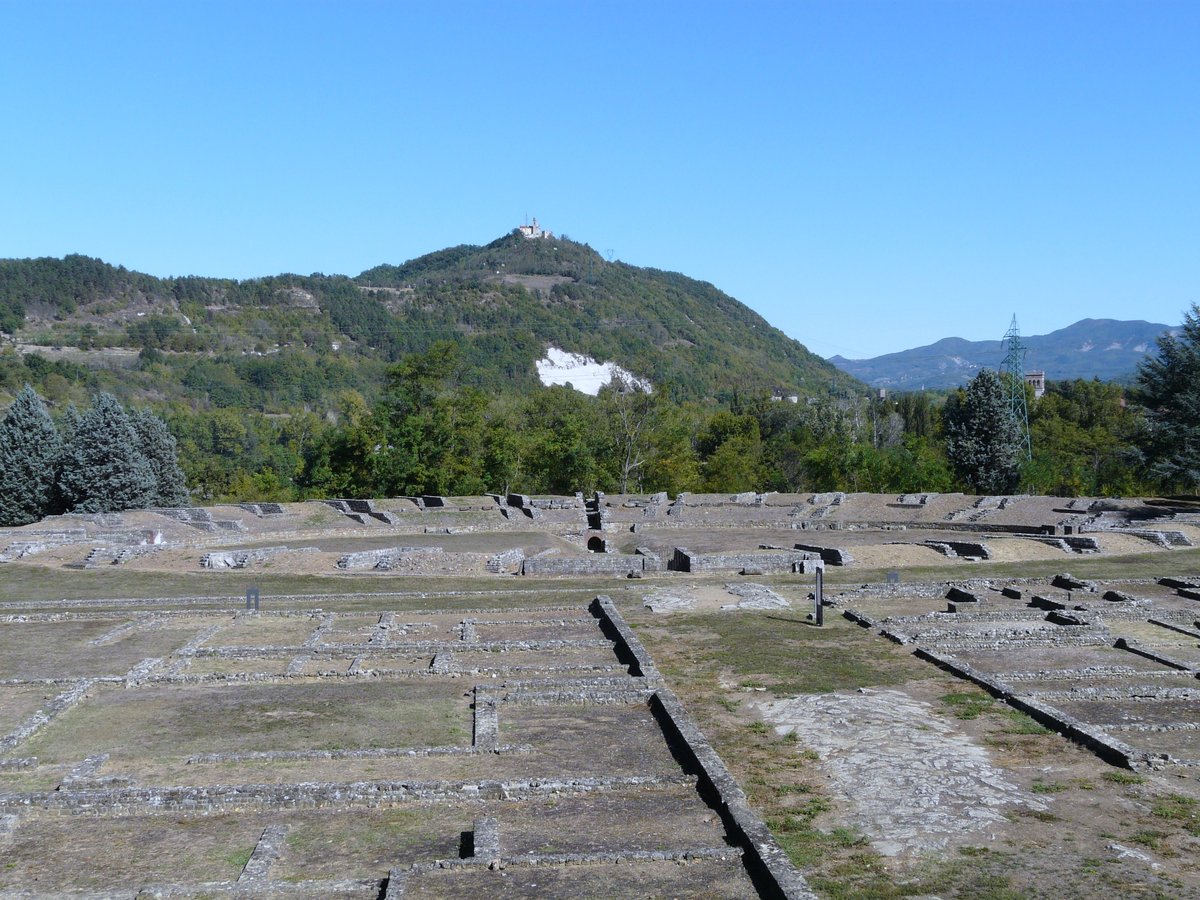
The Libarna Archaeological Area, in Serravalle Scrivia, is not the usual site fenced off with signs: it is a Roman city re-emerging among meadows and railway tracks, with its theatre, amphitheatre and two blocks of domus. Arriving at Via Arquata 63, you immediately realise that what you see is only part of ancient Libarna, which extended over about 23 hectares: today visitors can explore roughly a tenth of the settlement. Yet it takes very little to sense the urban scale: paved streets, porticoed courtyards, mosaics. Admission is free and visits are self-guided; groups and schools require booking and guided tours. Since June 2022, management has been entrusted to the Regional Directorate of Museums for Piedmont, with the Libarna Arteventi Association handling reception and promotion. I was struck by the contrast between the quietness of the place and the amount of history concentrated within a few steps. Do not expect a “museum” route: here you walk inside the ancient city, and that alone is reason enough to stop.
Historical background
Libarna grew up along the
Via Postumia, a road built in
148 BC that linked Genoa to Aquileia. The place name is pre-Roman and the area was already frequented in the Neolithic; the Roman town developed from the 1st century BC and became a
municipium between 89 and 49 BC, assigned to the Maecia tribe. Pliny the Elder mentions it. Between the 1st and 2nd centuries AD it reached its greatest splendour, with a forum, temples, theatre, amphitheatre, baths and domus. Crisis came in the 3rd century, when road routes changed; Libarna shrank to a village and was abandoned, while the population moved towards Serravalle and Arquata. Its rediscovery came in the 19th century, between the Strada Regia dei Giovi and the Turin-Genoa and Milan-Genoa railways.
- 148 BC: Via Postumia
- 89-49 BC: municipium
- 1st-2nd century AD: peak development
- 3rd century AD: crisis
- 1820-1823: rediscovery
Theatre and amphitheatre: the two souls of Roman entertainment
The theatre and amphitheatre are the two most recognisable landmarks. The theatre, datable to between the late 1st and early 2nd century AD, could hold around 3,800 spectators; it had one central and six secondary entrances, a colonnaded walkway and a large porticoed area serving as a foyer. Today it is partly compromised by the passage of two railway lines, which makes it look more fragmented. The amphitheatre, built in the second half of the 1st century AD or in the 2nd, was embedded in the urban fabric and occupied two city blocks. According to volumetric calculations based on its foundations, it could accommodate about 7,000 people, with two tiers, seating and a gallery for standing spectators. Its main entrance opened onto the decumanus maximus, flanked by twelve secondary corridors. Walking among the structures, what strikes you is the scale: this is not an isolated monument, but buildings designed for a living city.
Domus, mosaics and the myth of Lycurgus
The residential blocks tell the story of everyday life in Libarna. The domus, built from the late 1st century BC, were arranged around a porticoed courtyard, the peristyle, with wells and fountains; water came from the aqueduct fed by the Borlasca stream. Some houses were very large and wealthy, with marble slab floors. The highlight is the large mosaic depicting the myth of Lycurgus and Ambrosia, which bears witness to the decorative standard reached in the imperial age. The construction of the amphitheatre altered part of the block, with the opening of shops and an inn: a detail that suggests a neighbourhood that was anything but quiet. Among the finds are small amber sculptures, a bronze Victory, a statuette of Minerva and a model of a lighthouse. Some materials are in the Museum of Antiquities in Turin and the Civic Museums in Genoa; others can be seen in the exhibition room in Serravalle Scrivia.
From a self-guided visit to the museum room
The visit is divided into two stages. At the Archaeological Area at Via Arquata 63, entry is free and you can walk freely among the theatre, amphitheatre, streets and domus; for schools and groups, booking is required, with guided tours organised by the Associazione Libarna Arteventi. On special occasions, Touch Libarna is also used, an app with 3D reconstructions. The area is accessible to people with disabilities. The second stage is the museum room in the Palazzo Comunale, at Via Berthoud 49: it houses the Capurro and Varni collections, with finds from the first 19th-century excavations, capitals, cornices, inscriptions, pottery and oil lamps. Entry is free, and visits take place during municipal office hours or by appointment. I recommend not skipping it: after seeing the remains, the artefacts help bring the city into focus. Opening times and access change, so it is best to check the official channels before setting off.
Why visit it
Three concrete reasons. First: admission is free and you can visit at your own pace, so you can spend as much time at the site as you like without ticket constraints. Second: here you can see a theatre and an amphitheatre together—two spectacular buildings usually found in different settings—with estimated capacities of around 3,800 and 7,000 spectators. Third: the mosaic of Lycurgus and Ambrosia and the peristyle houses give a very vivid idea of Roman daily life, not just public monumentality. What’s more, the museum room in the Town Hall completes the picture with finds that would otherwise remain out of reach. The location along the Via Postumia also helps explain why Libarna was a strategic hub between Genoa and Aquileia. It is not a site where “everything is explained”: it is rather a place to read while walking, and perhaps that is precisely its charm.
When to go
There’s no perfect moment, but a few precautions help. As this is an open-air site, a dry day really changes the experience: paths and ruins are better enjoyed without mud. I’d avoid the middle hours of the hottest days, since there’s little shade between the theatre and the amphitheatre; early morning or late afternoon are better, when the low light brings out the volume of the foundations and the mosaics. In shoulder season the site is quieter, and you can linger without rushing. Before you go, though, always check the opening calendar: hours have changed over time, and guided tours require booking for groups and schools. If you happen to visit during events or the European Archaeology Days, it may be worth planning ahead: special openings add tours and activities.
In the Surrounding Area
Outside the archaeological site, Serravalle Scrivia is worth a stroll through its centre: according to the sources, it is one of the towns to which the population moved when Libarna lost its importance. This closes the circle between Roman city and medieval village. Not far away, Arquata Scrivia is also tied to Libarna’s fortunes: the fortifications of Serravalle and Arquata are cited as the reason for the inhabitants’ definitive move to better-defended sites. Another idea is to return to the museum room in the Palazzo Comunale, if you haven’t seen it yet: it is the natural continuation of the visit and houses finds from the nineteenth-century excavations. Don’t expect long distances or a complicated itinerary: the beauty here lies in reflecting on how a landscape of plains and hills has changed role over time. In the area, the Via Postumia remains the ideal thread.