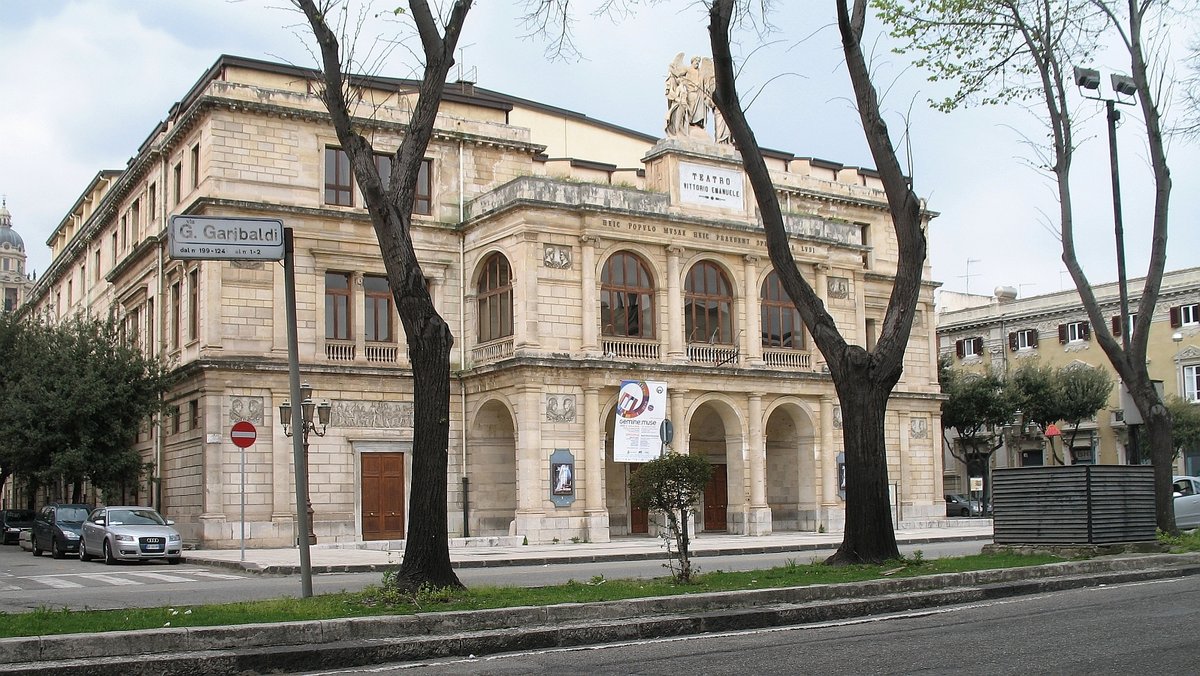
The Teatro Vittorio Emanuele is Messina’s cultural heart: a neoclassical building on Via Garibaldi, with a three-arch portico and a horseshoe-shaped auditorium. Inaugurated in 1852, it now hosts drama, opera, symphonic music and dance, and is home to the Ente Autonomo Regionale Teatro di Messina. The box office is open from Tuesday to Saturday, and on Sundays only on performance days.
– Record capacity: it is the largest theatre in Sicily, with almost a thousand seats.
– Architecture: three-arch portico and a marble sculpture by Saro Zagari.
– Interiors: ceiling frescoed by Renato Guttuso with the myth of Colapesce.
– Performances: seasons of drama, opera, symphonic music and dance.
Teatro Vittorio Emanuele in Messina: the largest theater in Sicily
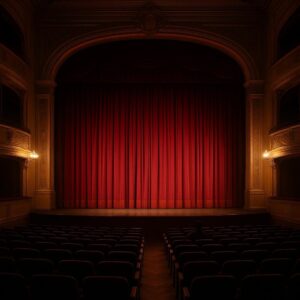
If you think of Messina and its theaters, the name that immediately comes to mind is the Teatro Vittorio Emanuele. It stands on Via Garibaldi, between Corso Cavour and the city center, and impresses from the outside too: a three-arched portico, Doric columns and a Neoclassical rusticated façade in Syracuse stone. This is no ordinary building: with its approximately 980 seats, it is the largest regional theater in Sicily. The horseshoe-shaped auditorium, with stalls, boxes, gallery and upper gallery, promises a theatrical experience of the kind you can feel even before the curtain rises. To me it felt like a place that has moved through the city’s history without losing its role as a cultural heart. Inside, however, the surprise is different: Renato Guttuso’s ceiling tells the myth of Colapesce. It is a theater worth seeing for its architecture alone; then perhaps you’ll return for a show.
Historical background
The history of the theatre goes back a long way: the area was occupied by the Carmine church and, after the 1738 earthquake, by the city prisons. On
2 October 1838 Ferdinand II of Bourbon ordered the construction of a new theatre; work began on
23 April 1842 to a design by the Neapolitan architect
Pietro Valente. It was inaugurated on
12 January 1852 as the Teatro Sant’Elisabetta. In
1860, after the landing of the Thousand, it was dedicated to
Vittorio Emanuele II. The 1908 earthquake rendered it unusable but did not erase its perimeter or part of its decorations; reconstruction was long and complex. In
1985 the theatre reopened with Aida, the same opera associated with the evening of 1908. Today it is home to the Ente Autonomo Regionale Teatro di Messina.
- 1838: Ferdinand II orders the new theatre.
- 1842: work begins under Pietro Valente.
- 1852: inauguration as Sant’Elisabetta.
- 1860: dedication to Vittorio Emanuele II.
- 1908: earthquake and long reconstruction.
- 1985: reopening with Aida.
Architecture: reading the portico
The façade is the part that struck me most. The three-arched portico is supported by Doric columns, and above it is a projecting loggia that once served as a passage for carriages. At the top stands the marble sculptural group by Saro Zagari, entitled “Time Discovering Truth and Messina”. The exterior is in rusticated Siracusa stone, clearly neoclassical in style. Don’t miss the bas-reliefs depicting scenes from Hercules’ life and the medallions with profiles of musicians and playwrights, added in the 19th century. Its dimensions? About 38 metres wide by 67 metres long. Inside, the horseshoe-shaped auditorium has been completely redone, but the layout is classic: stalls, tiers of boxes, gallery and upper gallery. Capacity is about 980 seats, with 342 seats in the stalls and around 600 seats in the boxes. One detail few notice: its acoustics were even cited in school physics textbooks.
Guttuso’s Ceiling and the Myth of Colapesce
You look up and the show has already begun. The ceiling of the main hall is frescoed by Renato Guttuso with the myth of Colapesce, an image that immediately gives the theatre a strong character. The legend tells of Nicola, the son of a fisherman, who loved the sea and knew the treasures of the seabed. Frederick II put him to the test by throwing a cup, a crown and a ring into the water: he recovered them all, but in the end did not resurface. It is said that he had seen Sicily resting on three columns, one of them broken, and that he chose to stay underwater to hold it up. It is a very evocative story from Messina, and seeing it painted above the auditorium changes the way you look at the hall. It made me think that this theatre is not just a venue for performances: it is also a piece of the city’s imagination. The fresco dates from 1985, the year it reopened.
Halls, seasons and library
The theatre doesn’t live by one hall alone. Today it includes the Sala Grande, the Sala Laudamo and the Sala Sinopoli, plus the Paolo Magaudda Library, open to the public with a historical archive of musical documents. The Sala Laudamo has a history of its own: it was created in 1921 from a restoration project that enlarged the stage to create a concert space, and takes its name from the Filarmonica Laudamo, the oldest concert society in Sicily. The programming is varied: drama, symphonic music, opera, dance, comedy theatre and concerts. Every year there is also space for the Messina Opera Film Festival and the Messina International Clarinet Competition, as well as exhibitions, meetings, workshops and school projects. If you’re looking for an evening different from the usual, here you’re spoiled for choice. Better check the calendar before you leave: shows change often and the box office has specific opening hours.
Why visit it
There are at least three concrete reasons to stop here. First: it is Sicily’s largest-capacity theatre, and that alone makes it a rare case in the regional landscape. Second: its history is closely intertwined with Messina, from the 1908 earthquake to the Aida conducted with the baton recovered from the rubble in 1968; it is a memory you can still feel. Third: its programme is not only opera but blends drama, symphonic music, dance and concerts, with festivals and initiatives for schools. In my view, it is worth it even just for the Guttuso fresco and the neoclassical portico, which from outside seems to promise an important evening. Tickets can be bought at the box office or online, with prices varying by event. Check the dates: if you find an opera or a drama performance that interests you, the theatre becomes the reason for the visit.
When to go
The best time? In my opinion, an evening with a performance, when the portico is lit up and the entrance fills with people. But arrive while there’s still some daylight: that way you can properly see the façade in Siracusa stone, the bas-reliefs and Saro Zagari’s sculpture. Then you go back in for the show and the atmosphere changes completely. If you can choose, go for a date with opera or prose, not just a walk past the building: the theatre is at its best when it’s alive. In spring or early autumn, a stroll along Via Garibaldi is pleasant, but it’s not a rule. On Sundays the box office only opens on performance days, so it’s best to plan ahead. And if you happen to be there on a rainy day, even better: the warm, slightly retro interior is just the right refuge.
In the area
Leaving the theatre, you can continue your visit while staying in the city centre. A stroll along Corso Cavour is the simplest way to see the city that lives around the theatre. Still in the centre, you can reach Piazza Duomo, with the Orion Fountain and the bell tower: these are real places, closely tied to Messina’s identity. If the historical thread of the staging interests you, keep in mind that the original sketch of the curtain painted by Michele Panebianco is held at the Regional Museum. I like to think of this route as a small thread linking theatre, square and museum. There’s no need to plan anything elaborate: just walk and let the centre guide you. And if you have time, stop and look at the façade from a different perspective: from there you can better understand the scale of the building.