If you only have one day to discover Modena, this walking itinerary through the historic center is perfect for you. Starting from Piazza Grande, a UNESCO World Heritage site, you'll visit the Cathedral with its Ghirlandina tower, the Town Hall, and the historic Albinelli Market. You'll stroll through the city center admiring Renaissance and Baroque architecture, with delicious stops to taste traditional Modena DOP balsamic vinegar and Lambrusco wine. You'll discover the art of the Cathedral Museums and the history of automobiles, all in a compact and well-organized route. Modena historic center itinerary allows you to experience the essence of this Emilian city in an intense and memorable way, without wasting time.
🗺️ Your trip at a glance
An 8-stop walking itinerary to discover the essence of Modena in just one day, from the UNESCO heart to the historic market.
- Ideal for: travelers with limited time who want to combine art, history, and authentic flavors in a compact route.
- Highlights: includes an interactive map with all stops, from the UNESCO heritage of Piazza Grande and Ghirlandina to the DOP flavors of Albinelli Market.
- Who it's for: perfect for urban explorers seeking a structured, walking itinerary with cultural and tasty breaks without wasting time.
Itinerary stops
Stop no. 1
Piazza Grande
 Starting your Modena itinerary from Piazza Grande means immediately immersing yourself in the city's essence. This square, a UNESCO World Heritage site since 1997 along with the Ghirlandina Tower and the Cathedral, is the perfect starting point to understand Modena's identity. The Romanesque Cathedral, with its facade sculpted by Wiligelmo, tells biblical stories through stone, while the Ghirlandina Tower rises as a civic symbol. The square isn't just an open-air museum: here you breathe daily life, with the historic market animating the spaces and benches where locals gather. Observe the details of the Town Hall, with its portico and the Secchia Rapita, symbol of the rivalries with Bologna. It's a place that unites art, history, and community, perfect for immediately understanding why Modena is so special.
- Go to the page: Piazza Grande Modena: Romanesque Cathedral and UNESCO Ghirlandina in the Historic Heart
- Piazza Grande, Modena (MO)
- Open in Google Maps
- View on Google Images

You should go if...
Stop no. 2
Ghirlandina
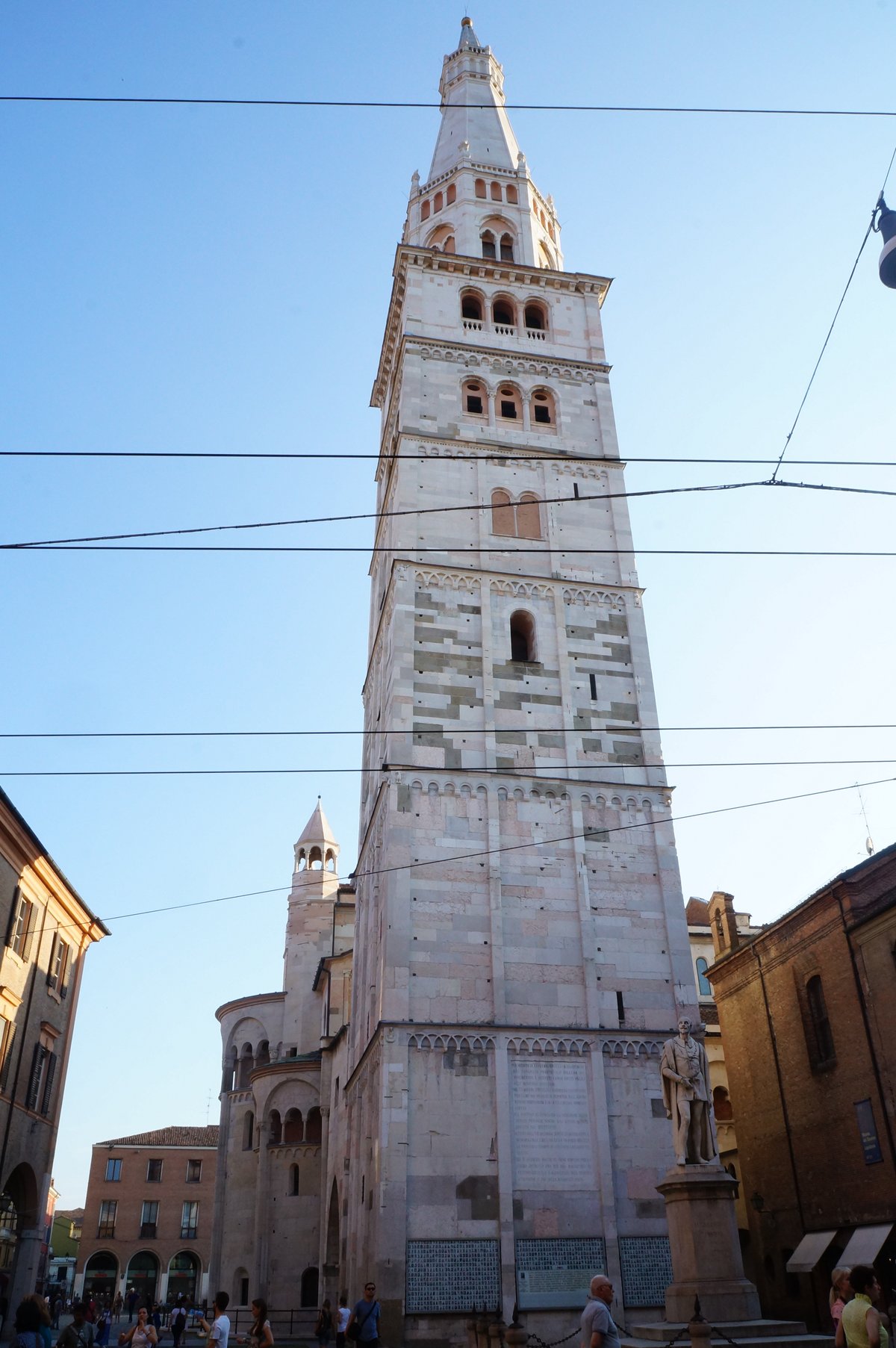 The Ghirlandina, an 88-meter bell tower standing beside Modena Cathedral, is a city symbol declared a UNESCO World Heritage Site. Ascending the 200 steps of the spiral staircase leads to the top, where the view stretches across Piazza Grande, terracotta rooftops, and the Emilia hills. Built between the 12th and 14th centuries, the tower displays Romanesque and Gothic elements, such as the bifora windows and octagonal spire. Inside, the Sala dei Torresani preserves carved capitals with biblical scenes, while the 'Secchia Rapita', a replica of the historic bucket, recalls the rivalries with Bologna. The climb requires some stamina, but the panorama rewards every effort, offering a unique perspective on Modena's historic center and its monuments.
- Go to the page: Ghirlandina of Modena: 89-Meter UNESCO Tower with Apennine Views
- Via Lanfranco, Modena (MO)
- Open in Google Maps
- View on Google Images
You should go if...
Stop no. 3
Albinelli Covered Market
 Leaving the Ghirlandina behind, you immerse yourself in the Albinelli Covered Market, a Modenese institution since 1931. This Art Deco space, designed by engineer Giuseppe Vaccaro, houses over 70 stalls where you can breathe in the authenticity of Emilia-Romagna. DOP cured meats like Prosciutto di Modena and Parmigiano Reggiano are the undisputed stars, accompanied by local cheeses, traditional balsamic vinegar and typical fresh pasta. The vendors, often heirs to family businesses, tell stories of tradition while offering tastings of specialities like erbazzone or tigelle. The atmosphere is lively yet orderly, with lights that enhance the colours of seasonal fruit and vegetables from the surrounding countryside. Here you understand Modena's connection to its land, in an experience that combines everyday life and gastronomic authenticity.
- Via Luigi Albinelli 13, Modena (MO)
- https://www.mercatoalbinelli.it/
- Open in Google Maps
- View on Google Images
You should go if...
Stop no. 4
Nymph Fountain
 Not far from the Albinelli Covered Market, on Via San Giacomo, you'll discover the Nymph Fountain, an 18th-century gem that captures attention with its understated elegance. Created in 1768 based on a design by Pietro Termanini, the white Carrara marble basin hosts a sculpture depicting a nymph, symbolizing purity and abundance. The flowing water comes from local springs, a detail that echoes the water-rich territory of Modena, also famous for its Traditional Balsamic Vinegar. Its location, near the ancient Via Francigena, recalls Modena's role as a crossroads for pilgrims and merchants. The bas-reliefs with floral motifs and harmonious shapes reflect the late Baroque style, while the tranquil atmosphere invites a reflective pause. Here, art merges with everyday history, offering a moment of quiet away from the bustle of the main squares.
- Via San Giacomo 11f, Modena (MO)
- Open in Google Maps
- View on Google Images
You should go if...
Stop no. 5
Fountain of the Two Rivers
 Approaching from Largo Garibaldi, the Fountain of the Two Rivers stands as a monumental work embodying Modena's hydrographic history. Created in 1838 by Modenese sculptor Giuseppe Gibellini, the fountain features two allegorical male figures representing the Secchia and Panaro rivers, waterways fundamental to the region's agricultural and artisanal development. The Carrara marble statues showcase meticulous anatomical details, with Secchia holding a cornucopia symbolizing abundance and Panaro supporting an oar, referencing ancient navigable routes. The octagonal basin made of local grey stone creates a chromatic contrast with the white sculptures, while the continuously flowing water recalls the importance of water resources for producing the renowned Traditional Balsamic Vinegar of Modena DOP. The strategic location near the Storchi Theatre makes it a gathering point for Modenese citizens, where public art engages with daily life in a space that combines practical function and symbolic value.
- Largo Giuseppe Garibaldi, Modena (MO)
- Open in Google Maps
- View on Google Images
You should go if...
Stop no. 6
Piazza Roma
 Leaving the Fountain of the Two Rivers behind, Piazza Roma unfolds as a vast rectangular space serving as a hinge between the historic center and the Ducal Palace. The current layout dates back to the Napoleonic period, when the area was redesigned to create a worthy entrance to the Este residence. The central lawn bordered by gravel pathways offers a refreshing break, while the centuries-old plane trees provide natural shade during the summer months. The nineteenth-century fountain at the center, with its circular stone basin, evokes the style of Emilia's country villas. Observing the perimeter buildings reveals neoclassical facades housing cultural institutions, including the Este University Library with its collection of illuminated manuscripts. The square serves as a perfect vantage point to admire the majestic facade of the Ducal Palace, now the Military Academy, an example of Emilian Baroque architecture.
- Modena (MO)
- Open in Google Maps
- View on Google Images
You should go if...
Stop no. 7
Monumental Temple of Saint Joseph to the War Fallen
 After crossing Piazza Roma, the route leads to Piazza Natale Bruni where the Monumental Temple of Saint Joseph to the War Fallen stands. The building represents a significant example of sacred architecture from the early 20th century, constructed between 1924 and 1929 based on a design by Modenese engineer Giuseppe Boni. The exposed brick facade characterizes the Emilian Neo-Romanesque style, while the interior houses commemorative artworks dedicated to the fallen of the First World War. Particularly evocative is the cycle of artistic stained-glass windows that filter the light, creating intimate atmospheres. The church fits harmoniously into the surrounding urban context, overlooking a green area that offers moments of tranquility away from city traffic. Its strategic location makes it an ideal stop for those wishing to delve into local history through its commemorative monuments.
- Piazza Natale Bruni, Modena (MO)
- Open in Google Maps
- View on Google Images
You should go if...
Stop no. 8
Vigarani Pavilion
 Leaving behind the monumental Temple of San Giuseppe ai caduti in guerra, you enter Viale Caduti in Guerra where the Vigarani Pavilion stands, an example of Modenese Liberty architecture dating back to the early 20th century. Built as a private residence, it now houses public offices while preserving its distinctive features: the facade is enriched with floral stucco decorations and wrought ironwork, typical of the Emilian floral style. Particularly interesting is the surrounding garden, which was once part of a larger park and now offers a peaceful corner with centuries-old trees. Its location, near the Botanical Garden, makes it an ideal stop for those who appreciate the balance between historical architecture and urban green spaces, characteristic of Modena's city planning.
- Viale Caduti in Guerra, Modena (MO)
- Open in Google Maps
- View on Google Images
You should go if...