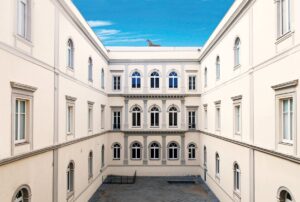
Commissioned by Charles of Bourbon and designed by Luigi Vanvitelli, the Royal Palace of Caserta is one of the most impressive royal residences in the world. With its 1,200 rooms and a park spanning 120 hectares, it offers a journey into 18th-century history and art. Here’s what not to miss during your visit:
– The Royal Apartments, including the Throne Room and the Grand Staircase made of Carrara marble.
– The Royal Park with the Waterfall Way, mythological fountains, and the English Garden.
– The Court Theater and the Palatine Chapel, Vanvitelli’s masterpieces.
– Practical Information: open Wednesday to Monday, ticket €19, closed on Tuesdays.
Introduction
Stepping into the Royal Palace of Caserta is like diving into history. 1,200 rooms, 1,742 windows, and a park that seems to go on forever: here you immediately understand why it’s called the Italian Versailles. The first time I crossed its threshold, I was left breathless in front of the white marble Grand Staircase. It is immense, sumptuous, yet at the same time, you feel at ease. It is not just a monument; it is an experience that envelops you.
Historical Background
The Royal Palace was commissioned by Charles of Bourbon in 1751 to create a new capital away from Naples, safe from eruptions and attacks from the sea. The project was entrusted to Luigi Vanvitelli, who laid the first stone on January 20, 1752. Construction, with over 2,000 workers, continued for decades. After Vanvitelli’s death in 1773, his son Carlo took over. The palace was inhabited from 1789 and completed in 1845. During World War II, it served as the Allied headquarters, and on April 29, 1945, the German surrender in Italy was signed there. In 1997, it became a UNESCO World Heritage site.
The Royal Apartments: A Dive into Bourbon Splendor
The tour begins in the Hall of the Halberdiers, decorated with frescoes and female busts. Next is the Throne Room, 35 meters long, with 28 columns and Murat’s throne. The Palatine Chapel, almost completely destroyed by the bombings of 1943, still preserves Bonito’s canvas of the Immaculate Conception, which miraculously survived. Not to be missed is the Court Theater, entirely designed by Vanvitelli, with a frescoed ceiling and the possibility of opening the stage onto the park. Every room is a masterpiece, with stuccoes, marbles, and silks from San Leucio.
The Royal Park: Nature and Scenic Beauty
The park stretches for 3 km along the Waterway, with fountains that recount myths. The most spectacular is the Fountain of Diana and Actaeon, with a 78-meter-high artificial waterfall. The English Garden, commissioned by Maria Carolina, is the first in Italy: a maze of paths, small lakes, and exotic plants such as the first European camellias. To reach the end of the park, a 45-minute walk is needed, but there are shuttles and bike rentals. Advice: bring water and comfortable shoes.
Why Visit It
It is the largest royal residence in the world by volume, a record that alone is worth the trip. Moreover, it has been the set of famous movies such as Star Wars and Mission: Impossible, so film fans will find familiar spots. Finally, the single ticket also allows you to visit the English Garden and temporary exhibitions: a great deal for a full day of culture.
When to Go
The best time to fully enjoy the palace is spring, when the English Garden is in bloom and temperatures are mild. In autumn, the park’s colors are incredible. Avoid weekends if possible: during the week there is much less crowding. Early morning is ideal for photographing the interiors without too many people.
In the Surroundings
A few kilometers away, San Leucio is an 18th-century village with the ancient silk mill, a UNESCO heritage site. The path among the looms and the workers’ houses is fascinating. Then Casertavecchia, the perched medieval village with the Cathedral and the Falcon’s Tower. If you have time left, the Amphitheater of Santa Maria Capua Vetere, second only to the Colosseum, is worth a visit.