
🧭 What to Expect
- Ideal for: a cultural trip or a weekend getaway
- Highlights: Royal Palace of Caserta, medieval Casertavecchia, and San Leucio
- Why visit: UNESCO heritage, Baroque art, and hilly landscape
- Tip: combine your visit with a tasting of local products
Events nearby

Caserta is not just the Royal Palace, even if it is its most famous jewel. With this article, I take you to discover the historic center, the village of Casertavecchia, and the evocative UNESCO World Heritage complex of San Leucio. An itinerary that blends art, history, and local traditions, perfect for a weekend or a day trip. From the Bourbon palace, masterpiece by Luigi Vanvitelli, to the medieval alleys of Casertavecchia, passing through the ancient silk factories of San Leucio: each stop has a unique charm. Get ready to walk among Italian gardens, hilly landscapes, and glimpses of Campanian life. And don't forget to taste buffalo mozzarella or Casertana pizza. Ready to go?
Overview
Itineraries nearby

The Royal Palace of Caserta: a Bourbon masterpiece
- Go to the page: Royal Palace of Caserta: Italy's Must-See Versailles
- Viale Giulio Douhet, Caserta (CE)
- https://www.reggiadicaserta.beniculturali.it/
- Open in Google Maps
- View on Google Images
- +39 082 3448084
 When you set foot in the Royal Palace of Caserta, you immediately understand why it is the largest royal residence in the world by volume. Commissioned by Charles of Bourbon and designed by Luigi Vanvitelli, the first stone was laid on January 20, 1752, and work ended in 1845. With its 47,000 square meters of surface area, 1,200 rooms, 34 staircases, and 1,742 windows, it is a triumph of splendor and geometry.
The Grand Staircase, with 116 steps of white Carrara marble, leads you to the Royal Apartments: don't miss the Throne Room, 35 meters long, and the Court Theater, an 18th-century gem. But the real highlight is the Royal Park: 120 hectares of greenery, with a 3 km long Water Way that culminates in the Fountain of Diana and Actaeon, with a 78-meter waterfall. The English Garden, commissioned by Maria Carolina, is the first in Italy, full of exotic plants and fake ruins.
Fun fact: scenes from Star Wars were filmed here, and in 1945, the German surrender in Italy was signed here. It is closed on Tuesdays, the full ticket costs €19, but the first Sunday of the month is free. Bring comfortable shoes: you'll need them to explore everything.
Casertavecchia: the medieval village
- Go to the page: Casertavecchia: Medieval Village Steeped in History and Flavors
- Via Erchemperto, Caserta (CE)
- Open in Google Maps
- View on Google Images
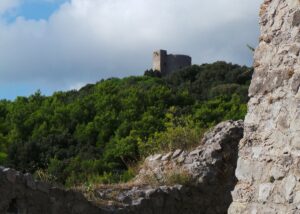
 If you think Caserta is just about the Royal Palace, you couldn't be more wrong. Just a few miles away, perched on Mount Virgo at 400 meters above sea level, lies Casertavecchia, a medieval village straight out of a fairy tale. Its origins date back to the 8th-9th century when the Lombards called it Casa Hirta. It reached its peak under the Normans, who built the Cathedral of San Michele Arcangelo between 1113 and 1153. A Romanesque masterpiece with Arab-Norman influences, it welcomes you with three marble portals and an interior with three naves divided by Roman columns. Look up and don't miss the octagonal tiburium and the bell tower from 1234, 32 meters tall, offering incredible views over the plain of Caserta. Strolling through the narrow cobblestone streets, you'll come across the Church of the Annunziata, Gothic from the 13th century, and the ruins of the Norman Castle. Its tower, 30 meters high, is the second tallest in Europe after that of Aigues-Mortes. Local legends speak of the ghost of Countess Siffridina wandering among the walls. Then, between one alley and another, you'll discover the charming tradition of the Spiritello di Casertavecchia: a small terracotta pot where you write a wish. If you're hungry, the village's taverns serve specialties like buffalo mozzarella, pappardelle with wild boar, and typical desserts. In summer, events like Settembre al Borgo and the Feast of San Michele on September 29th are not to be missed. Getting there is easy: from the Caserta bus station take line 103 or 110 (15-40 minute ride). If you arrive by car, there's paid parking (€2 per day) or free if you eat at some restaurants. The cathedral is open daily, free of charge, with extended hours in summer until 10:30 PM. In short, an unmissable stop for those who love history and authentic villages.
Belvedere of San Leucio: The Bourbon Utopia Between Silk and Beauty
- Via del Setificio, Caserta (CE)
- https://www.comune.caserta.it/belvedere/
- Open in Google Maps
- View on Google Images
- belvedere@comune.caserta.it
 If you think Caserta is only about the Royal Palace, you're wrong. A few kilometers away, on the hill of San Leucio, stands a complex that is both palace and factory: the Belvedere of San Leucio, a UNESCO World Heritage Site since 1997. Here Ferdinand IV of Bourbon brought to life an enlightened social experiment: a colony of silk workers with advanced laws, equal rights, and modern homes. Visiting the Belvedere means immersing yourself in a piece of history that foreshadowed the welfare state.
The tour begins with the Royal Apartments, frescoed by artists such as Hackert, and continues to the Industrial Archaeology section: here the 18th-century machinery is still operational. The deep silence of the spinning mill, broken only by the noise of the looms, is moving. But the true gem is the Silk Museum, where you can admire fabrics that have dressed the White House and Buckingham Palace.
The Italian Gardens unfold over seven terraces, although today only the first level is open to visitors. From there, the view stretches over the Royal Palace, Mount Vesuvius, and the gulf. A breathtaking panorama.
Don't miss the Weaver's House, a historic home with period furnishings that tells the story of the workers' lives. And the Quarters of San Carlo and San Ferdinando, the workers' row houses, a bit neglected today but still fascinating. If you like, take a stroll through the village streets: the atmosphere is suspended between the 18th century and utopia.
Practical info: full ticket costs €7, reduced €4. Entry is by reservation only with a guided tour. Closed on Wednesday afternoons. And remember, San Leucio silk is still produced: if you can, buy a handkerchief at the bookshop.
Diocesan Museum of Caserta: a treasure of sacred art in the heart of the city
- Piazza Alfonso Ruggiero, Caserta (CE)
- Open in Google Maps
- View on Google Images
 Two steps from the majestic Royal Palace, the Diocesan Museum of Caserta is a surprise for those who love sacred art. I discovered it almost by chance, and it was a heart-stopper. The venue is the Church of the Most Holy Redeemer in the historic center: a building that has undergone continuous transformations, like the chapel of the Blessed Sacrament, rebuilt in Neo-Romanesque style in 1928, and the Rosary chapel, which unfortunately lost its 18th-century decorations in 1972. The museum was founded in 1996 with funds from the 8 per thousand, but opened to the public only in 2011. The collection includes about 200 works – paintings, sculptures, vestments, reliquaries – all from churches of the diocese, recovered after the 1980 earthquake to save them from theft and decay. Among the oldest pieces are stone fragments from the 11th-12th centuries preserved in the detached location of Casertavecchia. In the main location, a panel with Saint Catherine of Alexandria by Pompeo Landulfo (1610-1620), a 17th-century Archangel Michael, and a 16th-century wooden Redeemer stand out. The atmosphere is intimate, almost private: you can feel the devotion of centuries. The museum is open from Tuesday to Sunday, 10:00-18:00 (closed Monday). Address: Piazza Duomo, 11. Phone: 0815158061. If you're passing through Caserta, stop by: it's an underestimated gem.