
🧭 What to Expect
- Ideal for lovers of art and Baroque culture
- Highlights: compact historic center, excellent street food, lively atmosphere
- Recommended: visit in spring or autumn for mild temperatures
- Must-see: Basilica of Santa Croce and Roman Amphitheater
Events nearby

Lecce is often called the 'Florence of the South' for its extraordinary Baroque architecture. Strolling through the historic center means getting lost among richly decorated churches, elegant squares, and ancient Roman remains. The vibrant heart is Piazza Sant'Oronzo with its Roman column, but don't miss the Basilica of Santa Croce, a masterpiece of Lecce Baroque. Castello di Carlo V and the Roman Amphitheater tell the story of a thousand-year past. For a break, the MUST - Historical Museum of the City offers an overview of local history. And after all that art, taste specialties like pasticciotto or puccie in the local bars. This guide takes you to discover what makes Lecce unique: a perfect mix of culture, cuisine, and a relaxed atmosphere.
Overview
- Basilica of Santa Croce
- Basilica of Santa Croce
- Roman Amphitheater of Lecce: A Plunge into Ancient Lupiae
- Roman Amphitheater of Lecce: A Plunge into Ancient Lupiae
- Roman Theatre of Lecce: A Hidden Gem Behind the Baroque
- Roman Theatre of Lecce: A Hidden Gem Behind the Baroque
- Castle of Charles V: A Fortress that Chronicles Centuries of History
- Porta Napoli: Charles V's Triumphal Arch
- Column of Saint Oronzo: A Symbol Between Heaven and History
- Porta Rudiae: The Baroque Gateway Between Myth and Devotion
- Porta San Biagio: The Southern Gate of the Historic Center
- Church of Saints Nicholas and Catald
- Palazzo del Seminario: Baroque and Sacred Art in the Heart of Lecce
- MUST: A Dive into Lecce's History Among the Cloisters of the Former Convent
- Torre di Belloluogo: Between Baroque and Medieval, a Queen's Retreat
- Torre del Parco: A Dive into the Middle Ages
- Teatro Apollo: A Neoclassical Jewel in the Heart of Lecce
- Villa Comunale: A Green Lung Between Baroque and History
Itineraries nearby


Basilica of Santa Croce
- Go to the page: Basilica of Santa Croce: Baroque facade with whales, dragons and symbols in Lecce
- Vico della Saponea, Lecce (LE)
- Open in Google Maps
- View on Google Images
 If there is one place that encapsulates the essence of Lecce Baroque, it is the Basilica of Santa Croce. Overlooking via Umberto I, its façade is a riot of decorations in Lecce stone, a soft limestone that allowed artists to carve incredible details. Work began in 1549 and continued for over a century, involving architects such as Gabriele Riccardi, Francesco Antonio Zimbalo, and Cesare Penna. The result? A church that is a veritable book of symbols: the telamones supporting the balustrade represent Turkish prisoners from the Battle of Lepanto, while the thirteen joyful putti above display the emblems of spiritual and temporal power. The rose window, dated 1646, is a masterpiece of intertwining vegetation and cherubs. Inside, the central nave is dominated by a gilded walnut coffered ceiling and a dome adorned with angels. Among the sixteen Baroque altars, the one of Saint Francis of Paola stands out, created by Zimbalo between 1614 and 1615: a triptych structure with 12 panels telling the life of the saint. Not to be missed is also the altar of Saint Oronzo with the painting of the 1743 earthquake, written in Lecce dialect. The basilica houses a relic of the Holy Cross, an object of great devotion. Today it is entrusted to the Archconfraternity of the Most Holy Trinity of Pilgrims. A practical tip: weekday masses are held at 6:00 PM, while on Sundays there are two masses, at 10:30 AM and 7:00 PM. If you pass through Lecce, stop for a few minutes to observe the façade: with every glance you will discover a new detail.
Basilica of Santa Croce
- Go to the page: Basilica of Santa Croce: the masterpiece of Lecce Baroque
- Vico della Saponea, Lecce (LE)
- Open in Google Maps
- View on Google Images
If there is one place that encapsulates the essence of Lecce Baroque, it is the Basilica of Santa Croce. Overlooking via Umberto I, its façade is a riot of decorations in Lecce stone, a soft limestone that allowed artists to carve incredible details. Work began in 1549 and continued for over a century, involving architects such as Gabriele Riccardi, Francesco Antonio Zimbalo, and Cesare Penna. The result? A church that is a veritable book of symbols: the telamones supporting the balustrade represent Turkish prisoners from the Battle of Lepanto, while the thirteen joyful putti above display the emblems of spiritual and temporal power. The rose window, dated 1646, is a masterpiece of intertwining vegetation and cherubs. Inside, the central nave is dominated by a gilded walnut coffered ceiling and a dome adorned with angels. Among the sixteen Baroque altars, the one of Saint Francis of Paola stands out, created by Zimbalo between 1614 and 1615: a triptych structure with 12 panels telling the life of the saint. Not to be missed is also the altar of Saint Oronzo with the painting of the 1743 earthquake, written in Lecce dialect. The basilica houses a relic of the Holy Cross, an object of great devotion. Today it is entrusted to the Archconfraternity of the Most Holy Trinity of Pilgrims. A practical tip: weekday masses are held at 6:00 PM, while on Sundays there are two masses, at 10:30 AM and 7:00 PM. If you pass through Lecce, stop for a few minutes to observe the façade: with every glance you will discover a new detail.Roman Amphitheater of Lecce: A Plunge into Ancient Lupiae
- Go to the page: Roman Amphitheatre of Lecce: History and Visitor’s Guide
- Piazza Sant'Oronzo, Lecce (LE)
- Open in Google Maps
- View on Google Images
- +39 080 5285210
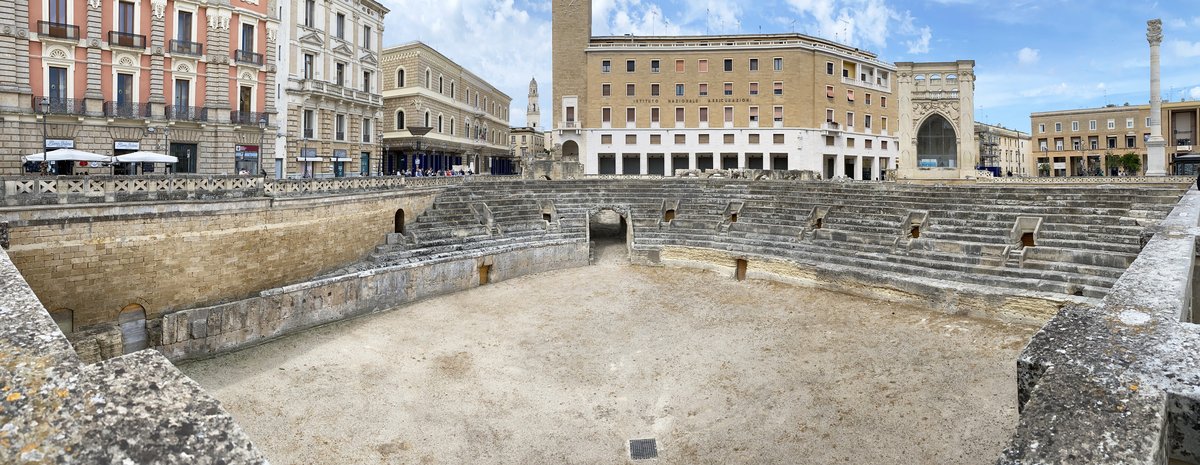 In Piazza Sant'Oronzo, right under your eyes, lies a piece of Roman history that in Lecce has become part of the landscape. The Roman Amphitheater dates back to the 1st-2nd century AD, commissioned by Octavian Augustus and later expanded under Hadrian. It could host up to 25,000 spectators, a staggering number considering the size of the city back then, the ancient Lupiae. Today, only a third is visible – the rest is still buried under the square and the Church of Santa Maria delle Grazie – but what you see is enough to stir emotions. Discovered by chance in the early 1900s during work for the Bank of Italy, the amphitheater underwent a major restoration between 2023 and 2024. Now it is open every day (10am-5pm, ticket €5) and finally accessible to all. The most evocative part? The median ambulatory, the circular corridor that can be walked for the first time. And if you come in summer, you might catch a show: the arena is still used for concerts and theater, with 400 seats. A tip: stop to look at the marble reliefs with hunting scenes – bears, lions, bulls – that decorated the parapet. They give you an idea of what happened here two thousand years ago.
Roman Amphitheater of Lecce: A Plunge into Ancient Lupiae
- Go to the page: Roman Amphitheatre of Lecce: 1st-Century Arena with 25,000 Seats in the Baroque Heart
- Piazza Sant'Oronzo, Lecce (LE)
- Open in Google Maps
- View on Google Images
- +39 080 5285210
In Piazza Sant'Oronzo, right under your eyes, lies a piece of Roman history that in Lecce has become part of the landscape. The Roman Amphitheater dates back to the 1st-2nd century AD, commissioned by Octavian Augustus and later expanded under Hadrian. It could host up to 25,000 spectators, a staggering number considering the size of the city back then, the ancient Lupiae. Today, only a third is visible – the rest is still buried under the square and the Church of Santa Maria delle Grazie – but what you see is enough to stir emotions. Discovered by chance in the early 1900s during work for the Bank of Italy, the amphitheater underwent a major restoration between 2023 and 2024. Now it is open every day (10am-5pm, ticket €5) and finally accessible to all. The most evocative part? The median ambulatory, the circular corridor that can be walked for the first time. And if you come in summer, you might catch a show: the arena is still used for concerts and theater, with 400 seats. A tip: stop to look at the marble reliefs with hunting scenes – bears, lions, bulls – that decorated the parapet. They give you an idea of what happened here two thousand years ago.Roman Theatre of Lecce: A Hidden Gem Behind the Baroque
- Go to the page: Roman Theatre of Lecce: History and Augustan Architecture
- Via del Teatro Romano, Lecce (LE)
- Open in Google Maps
- View on Google Images
 Walking through the baroque alleys of Lecce, you would never expect to come across a Roman theatre. Yet, right there, a stone's throw from Piazza Sant'Oronzo, the Roman Theatre is one of those places that surprises you. Discovered almost by chance in 1929 during work in the gardens of Palazzo D'Arpe and Palazzo Romano, it remained buried for centuries beneath the historic center. It dates back to the Augustan age, a gift from Augustus to Lupiae (ancient Lecce) to repay the hospitality he received. The cavea, carved into the rock and faced with square stonework, has an external diameter of 40 meters and could hold over 5,000 spectators. Today you see only part of it: the twelve rows of each section, the orchestra paved in white limestone, and the three wide semicircular steps reserved for notables. The stage, 30 meters wide, must have been imposing, probably about 20 meters high with statues of gods and emperors. The annexed museum, on Via degli Ammirati, houses artifacts such as theatrical masks from Villa Adriana and a model of Lupiae during the imperial era. Open Monday to Saturday (9:30 AM - 1:00 PM), it is a short but intense stop. And if you are lucky, you might catch a summer performance: the theatre is still alive, with shows that bring back the ancient atmosphere. A place that combines history and everyday life, perfect for those who love unexpected discoveries.
Roman Theatre of Lecce: A Hidden Gem Behind the Baroque
- Go to the page: Roman Theater of Lecce: Underground 1st-2nd Century Theater with 5,000 Seats
- Via del Teatro Romano, Lecce (LE)
- Open in Google Maps
- View on Google Images
Walking through the baroque alleys of Lecce, you would never expect to come across a Roman theatre. Yet, right there, a stone's throw from Piazza Sant'Oronzo, the Roman Theatre is one of those places that surprises you. Discovered almost by chance in 1929 during work in the gardens of Palazzo D'Arpe and Palazzo Romano, it remained buried for centuries beneath the historic center. It dates back to the Augustan age, a gift from Augustus to Lupiae (ancient Lecce) to repay the hospitality he received. The cavea, carved into the rock and faced with square stonework, has an external diameter of 40 meters and could hold over 5,000 spectators. Today you see only part of it: the twelve rows of each section, the orchestra paved in white limestone, and the three wide semicircular steps reserved for notables. The stage, 30 meters wide, must have been imposing, probably about 20 meters high with statues of gods and emperors. The annexed museum, on Via degli Ammirati, houses artifacts such as theatrical masks from Villa Adriana and a model of Lupiae during the imperial era. Open Monday to Saturday (9:30 AM - 1:00 PM), it is a short but intense stop. And if you are lucky, you might catch a summer performance: the theatre is still alive, with shows that bring back the ancient atmosphere. A place that combines history and everyday life, perfect for those who love unexpected discoveries.Castle of Charles V: A Fortress that Chronicles Centuries of History
- Viale Francesco Lo Re, Lecce (LE)
- http://www.castellocarlov.it/
- Open in Google Maps
- View on Google Images
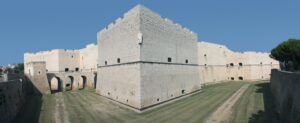
 If you stroll through Lecce, you cannot miss the Castle of Charles V, the largest in Apulia with its 13,000 square meters. It is a stone's throw from Piazza Sant’Oronzo, right on the eastern edge of the historic center. Its history is an interweaving of eras: born as a Norman castle in the 12th century, it was completely rebuilt in 1539 by order of Emperor Charles V, who commissioned architect Gian Giacomo dell’Acaya to transform it into a modern fortress against Turkish incursions. Of the ancient medieval core, two square towers remain: the Torre Magistra and the Torre Mozza, towering above the inner courtyard. The layout is quadrangular with four powerful lanceolate bastions – Santa Croce, San Martino, San Giacomo, and Santissima Trinità – and a moat that has now disappeared, filled in 1872. The main entrance was the Porta Reale, with Habsburg coat of arms and drawbridge, of which traces remain. Entering, you find yourself in a large courtyard dominated by the Angevin tower; from here guided tours (included in the ticket, €10) depart, leading you to the noble floor, where the Hall of Maria d’Enghien with its barrel vault stands out. On the ground floor is the Papier-Mâché Museum, a dive into Salento sacred art. Not to be missed are the underground prisons, where dell’Acaya himself was imprisoned, and the rampart walks with views over the city. The castle is open from Tuesday to Sunday, 10-8 (last entry 7pm). Once a barracks and military district, today it is a vibrant cultural center hosting exhibitions and events.
Porta Napoli: Charles V's Triumphal Arch
- Piazza Angelo Rizzo, Lecce (LE)
- Open in Google Maps
- View on Google Images
 Porta Napoli is one of the three surviving historic gates of Lecce, alongside Porta San Biagio and Porta Rudiae. Built in 1548 as a triumphal arch in honor of Emperor Charles V, it marks the monumental northern entrance to the historic center. Located in Piazzetta Arco di Trionfo, the gate stands about 20 meters tall and is made of Lecce stone. The design is attributed to military architect Gian Giacomo dell'Acaya, who conceived it with a single round arch flanked by two Corinthian columns on each side, supporting a triangular pediment. At the center of the tympanum stands the Habsburg coat of arms with the double-headed eagle, while below runs a Latin inscription extolling the feats of Charles V, called “the exterminator of the Turks.” On the sides, war trophies and symbols of imperial victories. Until 1934, the gate was connected to sections of walls, later removed to make way for modern traffic. Today it stands isolated but retains all its grandeur. Across from it, the Obelisk from 1822, about ten meters tall, celebrates Ferdinand I of Bourbon with mythological decorations and the coat of arms of the province. As you approach, notice the details: the columns, the pediment, the eagle. You can almost hear the sound of carts that once passed through here heading to Naples. A tip: pause for a moment in the small square, look at the arch, and imagine 1548. It's a piece of history welcoming you with open arms.
Column of Saint Oronzo: A Symbol Between Heaven and History
- Piazza Sant'Oronzo, Lecce (LE)
- Open in Google Maps
- View on Google Images
 Strolling through Piazza Sant'Oronzo, your gaze is captured by a column nearly 30 meters high that seems to reach for the sky. The Column of Saint Oronzo is far more than a monument: it is the beating heart of Lecce's devotion. Erected after the plague of 1656 as a thanksgiving to the patron saint, its story is a blend of faith, politics, and twists of fate. The marble drums come from Brindisi, where one of the Roman columns marking the end of the Appian Way had collapsed. The transfer was not peaceful: the people of Brindisi opposed it, and the pieces were transported at night to avoid tensions. Architect Giuseppe Zimbalo tapered the damaged blocks and created a Baroque base, while the original Roman capital was preserved. At the top, a statue of the saint in bishop's robes blesses the city. The first one, made of wood covered in copper, arrived from Venice in 1684, but in 1737 a firework set it ablaze during festivities. The head, miraculously intact, was put on display, and a new statue was made in 1739. In 2019 the statue was removed for restoration: too deteriorated to return to its height. So in April 2024, a faithful bronze replica replaced it, while the original was placed in the nearby Sedile museum. Today, looking at the column, you can't help but think of the stories it carries: ancient disputes, fires, miracles, and a city that has always protected its symbol.
Porta Rudiae: The Baroque Gateway Between Myth and Devotion
- Via Giuseppe Libertini, Lecce (LE)
- Open in Google Maps
- View on Google Images
 Porta Rudiae is one of Lecce's historic gates, but it's more than just an entrance: it's a monument blending history, myth, and faith. Rebuilt in 1703 by nobleman Prospero Lubelli, it stands on the ruins of a collapsed medieval gate. Its name recalls the ancient city of Rudiae, birthplace of the poet Quintus Ennius, toward which it is oriented. The facade is a triumph of Lecce Baroque: a single arch flanked by paired columns on high bases, topped by a pediment that resembles an open-air altar. High above dominates the statue of Saint Oronzo, patron of Lecce, flanked by Saints Irene and Dominic. But the real surprise is below: on the frieze of the entablature, four stone busts depict the mythical founders of the city: Malennio, Dauno, Euippa, and Idomeneo. A Latin inscription recalls Lubelli's generosity and the role of mayor Cesare Belli. Strolling in front of the gate, you'll also notice the two side doors that have been bricked up: once used for pedestrian passage and goods inspection. A curiosity: in June 2021, a lightning bolt damaged the statue of Saint Oronzo, but in August 2025 restoration work funded by the Ministry of Culture began. If you pass by at sunset, the Lecce stone turns amber: the best time for photos. Porta Rudiae is the ideal starting point for a Baroque itinerary: from here, take Via Libertini and reach Piazza Sant'Oronzo, passing churches and noble palaces. In short, it's not just a gate, but the calling card of an entire city.
Porta San Biagio: The Southern Gate of the Historic Center
- Via Beccherie Vecchie, Lecce (LE)
- Open in Google Maps
- View on Google Images
 Porta San Biagio is one of the three historic gates that define the ancient center of Lecce. Built in 1774 at the behest of Governor Tommaso Ruffo and designed by Emanuele Manieri, it rises on the remains of an earlier 16th-century gate commissioned by Charles V. Standing 17.3 meters tall, the structure is a triumph of Baroque elements: pairs of smooth-shafted columns frame the arch, while at the top stands the Lecce stone statue of San Biagio, bishop and protector. The coat of arms of Ferdinand IV of Bourbon and the city symbol (a she-wolf under a holm oak) complete the decoration. A Latin inscription commemorates the construction funded with public money. Today the gate is open 24 hours a day and is an essential passage for anyone heading toward Piazza d'Italia. In the Norman-Swabian era, locals would exit from here to stroll toward Torre del Parco, along a devotional route dotted with chapels. A curious detail: according to tradition, San Biagio was born in Lecce before leaving for Armenia. Every February 3, the city celebrates the saint with a festival in the nearby church. I recommend spending a few minutes to observe the carved details: the sunset light enhances the Lecce stone, making the gate even more evocative. If you are a history enthusiast, you'll notice the various architectural overlays that tell centuries of urban evolution.
Church of Saints Nicholas and Catald
- Via Vito Carluccio, Lecce (LE)
- Open in Google Maps
- View on Google Images
 If you think Lecce is all Baroque, prepare to think again. The Church of Saints Nicholas and Catald, a bit off the beaten path in the square of the Monumental Cemetery, is one of the rare examples of Norman architecture in the city. Founded in 1180 by Count Tancred of Hauteville (the one who survived a shipwreck and vowed to build it), it surprisingly blends Romanesque, Byzantine, and Baroque styles. Of the original façade, rebuilt in 1716 by Giuseppe Cino, the richly decorated portal with vegetal interlacing and the rose window remain: the rest is pure Lecce Baroque, with ten statues and the Olivetan coat of arms.
Entering, the three-nave interior will surprise you with the light filtering through the rose window and the grandeur of the octagonal dome. The quatrefoil pillars support barrel and cross vaults, and on the walls are preserved precious Late Gothic frescoes with stories of St. Benedict and St. Nicholas. Don't miss the 16th-century statue of St. Nicholas blessing by Gabriele Riccardi, and the two holy water stoups by the same artist. The Baroque altars by Mauro Manieri house canvases by Giovan Battista Lama.
Today the church is managed by the FAI and opens on Mondays, Thursdays, and Saturdays from 9:30 AM to 12:30 PM. A little-visited gem, perfect for those seeking a corner of authentic history away from the crowds.
Palazzo del Seminario: Baroque and Sacred Art in the Heart of Lecce
- Piazza Duomo, Lecce (LE)
- Open in Google Maps
- View on Google Images
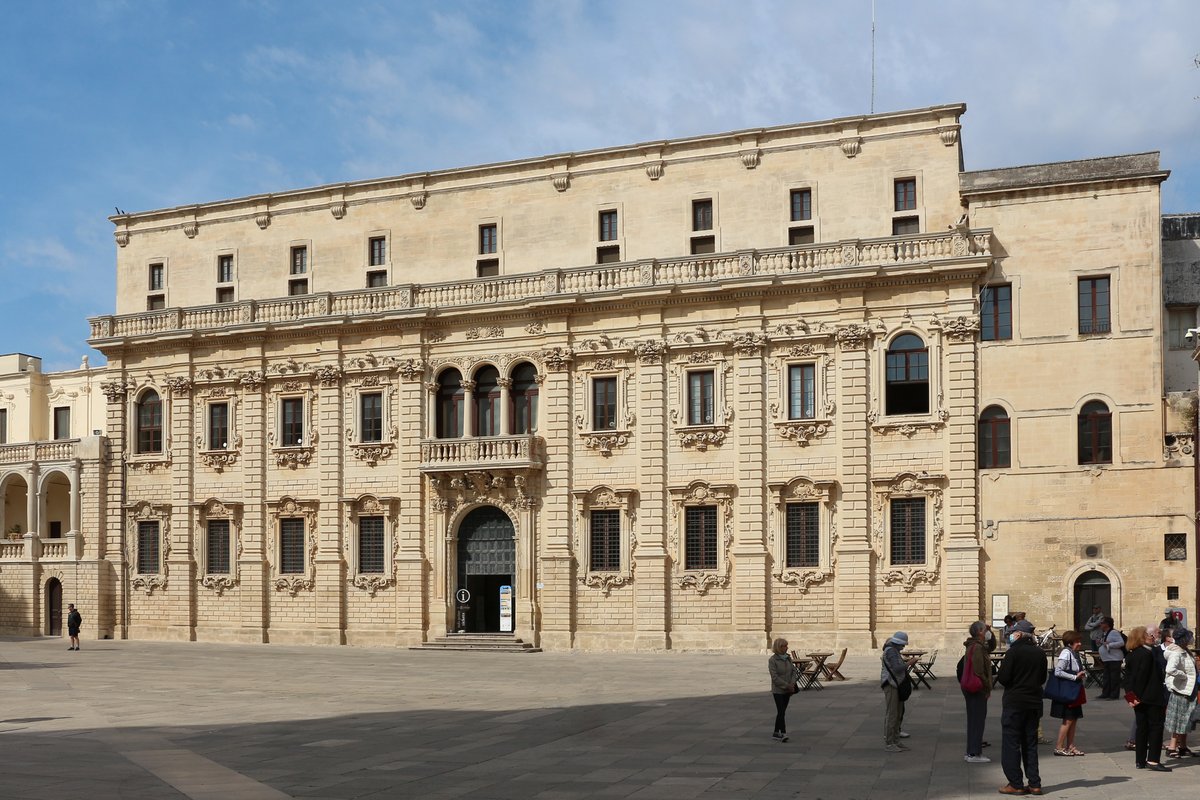 The Palazzo del Seminario is one of the most representative buildings of Leccese Baroque, overlooking Piazza Duomo. Built between 1694 and 1709 from a design by Giuseppe Cino at the behest of Bishop Michele Pignatelli, it was later expanded in 1729 with the attic by Mauro Manieri. The facade, inspired by the Palazzo dei Celestini, is adorned with ten rusticated pilasters, richly ornate windows, and a central portal topped by a loggia with a three-light window. Upon entering, in the entrance hall you can see eight busts in Lecce stone of the Doctors of the Church, while in the center of the porticoed cloister stands out the well called Vera Ovale, also by Cino, with vegetal decorations, putti, and a statue of Saint Irene. Today the palace houses the Diocesan Museum of Sacred Art (MuDAS), the Innocenziana Library (with over 10,000 volumes, including incunabula), and the Diocesan Historical Archive. Not to be missed is the Chapel of Saint Gregory the Wonderworker, with Cino's altar and a painting from 1696 by Paolo De Matteis. The visit is a dive into history: ticket €1 for the ground floor (cloister, chapel, gallery) or €4 for the complete museum. Open all year with variable hours; I recommend dedicating at least an hour and a half. Its location on Piazza Duomo makes it a must-stop on any Lecce itinerary.
MUST: A Dive into Lecce's History Among the Cloisters of the Former Convent
- Via degli Ammirati 11, Lecce (LE)
- http://www.mustlecce.it/
- Open in Google Maps
- View on Google Images
- +39 0832 682988
 In the heart of the historic center, next to the Roman Theatre, the Museo Storico della Città di Lecce (MUST) is an unmissable stop for anyone wanting to understand the soul of this city. It is housed in the former Convent of Santa Chiara, founded in 1410 by Bishop Tommaso Ammirato, which hosted the Poor Clares until 1866. After years as offices of the Finance Superintendency, it was restored and opened to the public in 2015. As soon as you enter, the large hall with vaulted arches strikes you with the light filtering in from the inner courtyards, blending the white of lime with the gold of Lecce stone. The route unfolds over two floors with two cloisters: on the ground floor, the Off Gallery dedicated to emerging artists and a multimedia room with 3D viewers to explore Lecce Baroque, including the façade of Santa Croce. On the first floor, the permanent collections: the archaeological section "Il Leccio e la Lupa" with Messapian, Roman, and medieval finds (including reconstructions of the amphitheaters of Lupiae and Rudiae), and the Cosimo Carlucci Civic Gallery with sculptures by the Salento master. There are also works by 19th and 20th-century artists, such as Oronzo Tiso and Giuseppe Casciaro. The museum hosts temporary exhibitions – currently "Aracne: filo per filo" – and offers a bookshop, café, and cloister with outdoor tables. Hours: Tuesday-Sunday (closed Monday), with varying hours: from October to April 9:00 AM-7:00 PM (Thu and Fri until 8:00 PM), from April to October 9:00 AM-9:00 PM. Tickets: full €5.50, reduced €3.50 (free under 10). Address: Via degli Ammirati, 11. A place where history, art, and technology blend, offering a unique perspective on the Lecce of yesterday and today.
Torre di Belloluogo: Between Baroque and Medieval, a Queen's Retreat
- Via Vecchia Surbo, Lecce (LE)
- Open in Google Maps
- View on Google Images
 Far from the chaos of the city center, nestled in the greenery of the city park, the Torre di Belloluogo is a medieval gem known to few. Built between the 13th and 14th centuries by the Brienne family, this cylindrical tower about 14 meters high is surrounded by a moat unique in Salento: still filled with spring water, making it impregnable. Cross the stone bridge (once a drawbridge) and step into a suspended world. It was the favorite residence of Maria d'Enghien, Countess of Lecce and Queen of Naples, who spent the last years of her life here. Climbing to the main floor, you discover a small chapel frescoed with the Stories of Saint Mary Magdalene: scenes like the Supper at the House of the Pharisee and the Noli me tangere, painted between the late 14th and early 15th centuries, perhaps by the school of Raimondello Orsini. Around, don't miss the hypogeum with Byzantine graffiti and a 17th-century trullo. Today the tower is managed by the municipality and open to the public on special occasions or by appointment. A corner of the Middle Ages that surprises you, just steps from the Lecce Baroque.
Torre del Parco: A Dive into the Middle Ages
- Viale Torre del Parco, Lecce (LE)
- Open in Google Maps
- View on Google Images
 If you think Lecce is all about Baroque, get ready to change your mind. Just a ten-minute walk from the historic center, Torre del Parco takes you back six centuries. Built in 1419, this medieval fortress is not just a monument: it's a full complex encompassing the tall Tower, the Prince's Palace (once the State Mint and Court of Law), and a 17th-century convent. As you enter, the atmosphere strikes you: the Convent Garden is an oasis with centuries-old palms and hackberries, perfect for a break. But the real show is beneath your feet. In the underground, you'll find the Galleys, the prisons where inmates carved curses and prayers into the stone. It's moving and a bit eerie, trust me. Today, the tower houses a 4-star hotel with a spa and restaurant, but it preserves the frescoes of the chapel and its ancient charm intact. If you have a soft spot for authentic history, don't miss it: it's an unexpected plunge into the past in Lecce.
Teatro Apollo: A Neoclassical Jewel in the Heart of Lecce
- Go to the page: Apollo Theatre Lecce: A Liberty Gem with Performances and Guided Tours
- Piazza Giuseppe Libertini, Lecce (LE)
- Open in Google Maps
- View on Google Images
 Strolling along Via Trinchese, the main pedestrian axis connecting Piazza Sant'Oronzo to Piazza Mazzini, you'll come across the elegant neoclassical façade of the Teatro Apollo. Inaugurated in stages between 1912 and 1926, it was built by master Vincenzo Cappello based on a design by engineer Tassoni. The colonnade and portico lead into a foyer that still preserves original stuccoes, frescoes, and gilding. With a capacity of about 800 seats, it offers an intimate yet grand ambiance.
What makes the Teatro Apollo truly special is its layered history: during the 2008-2017 restoration, Neolithic artifacts emerged, now displayed in a small museum inside. So you can combine a show with a dive into prehistoric Lecce. The programming is rich and varied: drama, musicals, classical music, dance, and family shows. Take a look at the lineup: I've seen names like Geppy Gleijeses and Massimo Ghini.
Practical tips: the box office opens at 6:30 PM on the evening of the show; you can book online via Vivaticket. If you're on a budget, there's a "suspended ticket" for just €8. The theater is easily reachable on foot from the historic center. Don't miss the chance to step inside – even without a show, it's worth it for the architecture and the artifacts.
Villa Comunale: A Green Lung Between Baroque and History
- Lecce (LE)
- Open in Google Maps
- View on Google Images
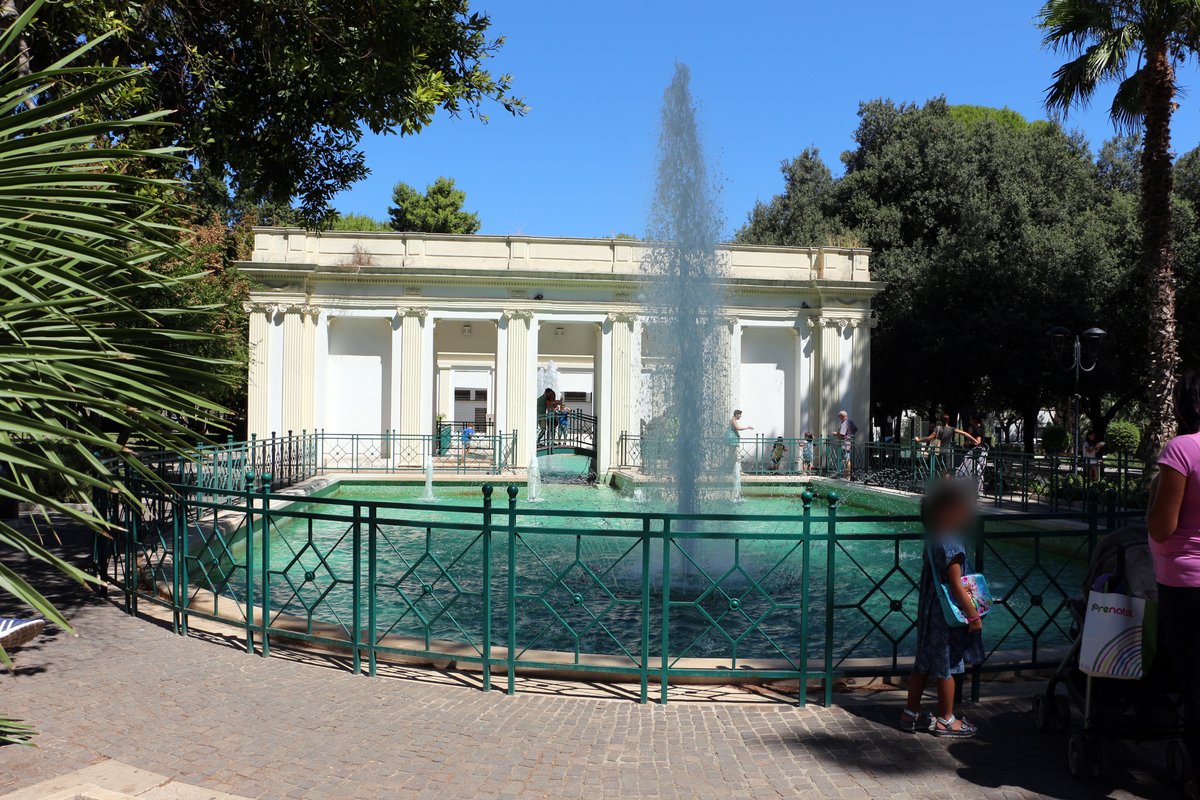 After strolling among the baroque churches, stop at the Villa Comunale Giuseppe Garibaldi, a 34,000 m² oasis just steps from Santa Croce. Inaugurated in 1830 and designed by Bernardini and Stella, it was the city's Italian garden, with geometric flowerbeds and centuries-old trees. Once called Villa della Lupa because of a cage with wolves (symbol of Lupiae), today it is a place of relaxation. At the center stands a neoclassical small temple with a green majolica dome, added in the 1950s, and all around 22 marble busts of Salento figures, from Galateo to Tito Schipa, works by Maccagnani and Mangionello. The vegetation is a riot of holm oaks, Washingtonia palms, araucarias, and even a rare Firmiana simplex. Walk along the paths, sit on a bench, or take children to the play area. Since 2026, the villa has been managed by private entities, with variable hours (from 9 am until evening), and hosts cultural events. It is the ideal place for a cool break before resuming the tour among the towers and palaces of Lecce.