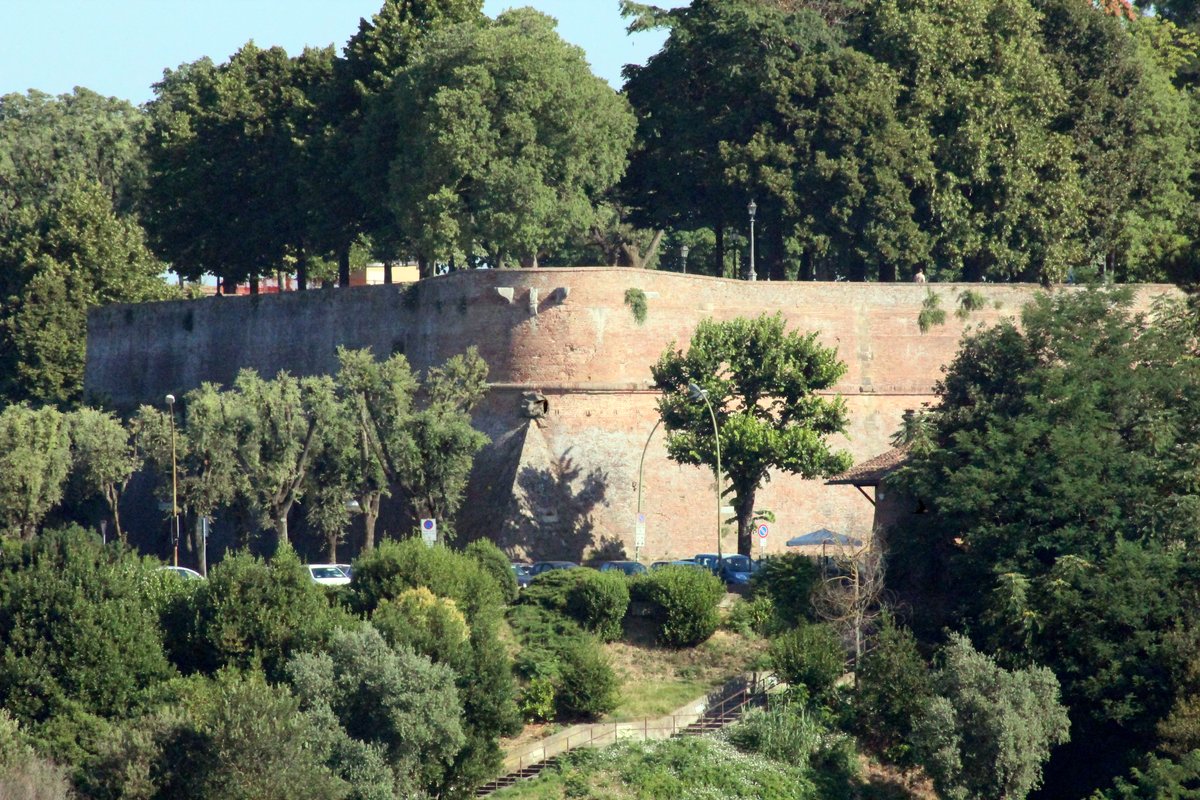
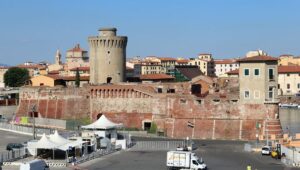
The Medici Fortress, also known as Forte di Santa Barbara, is a 16th-century fortress just steps from Siena’s center. Built by Cosimo I de’ Medici, it’s now a free public park, perfect for a break within historic walls. It houses the Enoteca Italiana, Siena Jazz concerts, and an amphitheater for summer shows.
• Free entry, always open
• Wine shop with Italian wine tastings
• Amphitheater for events and concerts
• Walks along tree-lined ramparts
A Park Within a Fortress: Siena’s Most Unexpected Corner
It’s not every day you get to stroll through a 16th-century fortress turned into a public garden. The Medici Fortress, or Forte di Santa Barbara, is one of those places that surprise you precisely because you least expect it. You enter from Piazza della Libertà and find yourself in a massive red-brick quadrilateral, with diamond-pointed bastions and tree-lined paths where people jog, read, and chat. The atmosphere is relaxed, almost timeless. And then, between one bastion and the next, you come across an amphitheater, a historic wine bar, and the headquarters of Siena Jazz. It’s the perfect mix of history, culture, and everyday life – all free and always open.
A Park Within a Fortress: Siena’s Most Unexpected Corner
It’s not every day you get to stroll through a 16th-century fortress turned into a public garden. The Medici Fortress, or Forte di Santa Barbara, is one of those places that surprise you precisely because you least expect it. You enter from Piazza della Libertà and find yourself in a massive red-brick quadrilateral, with diamond-pointed bastions and tree-lined paths where people jog, read, and chat. The atmosphere is relaxed, almost timeless. And then, between one bastion and the next, you come across an amphitheater, a historic wine bar, and the headquarters of Siena Jazz. It’s the perfect mix of history, culture, and everyday life – all free and always open.
Historical Overview
The fortress we see today was built between
1561 and 1563 under Cosimo I de’ Medici, after the Sienese had destroyed the previous Spanish citadel of Charles V in 1552. Designed by Baldassarre Lanci, it has a square plan with four imposing bastions (San Filippo, San Francesco, San Domenico, La Madonna) and an outer perimeter of about
1,500 meters. At the end of the 18th century, Grand Duke Peter Leopold demilitarized it, and in 1937 it became a public garden. Here are the key moments:
- 1548: Charles V builds a Spanish citadel
- July 26, 1552: Sienese uprising and destruction of the citadel
- 1555: Surrender of Siena; passed to the Medici
- 1561-1563: Construction of the Medici Fortress
- Late 18th century: Demilitarization under Peter Leopold
- 1937: Transformation into a public garden
Historical Overview
The fortress we see today was built between
1561 and 1563 under Cosimo I de’ Medici, after the Sienese had destroyed the previous Spanish citadel of Charles V in 1552. Designed by Baldassarre Lanci, it has a square plan with four imposing bastions (San Filippo, San Francesco, San Domenico, La Madonna) and an outer perimeter of about
1,500 meters. At the end of the 18th century, Grand Duke Peter Leopold demilitarized it, and in 1937 it became a public garden. Here are the key moments:
- 1548: Charles V builds a Spanish citadel
- July 26, 1552: Sienese uprising and destruction of the citadel
- 1555: Surrender of Siena; passed to the Medici
- 1561-1563: Construction of the Medici Fortress
- Late 18th century: Demilitarization under Peter Leopold
- 1937: Transformation into a public garden
Walk along the Walls and Relax
The best part? Walking on top of the walls, where there are paths shaded by trees and benches. From there you get an incredible view of the city: you can see the Torre del Mangia, the Duomo, and the Basilica of San Domenico. The perimeter is perfect for a stroll or a light jog – the Sienese know it well. On the bastions there are Medici coats of arms with travertine lion heads, and if you look closely, on the southeast side there is a statue of Saint Catherine. I love coming here at sunset, when the pink light caresses the bricks and the silence is broken only by the footsteps of those who, like me, are looking for a peaceful corner without leaving the center.
Walk along the Walls and Relax
The best part? Walking on top of the walls, where there are paths shaded by trees and benches. From there you get an incredible view of the city: you can see the Torre del Mangia, the Duomo, and the Basilica of San Domenico. The perimeter is perfect for a stroll or a light jog – the Sienese know it well. On the bastions there are Medici coats of arms with travertine lion heads, and if you look closely, on the southeast side there is a statue of Saint Catherine. I love coming here at sunset, when the pink light caresses the bricks and the silence is broken only by the footsteps of those who, like me, are looking for a peaceful corner without leaving the center.
Wine Bar, Jazz, and Summer Events
Inside the San Francesco bastion you’ll find the Italian Wine Bar (Enoteca Italiana), active for over 80 years: a perfect place to taste Tuscan wines and more. If you’re visiting in summer, I recommend checking out the Siena Jazz program, which holds concerts in the fortress – the acoustics of the central amphitheater are amazing. Every year, from May to September, Bastione San Domenico and Piazza della Libertà come alive with events like ViviFortezza, shows, and cultural events. It’s the ideal spot to combine culture, taste, and relaxation, perhaps with a glass of Chianti in hand as the sun sets.
Wine Bar, Jazz, and Summer Events
Inside the San Francesco bastion you’ll find the Italian Wine Bar (Enoteca Italiana), active for over 80 years: a perfect place to taste Tuscan wines and more. If you’re visiting in summer, I recommend checking out the Siena Jazz program, which holds concerts in the fortress – the acoustics of the central amphitheater are amazing. Every year, from May to September, Bastione San Domenico and Piazza della Libertà come alive with events like ViviFortezza, shows, and cultural events. It’s the ideal spot to combine culture, taste, and relaxation, perhaps with a glass of Chianti in hand as the sun sets.
Why Visit
Three practical reasons: first, it’s free and always open – no hours, no ticket. Second, it offers a unique view of Siena without queuing at any tower. Third, the meeting of military history and contemporary life: you can sip a wine inside a Renaissance bastion and then listen to a jazz concert under the stars. If you are a curious traveler, it’s a stop that won’t make you feel like a tourist, but a bit Sienese for an afternoon.
Why Visit
Three practical reasons: first, it’s free and always open – no hours, no ticket. Second, it offers a unique view of Siena without queuing at any tower. Third, the meeting of military history and contemporary life: you can sip a wine inside a Renaissance bastion and then listen to a jazz concert under the stars. If you are a curious traveler, it’s a stop that won’t make you feel like a tourist, but a bit Sienese for an afternoon.
When to Go
The best time? Late afternoon, around sunset. The warm light enhances the red bricks and the view of the city is spectacular. In summer, it also coincides with the start of concerts and evening events. But an early morning, when there are few people, is perfect for enjoying the silence and rustling of leaves. If you love jazz, schedule it during the Siena Jazz season (June to September).
When to Go
The best time? Late afternoon, around sunset. The warm light enhances the red bricks and the view of the city is spectacular. In summer, it also coincides with the start of concerts and evening events. But an early morning, when there are few people, is perfect for enjoying the silence and rustling of leaves. If you love jazz, schedule it during the Siena Jazz season (June to September).
Nearby
Just a few steps away you’ll find the Giardini della Lizza, which flank the fortress to the north. They are a lovely English-style park with statues and paths, perfect for completing your walk. On the other side, to the south, there is the Artemio Franchi Stadium, but if you’re not a football fan, I suggest heading to the historic center in five minutes on foot: Piazza del Campo and the Duomo are there, ready to make you fall in love with Siena all over again.
Nearby
Just a few steps away you’ll find the Giardini della Lizza, which flank the fortress to the north. They are a lovely English-style park with statues and paths, perfect for completing your walk. On the other side, to the south, there is the Artemio Franchi Stadium, but if you’re not a football fan, I suggest heading to the historic center in five minutes on foot: Piazza del Campo and the Duomo are there, ready to make you fall in love with Siena all over again.